
The correct word is fly or flies, depending on the meaning and the subject of the sentence. Fly can be a verb meaning “to move through the air,” a noun for an insect, or a word used for air travel. Flies is usually the third-person singular form of the verb fly, but it can also mean more than one insect.
These words look similar, but they do not always work in the same way. For example, we say, “Birds fly in the sky,” but “A bird flies in the sky.” We also say, “There are two flies on the wall.”
Understanding the difference between fly and flies will help you avoid common grammar and spelling mistakes.
This guide explains their meanings, pronunciation, word forms, grammar rules, common phrases, and everyday examples.
Quick Answer: Fly or Flies
Fly is used with I, you, we, and they in the present simple tense. It is also the base form of the verb and the singular name of a flying insect.
Flies is used with he, she, and it in the present simple tense. It is also the plural form of the noun fly.
Examples:
Birds fly south in winter.
A bird flies south in winter.
One fly is sitting near the window.
Two flies are sitting near the window.
The main rule is simple:
Use fly for plural subjects and the pronouns I, you, we, and they. Use flies with he, she, and it.
Quick Comparison Table
| Word | Main Use | Example |
| Fly | Base form of the verb | Birds fly over the lake. |
| Fly | Singular insect | A fly is on the table. |
| Fly | Air travel | I will fly to London tomorrow. |
| Flies | Verb with he, she, or it | She flies to Dubai every month. |
| Flies | Plural insect | Flies are near the food. |
Pronunciation and Word Forms
Fly
Pronunciation:
- US: /flaɪ/
- UK: /flaɪ/
Part of speech: Verb and noun
Examples:
- Birds fly across the sky.
- A fly is inside the room.
Flies
Pronunciation:
- US: /flaɪz/
- UK: /flaɪz/
Part of speech: Verb and plural noun
Examples:
- He flies to New York on Monday.
- Several flies are around the bin.
The word flies has one syllable, just like fly, but it ends with a /z/ sound.
Definition and Meaning of Fly
The word fly has several meanings. Its meaning depends on how it is used in a sentence.
1. Fly as a Verb
As a verb, fly means to move through the air, usually with wings or by using an aircraft.
Examples:
- Birds fly over the trees.
- Planes fly above the clouds.
- Eagles can fly for long distances.
- We will fly to Canada next week.
The verb fly is the base form. It is used after modal verbs such as can, will, may, and should.
Examples:
- Birds can fly.
- I will fly tomorrow.
- You should fly early in the morning.
After to, we also use the base form:
- I want to fly to Paris.
- They plan to fly home.
- She needs to fly before noon.
2. Fly as a Noun
As a noun, fly means a small insect with wings. A fly often appears around food, waste, or dirty places.
Examples:
- There is a fly in my kitchen.
- A fly landed on the glass.
- I saw a fly near the window.
- Please remove the fly from the room.
When you mean one insect, use fly, not flies.
Incorrect:
- There is a flies on the wall.
Correct:
- There is a fly on the wall.
3. Fly in Air Travel
Fly can also refer to travelling by plane.
Examples:
- I will fly to Lahore tomorrow.
- We usually fly during the summer.
- They want to fly first class.
- She is afraid to fly.
In this meaning, fly is often used with travel words such as:
- fly abroad
- fly home
- fly direct
- fly first class
- fly overnight
- fly to another country
Definition and Meaning of Flies
The word flies has two main uses. It can be the verb form of fly, or it can be the plural form of the noun fly.
1. Flies as a Verb
Flies is the present simple form used with he, she, or it.
Examples:
- He flies to New York every month.
- She flies for work.
- The bird flies very high.
- The plane flies over the city.
- My brother flies home on Fridays.
The rule is:
He, she, or it + flies
Examples:
- He flies.
- She flies.
- It flies.
Do not use fly after he, she, or it in a normal present simple sentence.
Incorrect:
- She fly to London every week.
- He fly very often.
Correct:
- She flies to London every week.
- He flies very often.
2. Flies as a Plural Noun
Flies is also the plural form of the insect fly.
Examples:
- There are many flies in the garden.
- Flies often gather around rubbish.
- I saw three flies near the door.
- The kitchen window was full of flies.
The spelling changes from fly to flies because the noun ends in a consonant followed by y.
The pattern is:
- one fly
- two flies
- one baby
- two babies
- one city
- two cities
However, not every word ending in y changes to ies. If a vowel comes before the final y, we usually add s:
- one boy → two boys
- one toy → two toys
- one day → two days
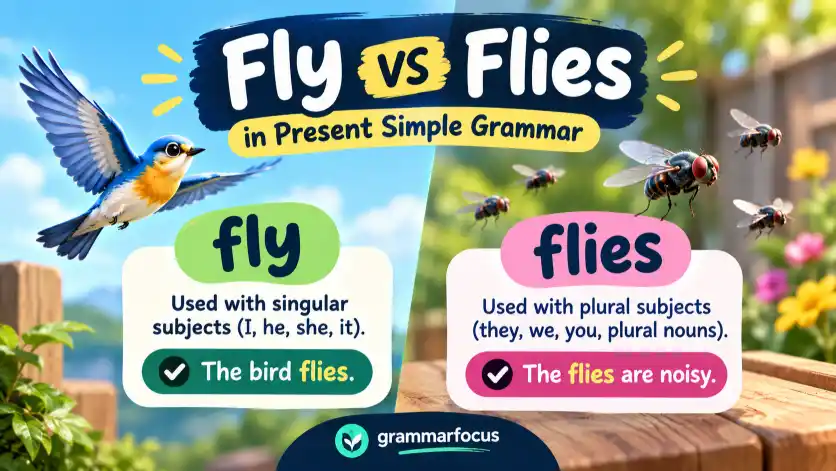
Fly vs Flies in Present Simple Grammar
The most common confusion happens when fly and flies are used as verbs.
Use Fly With These Subjects
Use fly with:
- I
- you
- we
- they
- plural nouns
Examples:
- I fly to Karachi twice a year.
- You fly very often.
- We fly on Friday.
- They fly to different countries.
- Birds fly south in winter.
- Planes fly above the clouds.
Use Flies With These Subjects
Use flies with:
- he
- she
- it
- singular nouns
Examples:
- He flies to Dubai every month.
- She flies for her job.
- It flies across the room.
- The bird flies over the river.
- My father flies on business trips.
Remember that a singular person or thing usually takes flies, while a plural subject takes fly.
Compare:
- The bird flies.
- The birds fly.
- My sister flies.
- My sisters fly.
Fly in Different Verb Forms
The verb fly is irregular. Its past form is not flied when we mean travelling through the air.
| Verb Form | Word | Example |
| Base form | fly | I want to fly. |
| Present with he/she/it | flies | She flies every week. |
| Past simple | flew | We flew to Turkey. |
| Past participle | flown | They have flown before. |
| Present participle | flying | He is flying now. |
Examples:
- I fly to Islamabad tomorrow.
- She flies to London every summer.
- We flew to Dubai last year.
- They have flown across the Atlantic.
- The plane is flying over the mountains.
The word flied is generally not correct for ordinary air travel. However, flied can appear in baseball language, such as “He flied out.”
Common Mistakes With Fly and Flies
Mistake 1: Using “Fly” With a Singular Subject
Incorrect:
- She fly to work every Monday.
Correct:
- She flies to work every Monday.
Mistake 2: Using Flies With Plural Subjects
Incorrect:
- Birds flies in the sky.
Correct:
- Birds fly in the sky.
Mistake 3: Using Flies for One Insect
Incorrect:
- I saw a flies on the wall.
Correct:
- I saw a fly on the wall.
Mistake 4: Using Fly for More Than One Insect
Incorrect:
- There are many fly in the kitchen.
Correct:
- There are many flies in the kitchen.
Mistake 5: Using Flied for Normal Air Travel
Incorrect:
- We flied to London last week.
Correct:
- We flew to London last week.
Fly and Flies in Questions
The choice between fly and flies also depends on the helping verb used in a question.
Questions With Do and Does
Use do with I, you, we, they, and plural subjects. Use does with he, she, it, and singular subjects.
After do or does, use the base form fly, not flies.
Examples:
- Do you fly often?
- Do they fly to London?
- Do birds fly at night?
- Does he fly for work?
- Does she fly every month?
- Does the bird fly high?
Incorrect:
- Does she flies to Dubai?
Correct:
- Does she fly to Dubai?
The word does already carries the third-person singular grammar. Therefore, the main verb returns to its base form.
Compare:
- She flies to Paris.
- Does she fly to Paris?
Fly and Flies in Negative Sentences
The same rule applies to negative sentences.
Use do not or don’t with I, you, we, they, and plural subjects. Use does not or doesn’t with he, she, it, and singular subjects.
After don’t or doesn’t, use fly.
Examples:
- I don’t fly very often.
- We don’t fly during winter.
- They don’t fly on Sundays.
- He doesn’t fly alone.
- She doesn’t fly for work.
- The bird doesn’t fly at night.
Incorrect:
- He doesn’t flies to New York.
Correct:
- He doesn’t fly to New York.
Remember this pattern:
- He flies.
- He doesn’t fly.
- Does he fly?
Common Expressions With Fly
The word fly appears in many common English expressions.
Fly High
Fly high can mean to move high in the air or to achieve great success.
Examples:
- The eagle can fly high above the mountains.
- Her new business is beginning to fly high.
Time Flies
The expression time flies means that time passes quickly.
Examples:
- Time flies when you are having fun.
- I cannot believe it is Friday already. Time flies!
Here, flies is correct because time is a singular subject.
Fly by
Fly by can mean to pass quickly.
Examples:
- The weeks fly by during the holidays.
- I watched the birds fly by the window.
Let It Fly
Let it fly can mean to allow something to move freely through the air. In informal speech, it can also mean to say or do something without holding back.
Example:
- He threw the ball and let it fly.
Fly Away
Fly away means to move away through the air.
Examples:
- The birds fly away before sunset.
- The balloon began to fly away in the wind.
Fly Over
Fly over means to travel above a place or to travel by plane across a place.
Examples:
- The plane will fly over the ocean.
- We will fly over the mountains tomorrow.
Fly or Flies in Everyday Writing
The correct word changes according to the subject and meaning.
School Writing
- Birds fly with the help of their wings.
- A butterfly flies from flower to flower.
- Many insects fly during the summer.
- The teacher explained how planes fly.
Emails
- I will fly to Chicago on Tuesday.
- She flies back on Thursday.
- We do not fly during the night.
- Does the airline fly directly to this city?
News Writing
- Several birds fly over the wetland each morning.
- The aircraft flies at a high altitude.
- The airline will fly passengers to three new destinations.
- A group of insects flies around the light.
Social Media Posts
- Time flies!
- We are ready to fly home.
- These birds fly so beautifully.
- She flies out tomorrow morning.
Formal Writing
- The aircraft flies at a speed of approximately 900 kilometres per hour.
- Many migratory birds fly thousands of kilometres each year.
- The research team observed how the insects fly.
- The company flies its staff to different offices.
The Spelling Rule: Why Fly Becomes Flies
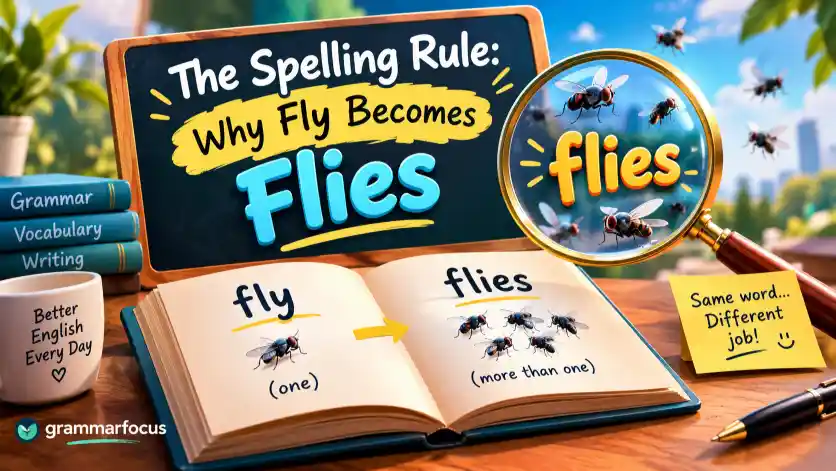
When fly is used as a noun, its plural form is flies. This follows a common spelling rule.
If a noun ends in a consonant plus y, change the y to ies to make it plural.
Examples:
- fly → flies
- baby → babies
- city → cities
- story → stories
- country → countries
- family → families
However, when a vowel comes before the final y, simply add s.
Examples:
- boy → boys
- toy → toys
- day → days
- key → keys
- journey → journeys
The spelling of flies is also used for the third-person singular verb form:
- fly → flies
- try → tries
- cry → cries
- carry → carries
- study → studies
But some verbs ending in y take only s when a vowel comes before the y:
- play → plays
- enjoy → enjoys
- stay → stays
- employ → employs
British English vs American English
There is no spelling difference between British and American English for fly and flies.
Both varieties use:
- fly
- flies
- flew
- flown
- flying
Examples in both varieties:
- Birds fly south in winter.
- She flies to London tomorrow.
- There are several flies near the window.
The difference may appear in related travel vocabulary. For example, British English often uses holiday, while American English commonly uses vacation. However, the verb fly remains the same in both forms of English.
Fly vs Flies: Important Context Clues
You can often choose the correct word by checking three things.
1. Is It One Insect or More Than One?
Use fly for one insect.
- A fly is on the wall.
Use flies for more than one insect.
- Flies are on the wall.
2. What Is the Subject?
Use flies with a singular third-person subject.
- The plane flies every day.
- My sister flies for work.
Use fly with a plural subject or I, you, we, and they.
- The planes fly every day.
- My sisters fly for work.
3. Is There a Helping Verb?
After can, will, do, does, did, may, or should, use fly.
Examples:
- She can fly.
- He will fly tomorrow.
- Does she fly often?
- They did fly last week.
- You should fly early.
Do not add -s after these helping verbs.
Incorrect:
- She can flies.
Correct:
- She can fly.
Fly or Flies: Quick Memory Trick
Use this simple memory trick:
One fly, many flies.
I fly, they fly.
He flies, she flies, it flies.
You can also remember the question rule:
After does, use fly.
Examples:
- She flies.
- Does she fly?
- She does not fly.
This pattern works with many other verbs too:
- He runs. → Does he run?
- She studies. → Does she study?
- It flies. → Does it fly?
Key Takeaways
- Fly is the base form of the verb.
- Flies is the present simple form with he, she, and it.
- Fly means one insect.
- Flies means more than one insect.
- Use fly after do, does, did, can, will, may, and should.
- The past tense of ordinary air travel is flew, not flied.
- The past participle is flown.
- British and American English use the same spelling.
- The plural spelling changes from fly to flies.
- Time flies is a common expression meaning that time passes quickly.
FAQs About Fly or Flies
Q1. Is “fly” or “flies” correct?
Answer. Both words are correct, but they have different uses. Fly is the base verb and the singular noun. Flies is the third-person singular verb form and the plural noun.
Q2. What is the plural of fly?
Answer. The plural of fly is flies.
Example:
- One fly
- Two flies
Q3. Is it correct to say “birds flies”?
Answer. No. The correct sentence is “Birds fly.” The subject birds is plural, so it takes fly, not flies.
Q4. Is it “she fly” or “she flies”?
Answer. The correct form is she flies in the present simple tense.
Example:
- She flies to New York every month.
Q5. Is “Does she flies?” correct?
Answer. No. The correct sentence is “Does she fly?” After does, use the base form of the verb.
Q6. What is the past tense of fly?
Answer. The past tense of fly is flew.
Examples:
- We flew to Turkey last year.
- She flew home yesterday.
Q7. Is “flied” the past tense of fly?
Answer. Flied is not the normal past tense for air travel. Use flew instead. The word flied may appear in special baseball expressions, such as “He flied out.”
Q8. Why does fly become flies?
Answer. The noun fly changes to flies because it ends in a consonant followed by y. The same spelling pattern appears in words such as baby → babies and city → cities.
Conclusion
The difference between fly and flies depends on grammar and meaning. Use fly as the base form of the verb, with I, you, we, they, and plural subjects. Use flies with he, she, and it, or when you mean more than one insect.
For example, “Birds fly in the sky” is correct, while “A bird flies in the sky” is also correct. When talking about insects, say “one fly” but “two flies.”
The easiest way to remember the difference is this: he, she, and it fly with -ies, but I, you, we, and they fly without -ies.
Read More About:
- Summary vs Summery: One Letter, Big Difference (2026)
- Gest vs Jest: A Word Most People Have Never Heard (2026)
- Bass or Base? Even Native Speakers Mix These Up (2026)
- Edition or Addition? How to Choose the Right Word Every Time

I’m Elena Cooper, an English grammar writer with 6 years of experience explaining grammar, punctuation, sentence structure, word usage, and common English mistakes. I create clear, practical, and easy-to-follow content that helps readers understand confusing grammar rules and use English accurately and confidently.