Lives or lifes can be confusing, but lives is the correct plural of life. The word lifes is generally incorrect in standard English. For example, you should write “Many lives were saved,” not “Many lifes were saved.”
The word lives can also be a verb, as in “She lives in London.” Understanding how the word is used in a sentence will help you choose the correct form every time.
Lives or Lifes: Quick Answer
Use lives as the plural of the noun life and as the third person singular form of the verb live. Do not use lifes as the standard plural of life.
| Word | Correct Usage | Example |
| Lives | Correct plural of life | The accident changed many lives. |
| Lifes | Incorrect as the standard plural of life | Many lifes were affected. ❌ |
Quick tip: When life means a person’s existence, its plural is lives, not lifes.
Pronunciation and Word Form
The word lives has two common pronunciations because it can have different meanings.
- Lives (noun): /laɪvz/ the plural of life
- Lives (verb): /lɪvz/ the third person singular form of live
Examples:
- Noun: Many people lost their lives in the disaster.
- Verb: He lives near the city centre.
Although both forms are spelled lives, their vowel sounds are different. The meaning of the sentence helps you identify the correct pronunciation.
Definition and Meaning of Lives or Lifes
Lives is the correct plural form of life. It refers to the existence, experiences, or living conditions of more than one person or animal. The word can also describe the different ways people live or the experiences they have.
Examples:
- Human lives: The rescue team saved three lives.
- Personal experiences: Their lives changed after moving abroad.
- Daily routines: The two friends lead very different lives.
- Verb form: She lives with her family.
The spelling changes from life to lives because many English nouns ending in f or fe form their plurals with ves. However, this is not a rule for every word ending in f or fe. For example, roof becomes roofs, not rooves, in standard modern English.
The Origin of Lives or Lifes
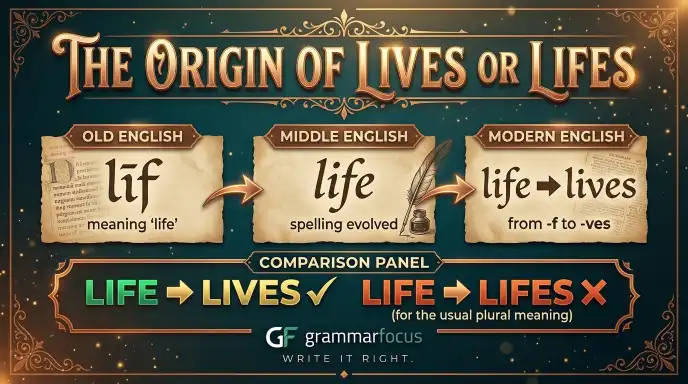
The word life comes from Old English līf, meaning life or existence. Its plural form developed into lives over time. The change from fe to ves follows an established English spelling pattern found in several common words.
For example:
- Life → Lives
- Wife → Wives
- Knife → Knives
- Leaf → Leaves
This pattern explains why lives is correct while lifes is generally considered a spelling error when referring to more than one life.
Common Mistakes with Lives or Lifes
Understanding the difference between life, lives, and live can prevent many common writing errors.
Mistake 1: Writing Lifes Instead of Lives
The most common mistake is adding s to life without changing the ending.
- Incorrect: The accident affected many lifes.
- Correct: The accident affected many lives.
Remember: The plural of life is lives.
Mistake 2: Confusing Lives with Live
Lives can be a noun or a verb, but live has different uses and pronunciations.
- Noun: Their lives are very different.
- Verb: They live in a small town.
- Adjective: We watched a live performance.
Choose the form that fits the sentence.
Mistake 3: Using Life Instead of Lives
Use life for one person’s existence or experience. Use lives when referring to more than one.
- Incorrect: The rescue saved several life.
- Correct: The rescue saved several lives.
Mistake 4: Assuming Every Word Ending in F Changes to V
English plural forms do not all follow the same pattern.
- Life → Lives
- Leaf → Leaves
- Roof → Roofs
- Chief → Chiefs
Learn common plural forms individually when they do not follow a predictable pattern.
Everyday Examples of Lives or Lifes
These examples show how to use lives correctly in different situations.
Everyday Conversation
- Our lives became easier after we moved closer to work.
- She lives with her parents.
- Good friends can make our lives happier.
- He lives in a quiet neighbourhood.
School and Formal Writing
- Education can improve people’s lives.
- The study examined the lives of children in rural communities.
- The new policy may affect thousands of lives.
- The author describes how the characters’ lives change over time.
Emails and Messages
- Your support has made our lives easier.
- She lives close to the office, so she can walk to work.
- We hope the new service improves customers’ lives.
- The two teams lead different lives outside work.
News and Reports
- Emergency workers saved several lives after the fire.
- The new treatment has improved the lives of many patients.
- The storm disrupted the lives of families across the region.
- The report explores how rising costs affect everyday lives.
Life vs. Lives vs. Live
These three words look similar, but their meanings and uses differ.
| Word | Meaning | Example |
| Life | Singular noun | Life can be unpredictable. |
| Lives | Plural noun | Many lives were saved. |
| Lives | Verb form of live | She lives in Canada. |
| Live | Base verb | They live nearby. |
| Live | Adjective meaning happening in real time | We watched a live show. |
The key distinction: Life is singular, lives is its plural, and live is the base form of the verb.
Key Takeaways
- Lives is the correct plural of life.
- Lifes is generally incorrect in standard English.
- Lives can also be the verb form of live.
- The plural spelling pattern also appears in words such as wife/wives and knife/knives.
- Always check if the sentence needs a noun or a verb.
Frequently Asked Questions
Q1. Is it lives or lifes?
Answer. Lives is correct when referring to more than one life. Lifes is generally a spelling mistake in standard English.
Q2. Why does life become lives?
Answer. Many English nouns ending in fe change to ves in the plural. This is why life becomes lives.
Q3. Is lives a singular or plural word?
Answer. As a noun, lives is the plural of life. As a verb, it is the singular form used with he, she, or it, as in “She lives here.”
Q4. Can lifes ever be correct?
Answer. Lifes is not the standard plural of life. In ordinary writing, use lives. An unusual brand name or deliberately nonstandard expression may use lifes, but that does not make it the standard plural.
Q5. What is the difference between life and lives?
Answer. Life refers to one person’s existence or experience, while lives refers to more than one. For example, “Her life changed” and “Their lives changed.”
Q6. What is the difference between lives and live?
Answer. Lives can be the plural noun lives or a verb form, as in “He lives here.” Live can be the base verb, as in “They live here,” or an adjective, as in “a live show.”
Q7. What are some words similar to life and lives?
Answer. Similar plural patterns include wife/wives, knife/knives, and leaf/leaves. However, some words ending in f form plurals with s, such as roof/roofs.
Q8. How can I remember the correct spelling?
Answer. Remember the simple pattern life → lives. When you mean more than one life, change the fe ending to ves instead of simply adding s.
Conclusion
Lives is the correct plural of life, while lifes is generally incorrect in standard English. The word lives can also be used as a verb, as in “She lives nearby.”
To avoid mistakes, remember life → lives and check how the word functions in your sentence. This simple rule will help you use the correct spelling in everyday and formal writing.
Learn More About Grammar:
- Favorite or Favourite: The Simple US vs. UK Rule Explained!
- Somber or Sombre? The Simple Rule You Need to Know!
- Sees or See’s: The One Grammar Mistake You Must Avoid! [2026]

I’m Elena Cooper, an English grammar writer with 6 years of experience explaining grammar, punctuation, sentence structure, word usage, and common English mistakes. I create clear, practical, and easy-to-follow content that helps readers understand confusing grammar rules and use English accurately and confidently.