
Somber or sombre are both correct spellings of the same word. Somber is the standard spelling in American English, while sombre is preferred in British English and other varieties that follow British spelling.
Both words describe a dark, serious, gloomy, or sad mood. You may see them in literature, news reports, and everyday writing to describe a person’s expression, an atmosphere, or a serious situation.
The main difference is regional spelling, not meaning. This guide explains their definitions, origins, and usage to help you choose the right spelling for your audience.
Somber or Sombre: Quick Answer
Use somber in American English and sombre in British English. Both spellings have the same meaning and pronunciation.
| Word | Correct Usage | Example |
| Somber | American English | The room had a somber atmosphere. |
| Sombre | British English | The news cast a sombre mood over the town. |
Quick tip: Choose the spelling that matches your audience and use it consistently.
Pronunciation and Word Form
Both words have the same pronunciation and grammatical uses.
- Somber: /ˈsɑːm.bɚ/ (US)
- Sombre: /ˈsɒm.bə/ (UK)
- Part of speech: Adjective
Both words describe something serious, gloomy, or sad.
Examples:
- The speaker had a somber expression.
- The ceremony took place in a sombre atmosphere.
Definition and Meaning of Somber or Sombre
Somber and sombre mean dark, gloomy, serious, or sad. They can describe a person’s expression, a place, a mood, or an event. The words often appear in writing about grief, difficult news, serious occasions, or quiet surroundings.
Examples include:
- A somber mood: Everyone became quiet after hearing the news.
- A sombre expression: She looked serious and sad.
- Somber colors: The artist used dark shades in the painting.
- A sombre atmosphere: The memorial service was quiet and reflective.
Although the words can describe physical darkness, they often refer to emotions or moods.
The Origin of Somber or Sombre
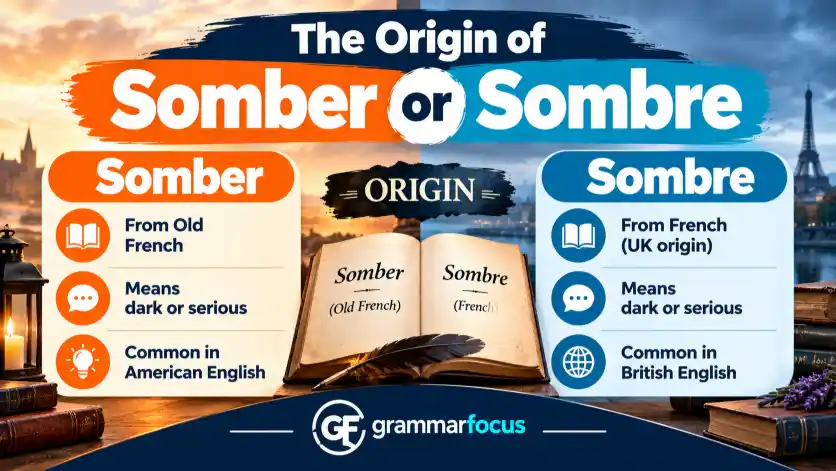
Both spellings come from the French word sombre, meaning dark or gloomy. The word entered English through French and developed into two common spelling forms.
Somber became the standard spelling in American English, while sombre remained common in British English. The difference reflects regional spelling conventions rather than a change in meaning.
British English vs American English Spelling
The main difference between somber and sombre is the variety of English in which each spelling is preferred.
| English Variety | Preferred Spelling |
| American English | Somber |
| British English | Sombre |
| Canadian English | Sombre is common, but usage can vary |
| Australian English | Sombre |
In the United States, writers generally use somber. In the UK, Australia, and many other countries following British conventions, sombre is preferred.
Both forms are correct. The best choice depends on your audience, publication style, or location.
Common Mistakes with Somber and Sombre
Writers sometimes assume that one spelling is incorrect. In reality, both are accepted English spellings.
Mistake 1: Treating Sombre as Incorrect
Incorrect claim: Sombre is always a spelling mistake.
Correct explanation: Sombre is the standard British English spelling.
Mistake 2: Using American and British Spellings Inconsistently
A document may look inconsistent if it uses somber alongside British spellings such as colour and centre.
Tip: Follow one spelling convention throughout your article or document.
Mistake 3: Confusing Somber with Somberness
Somber is an adjective, while somberness is a noun that describes a gloomy or serious quality.
- Adjective: His voice sounded somber.
- Noun: The somberness of the room was noticeable.
Mistake 4: Using the Word for Every Kind of Sadness
Somber and sombre usually suggest a serious, gloomy, or restrained mood. For everyday sadness, words such as upset or unhappy may be more natural.
Everyday Examples of Somber vs. Sombre
These examples show how both spellings work in common situations.
Everyday Conversation
- His face looked somber after the conversation.
- It was a sombre day for the whole family.
- She gave me a somber look before leaving.
News and Reports
- The mayor delivered a somber statement after the tragedy.
- The report described a sombre outlook for the industry.
- The community gathered in a sombre mood following the accident.
Formal Writing
- The ceremony began with a somber moment of silence.
- The author creates a sombre atmosphere throughout the novel.
- The painting uses dark colors to create a somber effect.
Emails and Messages
- Today’s announcement has left the team in a somber mood.
- It was a sombre occasion, and everyone paid their respects.
- The news brought a somber tone to the meeting.
Which Spelling Should You Use?
Your choice depends on your audience.
- Use somber when writing for American readers or following American English conventions.
- Use sombre when writing for British readers or following British English conventions.
- For international content, choose the spelling that best fits your target audience and keep it consistent.
Neither spelling is more correct in every situation. Both communicate the same meaning.
Key Takeaways
- Somber is the preferred American English spelling.
- Sombre is the preferred British English spelling.
- Both words mean dark, gloomy, serious, or sad.
- Their meaning and grammatical use are the same.
- Choose one spelling based on your audience and use it consistently.
Frequently Asked Questions
Q1. Is it somber or sombre?
Answer. Both spellings are correct. Somber is standard in American English, while sombre is standard in British English.
Q2. What does somber or sombre mean?
Answer. Both words mean dark, gloomy, serious, or sad. They can describe a mood, expression, place, or occasion.
Q3. Is sombre British or American?
Answer. Sombre is the preferred British English spelling. American English generally uses somber.
Q4. Is somber spelled with an “e”?
Answer. In American English, it is usually spelled somber, without a final e. The British English spelling is sombre, with an e.
Q5. Do somber and sombre have the same pronunciation?
Answer. Yes, they have the same pronunciation within a given English variety. The pronunciation can differ slightly between American and British accents.
Q6. Can I use sombre in American English?
Answer. Yes, readers may understand sombre, but somber is the usual spelling in American English. Follow the spelling style required by your publication.
Q7. What is a synonym for somber or sombre?
Answer. Common synonyms include gloomy, serious, grave, solemn, and melancholy. The best choice depends on the sentence.
Q8. Is somber a noun or an adjective?
Answer. Somber is an adjective. It describes a serious, gloomy, or sad quality. Somberness is the related noun.
Conclusion
Somber and sombre mean dark, gloomy, serious, or sad. Both spellings have the same meaning, but somber is standard in American English, while sombre is preferred in British English.
Choose the spelling that matches your audience and keep it consistent throughout your writing. Both forms are correct in their respective varieties of English.
Learn More About Grammar:
- Modeled or Modelled: Which Spelling Should You Use?
- Esthetic or Aesthetic? Why Skincare Pros Spell It Differently
- Stoped or Stopped? Fix It in 5 Seconds With This Rule

I’m Elena Cooper, an English grammar writer with 6 years of experience explaining grammar, punctuation, sentence structure, word usage, and common English mistakes. I create clear, practical, and easy-to-follow content that helps readers understand confusing grammar rules and use English accurately and confidently.