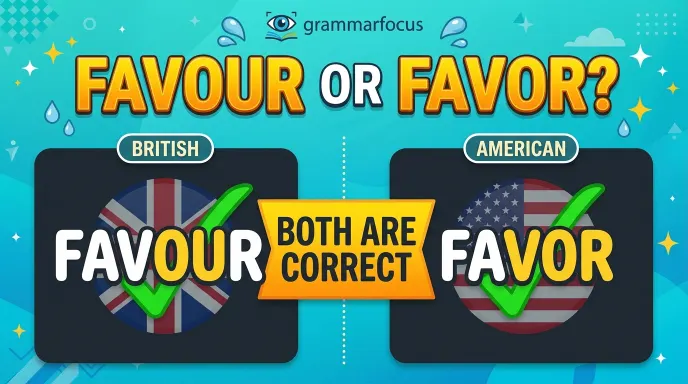
Favour and favor are both correct spellings. The main difference is regional: favour is used in British English, while favor is standard in American English.
Both words have the same meaning. They can refer to a kind act, helpful support, or special approval. The only difference is the letter u.
Choosing the right spelling is simple. Follow the English style used by your readers, and keep it consistent throughout your writing.
Quick Answer
Use favour in British English and favor in American English. Both forms are correct.
| Word | Correct Use | Example |
| Favour | British English | Could you do me a favour? |
| Favor | American English | Could you do me a favor? |
Both spellings have the same meaning and pronunciation. The choice depends on the type of English you are using.
Definition and Meaning
Favour and favor can be used as both nouns and verbs. Their meanings are the same.
Favour or Favor as a Noun
As a noun, the word can mean a kind act, help, or support given to someone.
Examples:
- Could you do me a favour?
- She asked her friend for a favor.
- Thank you for your help and favor.
It can also mean approval or preference.
- The judge showed no favour to either side.
- The plan gained favor among local residents.
Favour or Favor as a Verb
As a verb, the word means to prefer, support, or treat someone or something positively.
Examples:
- Many teachers favour simple explanations.
- The committee may favor the second proposal.
- The conditions favour the home team.
The spelling changes by region, but the meaning stays the same.
The Origin of Favour or Favor
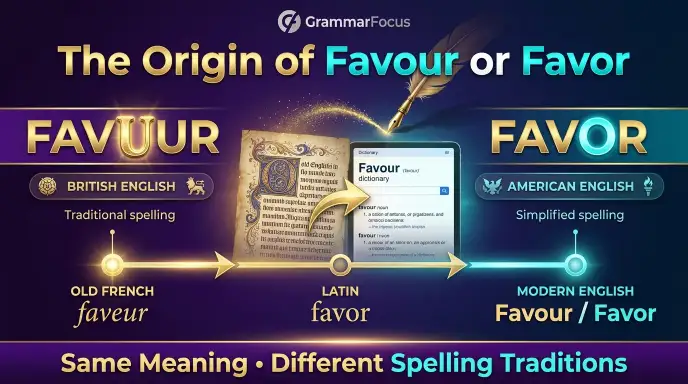
Both spellings come from the same word history. The word entered English through Old French favor, which came from Latin favor, meaning approval, goodwill, or support.
Over time, British English adopted the spelling favour, with a u. American English later became more consistent with the shorter spelling favor.
This difference appears in several other words, too. British English often uses colour, honour, and labour, while American English uses color, honor, and labor.
The spelling of favour or favor follows this familiar pattern.
British English vs American English Spelling
The main spelling difference is the extra u in British English.
| British English | American English |
| Favour | Favor |
| Colour | Color |
| Honour | Honor |
| Labour | Labor |
| Neighbour | Neighbor |
In the UK, favour is the usual spelling. In the United States, favor is standard.Other English varieties, including Canadian and Australian English, generally use favour, though some style guides or specific contexts may differ.The important point is to match your spelling to your intended audience.
Which Spelling Should You Use?
The best spelling depends on your readers.
Use Favour for British English
Choose favour when writing for readers in the United Kingdom. It is also commonly used in Australia and New Zealand.
Examples:
- Could you do me a favour?
- The proposal found favour with the board.
- She agreed to favour the more practical option.
Use Favor for American English
Choose favor when writing for a US audience.
Examples:
- Could you do me a favor?
- The new plan gained favor with voters.
- The coach may favor a different strategy.
Keep Your Spelling Consistent
Do not switch between favour and favor in the same article without a clear reason. Pick the spelling that fits your audience and use it throughout.
For example, a US article would normally use favor, color, and honor. A British article would normally use favour, colour, and honour.
Common Mistakes with Favour or Favor
1. Thinking One Spelling Is Wrong
Both forms are correct. The difference comes from regional spelling rules.
2. Mixing British and American Spellings
Using favour in one paragraph and favor in another can make an article look inconsistent.
3. Forgetting the Audience
If you are writing for an American publication, use favor. For a British publication, use favour.
4. Assuming the Meaning Changes
The meaning does not change when the u is removed. Both words can mean help, approval, or support.
5. Changing a Direct Quote
If you quote a source that uses favour or favor, keep the original spelling inside the quote. Outside the quote, follow the spelling style used in your own writing.
Everyday Examples of Favour or Favor
In Emails
British English: Could you do me a favour and review this file?
American English: Could you do me a favor and review this file?
In Business Writing
British English: The company may favour a flexible work policy.
American English: The company may favor a flexible work policy.
In News Articles
British English: The proposal found favour with local leaders.
American English: The proposal found favor with local leaders.
In Everyday Conversation
British English: Thanks for doing me a favour.
American English: Thanks for doing me a favor.
These examples show that the meaning stays the same. Only the regional spelling changes.
Favour or Favor: Google Trends & Usage Data
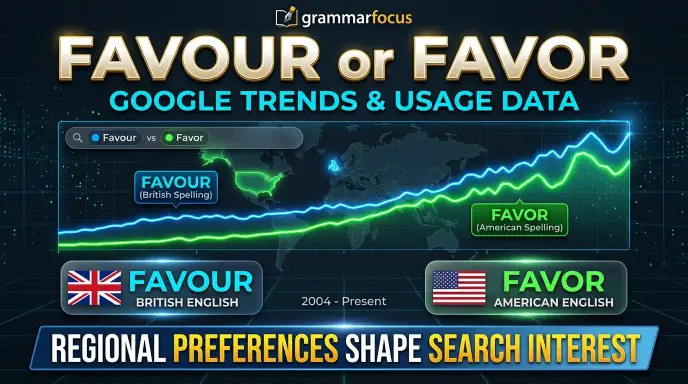
Both favour and favor are used in English, but their popularity varies by region. Favor is standard in the United States, while favour is common in the United Kingdom, Australia, and New Zealand.
Search interest often reflects these regional differences. People in the US are more likely to search for favor, while people using British English may look for favour.
Google Trends compares search interest over a selected time and location. It does not provide a complete count of how often each word appears in books, articles, or everyday conversations.
The main lesson is simple: both spellings are correct, so choose the one that matches your audience.
Favour or Favor in Common Expressions
Both spellings appear in many common English expressions. Their meanings remain the same.
| Expression | Meaning | Example |
| Do me a favour/favor | Ask someone for help | Could you do me a favor? |
| In favour/in favor of | Support an idea or choice | The committee voted in favour of the plan. |
| Find favour/find favor | Gain approval | The proposal found favor with the team. |
| Return the favour/favor | Help someone who helped you | I will return the favor soon. |
| Play favourites/play favorites | Treat some people better than others | Teachers should not play favorites. |
When writing for a British audience, use the forms with u. For an American audience, use the forms without it.
Singular and Plural Forms
The spelling difference also applies to related forms.
| British English | American English |
| Favour | Favor |
| Favours | Favors |
| Favoured | Favored |
| Favouring | Favoring |
| Favourite | Favorite |
For example:
- British: She favoured the first option.
- American: She favored the first option.
- British: It is my favourite book.
- American: It is my favorite book.
Notice that the British spelling often keeps the u, while the American spelling usually removes it.
Key Takeaway:
Remember these simple points:
- Favour is the standard British spelling.
- Favor is the standard American spelling.
- Both words have the same meaning and pronunciation.
- The spelling difference does not change the word’s meaning.
- British English usually uses favourite, while American English uses favorite.
- Choose one spelling style and use it consistently.
Easy rule: British English uses favour; American English uses favor.
FAQs
Q1. Is favour or favor correct?
Answer. Both are correct. Favour is the standard British spelling, while favor is the standard American spelling.
Q2. What is the difference between favour and favor?
Answer. The only difference is the spelling. Favour includes a u, while favor does not. Both have the same meaning.
Q3. Is favour British English?
Answer. Yes. Favour is commonly used in British English and is also standard in several other varieties, including Australian and New Zealand English.
Q4. Is favor American English?
Answer. Yes. Favor is the standard spelling in American English.
Q5. Is it favourite or favorite?
Answer. Both spellings are correct. Use favourite in British English and favorite in American English.
Q6. Is favoured or favored correct?
Answer. Both forms are correct in their respective spelling styles. British English uses favoured, while American English uses favored.
Q7. Do favour and favor sound the same?
Answer. Yes. Both spellings have the same pronunciation. The difference is only written.
Q8. Which spelling should I use in a formal email?
Answer. Use favour for a British audience and favor for an American audience. Keep the same spelling style throughout the email.
Conclusion:
Favour and favor are two regional spellings of the same English word. Neither spelling is wrong. The right choice depends on the variety of English you are using.
Choose favour for British English and favor for American English. The same pattern applies to related words such as favourite/favorite and favoured/favored.For clear, professional writing, focus on your audience and keep your spelling consistent.
Learn More About Grammar:
- Winning or Wining: One Letter That Changes the Meaning
- Supersede or Supercede: One Letter, One Common Error
- Shiny or Shiney: Which Is Correct? Spelling Explained in 2026

I’m Alex Morgan, an American English writer with 6 years of experience exploring grammar, punctuation, sentence structure, and everyday English usage. I enjoy turning confusing grammar rules into clear, practical explanations that help readers write and communicate with confidence.