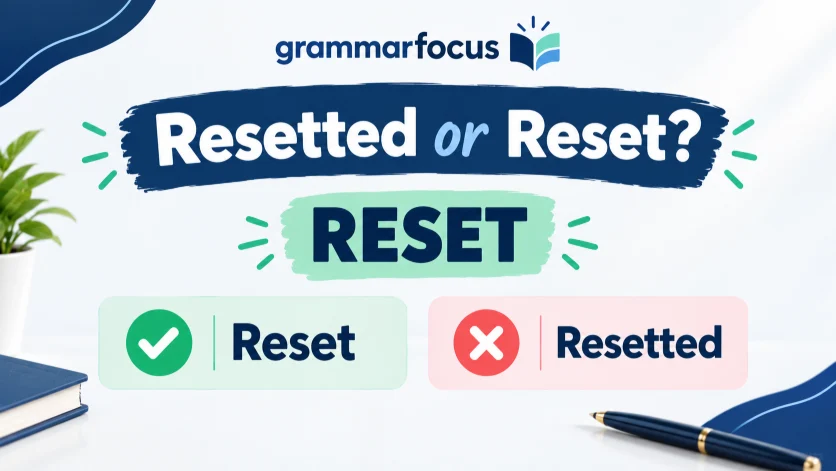
Have you ever wondered if resetted or reset is the correct form when talking about something that was changed back to its original settings? This is a common question because many English verbs form their past tense by adding -ed. However, reset works differently.
Reset is the correct past tense and past participle of the verb reset. Resetted is generally considered incorrect in standard English.
For example, you should say, “I reset my password yesterday,” not “I resetted my password yesterday.”
Understanding this small difference can help you avoid mistakes in emails, technical writing, schoolwork, and everyday conversation.
Resetted or Reset: Quick Answer
Reset is the correct form in standard English.
The verb reset has the same form in the present tense, past tense, and past participle:
- Present: I reset the device.
- Past: I reset the device yesterday.
- Past participle: I have reset the device.
Resetted is not normally used in standard English. Although it may appear in informal writing or online, reset is the form you should use in correct English.
Quick Comparison: Reset vs. Resetted
| Form | Standard English? | Example |
| Reset | Yes | I reset the device. |
| Resets | Yes | The system resets automatically. |
| Resetting | Yes | The device is resetting. |
| Resetted | No, not standard | Avoid this form. |
The most important rule is simple: use reset, not resetted, for the past tense and past participle.
Pronunciation
Reset has two syllables, and the pronunciation changes slightly depending on if it is used as a noun or verb.
As a verb:
- US: /ˌriːˈset/
- UK: /ˌriːˈset/
The stress falls on the second syllable: re-SET.
The word sounds the same when reset is used for the present, past, or past participle form.
Definition and Meaning of Reset
Reset means to set something again, usually to its original position, condition, or settings.
It is commonly used for computers, phones, passwords, machines, devices, controls, and systems. It can also be used in a more general sense when someone starts something again or returns to a previous state.
For example:
- I need to reset my phone.
- She reset her password yesterday.
- The technician has reset the system.
- You can reset the timer before starting again.
The key point is that reset does not change to resetted when talking about the past.
Why Is “Reset” Correct?
Many regular English verbs form their past tense by adding -ed.
For example:
- clean → cleaned
- open → opened
- start → started
- reset → reset
Although reset ends in a consonant sound and looks like a word that could take -ed, standard English keeps the same form for all three principal forms of the verb.
| Form | Correct Word | Example |
| Base form | reset | I need to reset the device. |
| Past tense | reset | I reset the device yesterday. |
| Past participle | reset | I have reset the device. |
So, reset → reset → reset.
This is why adding -ed to make resetted is unnecessary.
Reset, Set, and Similar Unchanged Verbs
Reset follows the same pattern as the verb set. These verbs keep the same form in the present tense, past tense, and past participle.
| Verb | Present | Past | Past Participle |
| Set | set | set | set |
| Reset | reset | reset | reset |
| Put | put | put | put |
| Cut | cut | cut | cut |
| Hit | hit | hit | hit |
For example:
- I set the timer yesterday.
- I have set the timer.
- I reset the timer yesterday.
- I have reset the timer.
This pattern explains why resetted is not needed in standard English. Just as set remains set, reset remains reset.
Remember:
set → set → set reset → reset → reset
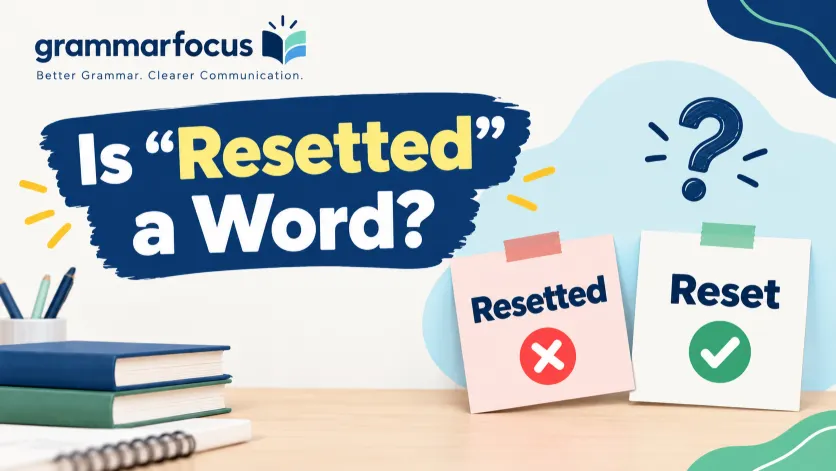
Is “Resetted” a Word?
Resetted may be found in informal writing, user-generated content, or nonstandard English, but it is not the standard past-tense form of reset.
When you are writing an article, email, report, assignment, instruction, or professional message, use reset instead.
Incorrect:
I resetted my password last night.
Correct:
I reset my password last night.
Incorrect:
The system was resetted by the technician.
Correct:
The system was reset by the technician.
The same rule applies if reset is used actively or in a passive sentence.
Formal vs. Casual English
In casual speech or informal online writing, you may sometimes see resetted. However, it is not the standard past-tense or past-participle form of reset.
For formal, academic, professional, and technical writing, always use reset.
Formal and Professional Examples
- The system was reset by the technician.
- Your password has been reset successfully.
- I reset my account settings yesterday.
- The device needs to be reset before use.
Informal or Nonstandard Example
- I resetted my phone yesterday. ❌
The correct sentence is:
- I reset my phone yesterday. ✅
The safest rule is simple: even if you see resetted in informal writing, use reset in standard English.
Reset as a Verb
As a verb, reset means to set something again or return it to a particular state.
It is especially common in technology.
Present Tense
Use reset when the action happens now, happens regularly, or is generally true.
- I reset my password every few months.
- We reset the router when the connection stops working.
- The app lets users reset their settings.
Past Tense
Use reset when the action happened in the past.
- I reset my password yesterday.
- She reset the router this morning.
- They reset the machine after the error appeared.
Notice that the past form is still reset, not resetted.
Past Participle
Use reset after helping verbs such as has, have, and had, or in passive constructions.
- I have reset my password.
- He had reset the device before the technician arrived.
- The system has been reset.
- The settings were reset automatically.
Reset vs. Resetted
The difference is simple:
Reset is the standard English form.
Resetted is generally a nonstandard form and should be avoided in formal or correct English.
Compare these sentences:
Correct:
“I reset the password yesterday.”
Incorrect:
“I resetted the password yesterday.”
Correct:
“The device has been reset.”
Incorrect:
“The device has been resetted.”
A useful way to remember the rule is:
Reset stays reset.
Think of it as:
reset → reset → reset
This pattern is the same if you are talking about something happening now, something that happened yesterday, or something that has already happened.
Why Do People Say “Resetted”?
The mistake usually comes from a common English pattern. Many verbs form their past tense by adding -ed, so speakers may naturally assume that reset should become resetted.
For example:
- restart → restarted
- update → updated
- repair → repaired
- reset → reset
Because restart and reset have similar meanings in some situations, it can feel natural to say resetted. However, the standard form is still reset.
This is an important distinction between what may sound logical and what is grammatically accepted in standard English.
Origin of the Word Reset
The word reset is formed from re-, meaning “again” or “back,” and set, meaning to put something in a particular position or condition.
The verb became especially common as technology developed. Today, people regularly use reset when talking about devices, passwords, software, settings, and systems.
The structure also helps explain why the word keeps its form. The base verb set itself has the same form in the present and past:
- I set the timer.
- I set the timer yesterday.
- I have set the timer.
Reset follows the same pattern:
- I reset the timer.
- I reset the timer yesterday.
- I have reset the timer.
Which One Should You Use?
Choose reset whenever you need the standard English form of the verb.
Use reset for:
- Present actions: “I reset the device.”
- Past actions: “I reset the device yesterday.”
- Perfect tenses: “I have reset the device.”
- Passive sentences: “The device was reset.”
- Formal and professional writing: “The account was reset successfully.”
Avoid resetted in standard English.
The easiest rule is simple: when the verb is reset, its past and past participle forms are also reset.
A Quick Memory Trick
Use this simple pattern to remember the correct form:
set → set → set reset → reset → reset
Just as set stays the same in the past tense and past participle, reset also stays the same.
Quick Examples
- I set the timer yesterday. ✅
- I reset the timer yesterday. ✅
- She has reset her password. ✅
- The system was reset automatically. ✅
- I resetted my phone yesterday. ❌
Remember: Use reset, not resetted, in standard English.
Common Uses of Reset in Real Life
The word reset appears in many everyday situations, especially when something needs to return to a previous state or start again.
Technology and Devices
You may reset a phone, computer, router, or other device when it stops working properly.
- I reset my phone after it became unresponsive.
- The technician reset the router.
- The device has been reset to its original settings.
Passwords and Accounts
Reset is also very common when talking about passwords and online accounts.
- I reset my password after forgetting it.
- She has reset her account password.
- The website asked me to reset my password.
Customer Support and Work Communication
The word reset is also common in customer support, workplace communication, and technical instructions. It is often used when someone needs to change a password, restore settings, or solve a system problem.
Examples
- Please reset your password to continue.
- Our support team has reset your account.
- The technician reset the system yesterday.
- Your login details have been reset successfully.
- I need to reset my account settings.
In all these examples, reset is the correct form. The word resetted should not be used in professional emails, support messages, or technical instructions.
Timers and Controls
The word can also describe setting a timer, counter, or control back to a starting point.
- I reset the timer before starting again.
- The machine reset the counter automatically.
- The settings were reset after the update.
Starting Again
In everyday speech, reset can also have a broader meaning. Someone may use it when they want to pause, start fresh, or change their approach.
- I took the weekend off to reset and relax.
- The team reset its strategy after losing the first game.
- She needed some quiet time to reset before returning to work.
Common Mistakes With Reset
The biggest mistake is adding -ed to reset.
Mistake 1: Using “Resetted” as the Past Tense
Incorrect:
I resetted my laptop yesterday.
Correct:
I reset my laptop yesterday.
The past tense remains reset.
Mistake 2: Using “Resetted” After Have or Has
Incorrect:
I have resetted the settings.
Correct:
I have reset the settings.
After have, has, or had, use the past participle reset.
Mistake 3: Using “Resetted” in Passive Sentences
Incorrect:
The account was resetted.
Correct:
The account was reset.
The passive structure uses was/were + reset, not resetted.
Mistake 4: Confusing Reset With Restart
Reset and restart sometimes mean similar things, but they do not always mean the same thing.
Restart usually means stopping something and starting it again.
Reset often means returning something to a particular setting, position, or state.
For example:
- I restarted my computer after installing the update.
- I reset my computer to its factory settings.
Choosing the right word depends on what you mean.
Reset in Different Sentence Patterns
Knowing common sentence structures makes it easier to use reset correctly.
Simple Present
Use reset for regular actions or general statements.
- I reset my password regularly.
- The system resets automatically every night.
Notice that he, she, it, or another singular subject takes resets.
Simple Past
The past form is still reset.
- I reset the device yesterday.
- She reset the timer before the test.
- They reset the system after the error.
Present Perfect
Use has reset or have reset.
- I have reset my password.
- She has reset the device.
- We have reset the settings.
Past Perfect
Use had reset.
- He had reset the router before the technician arrived.
- They had reset the system before the meeting began.
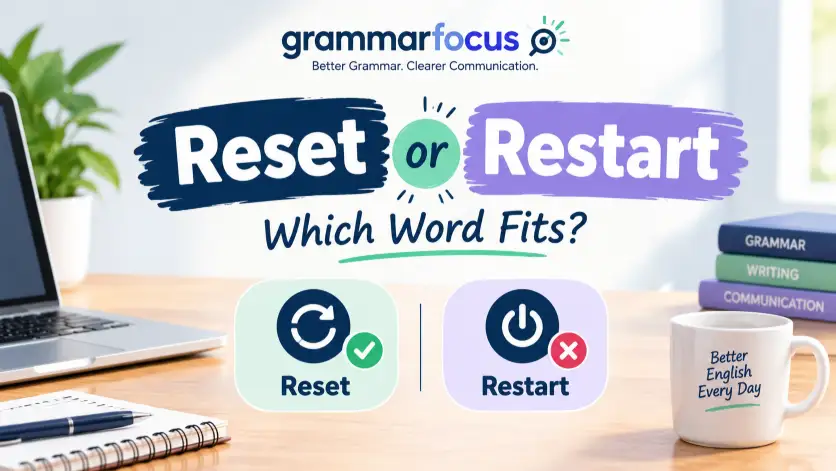
Reset or Restart: Which Word Fits?
Although these words can overlap, they often describe different actions.
Use restart when you mean to stop something and start it again.
I restarted my computer because it was running slowly.
Use reset when you mean to return something to a particular setting or state.
I reset my computer to its factory settings.
A restart does not necessarily erase settings or personal information. A reset can, depending on the device or system.
This distinction is especially useful when following technical instructions.
Real-Life Examples of Reset
Here are some natural examples from situations you may encounter in everyday life.
At Home
Your Wi-Fi stops working, so you reset the router.
“I reset the router, and the internet is working again.”
At Work
You forget your company password and change it.
“I reset my work password this morning.”
On a Phone
You want to return your phone to its original settings.
“He reset his phone before selling it.”
At School
A teacher starts a timer again before another activity.
“The teacher reset the timer for the next exercise.”
In Sports
A team changes its approach after a poor start.
“The coach told the players to reset and focus on the second half.”
These examples show how naturally reset works in both technical and everyday contexts.
Reset in British and American English
There is no major spelling difference between British and American English for reset.
Both varieties use:
- reset
- resets
- resetting
- reset
For example:
American English:
I reset my password yesterday.
British English:
I reset my password yesterday.
The spelling resetted is not the standard form simply because of a British-American difference. If you are writing for either audience, reset is the safe standard choice.
Resetting vs. Resetted
Another useful form is resetting.
Resetting is the present participle or gerund form of reset.
Examples:
- The computer is resetting.
- I am resetting the device.
- Resetting the router may solve the problem.
Notice the spelling:
reset + ing = resetting
The final t is doubled before -ing.
By contrast, the past tense does not become resetted:
reset + past = reset
So the main forms are:
reset → reset → reset → resetting
Key Takeaways
- Reset is the correct standard form.
- Resetted is generally considered nonstandard.
- The past tense of reset is reset.
- The past participle of reset is also reset.
- Use resets with third-person singular subjects in the present tense.
- Use resetting for the -ing form.
- Reset is common in technology, passwords, devices, timers, and everyday situations.
- Restart and reset can have different meanings, especially with electronic devices.
Frequently Asked Questions
Q1. Is “resetted” grammatically correct?
Answer. No. Resetted is generally not considered the standard past-tense or past-participle form of reset. Use reset instead.
Q2. Is it “I reset” or “I resetted”?
Answer. The correct form is “I reset.” For example, “I reset my password yesterday.”
Q3. Is “reset” the past tense of reset?
Answer. Yes. Reset is both the present and past form of the verb. For example, “I reset the device yesterday.”
Q4. Is it “have reset” or “have resetted”?
Answer. Use have reset. For example, “I have reset my password.”
Q5. Is “reset” an irregular verb?
Answer. Reset has an unchanged past form. Its main forms are reset, reset, reset. It behaves like set, which also keeps the same form in the present, past, and past participle.
Q6. What is the difference between reset and restart?
Answer. Restart usually means to stop something and start it again. Reset often means to return something to a particular setting or state. The exact meaning depends on the context.
Q7. Is “resetting” correct?
Answer. Yes. Resetting is the correct -ing form of reset. For example, “The system is resetting.”
Q8. How do I remember if to use reset or resetted?
Answer. Remember this simple pattern: reset → reset → reset. The past tense and past participle do not take -ed.
Conclusion
When choosing between resetted or reset, always use reset in standard English. The verb keeps the same form in the base form, past tense, and past participle.
You can say, “I reset my password yesterday,” “I have reset the device,” or “I reset the settings.” Avoid resetted in formal, academic, professional, and everyday standard English.
Once you remember reset → reset → reset, this common grammar problem becomes easy to avoid.
Learn More About Grammar

I’m Alex Morgan, an American English writer with 6 years of experience exploring grammar, punctuation, sentence structure, and everyday English usage. I enjoy turning confusing grammar rules into clear, practical explanations that help readers write and communicate with confidence.







2 thoughts on “Resetted or Reset? The Grammar Mistake Everyone Makes (2026)”