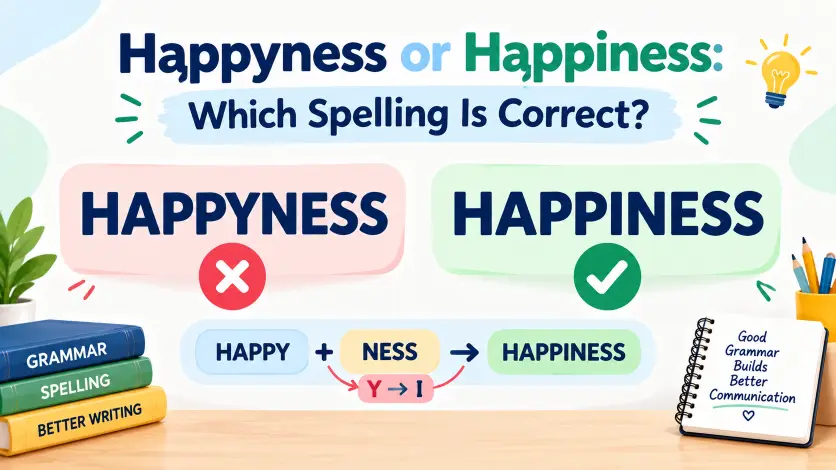
Have you ever written happyness or happiness and wondered which spelling is correct? This is a common spelling mistake because the word happy changes slightly when the ending -ness is added.
The correct spelling is happiness. Happyness is incorrect in standard English.
The reason is simple: when an adjective ends in -y, the y usually changes to i before the suffix -ness is added. So:
happy + ness = happiness
Not:
happy + ness = happyness
This spelling rule also appears in other words, such as busy → business and lazy → laziness. Understanding the pattern can help you avoid similar mistakes in your writing.
In this guide, you will learn why happiness is correct, why happyness is wrong, how the word is pronounced, how it is used in sentences, and how to remember the spelling easily.
Happyness or Happiness: Quick Answer
Happiness is the correct spelling in standard English.
Happyness is a misspelling and should not be used in formal or standard writing.
The correct form is:
Happiness
For example:
Happiness is more important than wealth.
Spending time with family brings me happiness.
The spelling changes because happy ends in y. When -ness is added, the final y changes to i:
happy → happiness
The same pattern appears in:
- happy → happiness
- lazy → laziness
- busy → business
- easy → easiness
- lonely → loneliness
So if you are unsure between happyness and happiness, choose happiness.
Quick Comparison Table
| Form | Word Type | Meaning | Correct? | Example |
| Happiness | Noun | The state or feeling of being happy | Yes | Happiness is important. |
| Happy | Adjective | Feeling or showing pleasure | Yes | She is happy today. |
| Happyness | Misspelling | Intended to mean happiness | No | Avoid this spelling. |
| Happines | Misspelling | Intended to mean happiness | No | Use happiness instead. |
What Does Happiness Mean?
Happiness is a noun that describes a state of feeling happy, satisfied, content, or pleased.
For example:
Money cannot guarantee happiness.
In this sentence, happiness means a feeling or state of being happy.
Another example is:
Her happiness was obvious when she received the good news.
Here, the word describes her positive emotional state.
Happiness as a Noun
The word happiness is the noun form of the adjective happy.
Compare these forms:
| Word | Part of Speech | Example |
| Happy | Adjective | She is happy. |
| Happily | Adverb | She smiled happily. |
| Happiness | Noun | Her happiness was clear. |
This difference is useful when building a sentence.
You use happy to describe a person or thing:
He looks happy.
You use happiness to name the feeling or state:
He found happiness in his new job.
Common Uses of Happiness
Happiness can describe personal feelings, relationships, life satisfaction, or general well-being.
Common phrases include:
- personal happiness
- lasting happiness
- true happiness
- inner happiness
- happiness and peace
- happiness in life
- source of happiness
- pursuit of happiness
Examples:
Family is an important source of happiness.
She found happiness in helping others.
Everyone wants happiness in life.
Why Is Happiness Spelled With “I”?
The spelling becomes easier to understand when you look at the word formation.
The base adjective is:
happy
The suffix is:
-ness
When -ness is added to an adjective ending in y, the y usually changes to i.
So:
happy + ness → happiness
The same spelling pattern appears in many English words.
Examples of the Same Rule
Consider these words:
lazy → laziness
wild → wildness
lonely → loneliness
ready → readiness
friendly → friendliness
The final y changes to i before -ness.
This is why happyness is not the standard spelling.
A Simple Spelling Formula
Remember this:
Words ending in consonant + y → change y to i before -ness.
For happy:
happ + y + ness
becomes:
happ + i + ness
So the final word is:
happiness
This rule is one of the easiest ways to remember the correct spelling.
Happyness vs Happiness: The Main Difference
There is no difference in meaning because happyness is not the standard spelling of the word.
The real comparison is:
Happiness = correct
Happyness = incorrect
If you see happyness in a sentence, it is normally a spelling error rather than a different form of the word.
For example:
Incorrect:
She wishes you health and happyness.
Correct:
She wishes you health and happiness.
Another example:
Incorrect:
Money does not always bring happyness.
Correct:
Money does not always bring happiness.
The important point is that changing i to y changes the spelling incorrectly. It does not create a second accepted version.
The Origin of Happiness
The word happiness comes from happy, which has a long history in English.
The word happy developed from Middle English forms related to hap, a word associated with chance, fortune, or what happens.
Over time, happy developed its modern meaning of being pleased, fortunate, or experiencing positive feelings.
The suffix -ness is used to form nouns from adjectives. It describes a state, quality, or condition.
For example:
- kind → kindness
- dark → darkness
- weak → weakness
- happy → happiness
Therefore, happiness literally follows a common English word-building pattern: happy + -ness.
The spelling change from y to i is part of the standard spelling pattern used when forming many nouns with -ness.

Pronunciation and Word Form
Knowing the pronunciation and grammatical form of happiness can make the word easier to use correctly.
Happiness
Pronunciation:
US: /ˈhæp.i.nəs/
UK: /ˈhæp.i.nəs/
It sounds roughly like:
HAP-ee-nuhs
The stress is on the first syllable.
Part of speech: Noun
Example:
Happiness comes from many different things.
Happy
The base word happy is an adjective.
Pronunciation:
US: /ˈhæp.i/
UK: /ˈhæp.i/
Example:
She looks happy today.
The relationship is easy to remember:
happy → happiness
The adjective describes someone or something, while the noun names the state or feeling.
British English vs American English
There is no spelling difference between British and American English for happiness.
Both use:
happiness
The incorrect form happyness is not the standard spelling in either variety.
| Word | British English | American English | Status |
| Happiness | happiness | happiness | Correct |
| Happyness | happyness | happyness | Incorrect |
For example:
Happiness is important for a healthy life.
This spelling is correct for British, American, Canadian, Australian, and international English.
Why This Matters
Some English words have different British and American spellings, such as colour/color or centre/center.
Happiness is not one of those words.
You do not need to choose a different spelling based on your audience. If you are writing for readers in the United States, United Kingdom, Canada, or Australia, happiness is the standard form.
How to Use Happiness in a Sentence
The word happiness can be used in many types of sentences.
Everyday Writing
Her happiness made everyone smile.
I wish you health and happiness.
Academic Writing
Researchers often study the factors that influence happiness.
Business Writing
Employee happiness can affect workplace culture.
Personal Writing
True happiness does not always come from material things.
Social Media
Choose happiness every day.
In each example, happiness works as a noun.
A useful way to check your sentence is to replace happiness with joy or contentment. If the sentence still makes sense, you are probably using the noun correctly.
For example:
Family brings happiness.
Can become:
Family brings joy.
This confirms that happiness is naming a feeling or state.
Real-Life Examples
The word happiness is common in everyday life. We use it when talking about positive feelings caused by people, events, achievements, or simple moments.
At Work
After getting a promotion, Sarah felt a deep sense of happiness.
With Family
Spending time with family can bring a lot of happiness to everyday life.
At School
Winning the competition filled the students with happiness.
In Daily Conversation
“You could see the happiness on his face when he heard the good news.”
These examples show how happiness fits naturally into real conversations and everyday writing.
Common Mistakes With Happiness
The most common mistake is writing happyness instead of happiness. This usually happens because writers remember the spelling of happy and simply add -ness without changing the final letter.
Mistake 1: Happyness
Incorrect:
I wish you health and happyness.
Correct:
I wish you health and happiness.
The y in happy changes to i when -ness is added.
Mistake 2: Happines
Another common typo is leaving out the second s.
Incorrect:
Everyone deserves happines.
Correct:
Everyone deserves happiness.
The correct spelling ends with -ness, so it has two s letters:
h-a-p-p-i-n-e-s-s
Mistake 3: Happy Ness
Do not write the word as two separate words.
Incorrect:
Finding happy ness is important.
Correct:
Finding happiness is important.
Happiness is one word.
Other Words With the Same Spelling Pattern
Learning related words is a good way to remember the spelling of happiness.
Many adjectives ending in -y change y to i when -ness is added.
| Adjective | Noun |
| happy | happiness |
| lazy | laziness |
| lonely | loneliness |
| ready | readiness |
| friendly | friendliness |
| silly | silliness |
| busy | busyness |
| noisy | noisiness |
For example:
She was known for her friendliness.
His laziness affected his work.
The child’s silliness made everyone laugh.
Seeing the same pattern in several words makes happiness easier to remember.
A Useful Warning
The spelling rule is most useful when the y follows a consonant, as in happy.
English spelling has exceptions and other patterns, so it is better to learn common word forms rather than assume that every word ending in y will behave exactly the same way.
For happy, however, the correct form is clear:
happy → happiness
Happiness in Different Types of Writing
Happiness is a flexible noun, so it can appear in casual, formal, academic, and professional writing.

In Everyday Conversation
Your happiness matters to me.
I hope this brings you happiness.
These sentences sound natural in personal communication.
In Academic Writing
The study examined the relationship between income and happiness.
Here, happiness refers to a general state or condition that can be discussed as a subject of study.
In Business Writing
Employee happiness is an important part of a positive workplace.
The word can be used when discussing workplace experience and satisfaction.
In Articles and Blogs
Many people search for happiness in their daily lives.
This type of sentence is common in lifestyle, personal development, and educational content.
In Formal Messages
We wish you continued health, success, and happiness.
This is a common formal expression for greetings and good wishes.
Happiness vs Happy: Choosing the Right Form
One reason people make mistakes with happiness is that happy and happiness have different grammatical jobs.
Use happy when you describe a person, feeling, or situation.
She is happy with the results.
Use happiness when you name the feeling or state.
The results brought her happiness.
Compare:
- I am happy.
- I feel happiness.
- Her happiness is important.
The first sentence uses an adjective. The other sentences use the noun.
This distinction can help you decide if you need happy or happiness when building a sentence.
When Should You Use Happiness?
Use happiness when you need a noun to describe the state or feeling of being happy.
Common sentence patterns include:
Happiness + Verb
Happiness comes from many sources. For everyone, it can play an important role in everyday life.
Verb + Happiness
Family brings happiness.
The news brought him happiness.
Possessive + Happiness
Her happiness was obvious.
Your happiness is important.
Adjective + Happiness
True happiness cannot always be measured.
Personal happiness is different for everyone.
These patterns show how naturally happiness fits into different sentence structures.
Happiness in Common Expressions
Some expressions make the correct spelling especially easy to remember.
Health and Happiness
I wish you health and happiness.
This is a common phrase used in greetings and good wishes.
Pursuit of Happiness
The pursuit of happiness refers to the effort to seek a happy and fulfilling life.
Everyone has their own idea of the pursuit of happiness.
Find Happiness
She found happiness in her new career.
Bring Happiness
The gift brought happiness to the children.
True Happiness
True happiness is not always connected to wealth.
Learning these common combinations can help you recognize the correct spelling when writing quickly.
Google Trends & Modern Usage
Searches for happyness or happiness are mainly related to spelling correction. People often type the incorrect version because the word begins with happy, which can make the spelling change easy to miss.
Common search variations include:
- happyness or happiness
- happiness spelling
- how to spell happiness
- is happyness correct
- correct spelling of happiness
- happyness meaning
- happiness meaning
- happy or happiness
The search intent is usually straightforward: the reader wants to confirm the correct spelling or understand why the y changes to i.
This is also useful for learners because the same spelling pattern appears in several other English words. Learning happy → happiness as part of a wider pattern is more useful than simply memorizing one word.
For modern standard English, happiness is the form to use in schoolwork, professional writing, websites, emails, and published content.
Key Takeaways
- Happiness is the correct standard spelling.
- Happyness is a spelling mistake.
- The word comes from happy + -ness.
- The final y in happy changes to i before -ness.
- Happiness is a noun.
- Happy is an adjective.
- British and American English both use happiness.
- Remember the pattern: happy → happiness.
FAQs About Happyness or Happiness
Q1. Is happyness or happiness correct?
Answer. Happiness is the correct spelling. Happyness is a misspelling. The final y in happy changes to i when the suffix -ness is added, giving us happy → happiness.
Q2. Why is happiness spelled with an i?
Answer. Happiness is formed from happy and -ness. Because the final y in happy follows a consonant, it changes to i before the suffix is added. Therefore, happy + ness becomes happiness, not happyness.
Q3. Is happyness a real word?
Answer. Happyness is not the standard English spelling of the noun. It may appear online as a typo, username, brand name, or informal stylization, but standard writing should use happiness.
Q4. What is the noun form of happy?
Answer. The noun form of happy is happiness. For example, happy describes a person or state, while happiness names the feeling or condition. You can say, “She is happy,” or “Her happiness is important.”
Q5. Is happiness spelled the same in British and American English?
Answer. Yes. Both British and American English use happiness. There is no standard British spelling such as happyness. The correct spelling remains happiness regardless of which variety of English you use.
Q6. How do you remember the spelling of happiness?
Answer. Start with the word happy and remember the spelling change before -ness: happy → happiness. You can also connect it with similar words such as lazy → laziness and lonely → loneliness.
Q7. What is the difference between happy and happiness?
Answer. Happy is an adjective used to describe someone or something, while happiness is a noun that names the state or feeling of being happy. For example, “She feels happy” uses the adjective, while “She values her happiness” uses the noun.
Q8. Can I use happyness in informal writing?
Answer. You may see happyness used intentionally in usernames, brand names, creative writing, or stylized names. However, it should not be used as the standard spelling in essays, articles, business writing, or other formal content. Use happiness for standard English.
Conclusion
If you are choosing between happyness or happiness, the correct answer is happiness.
The spelling becomes easier to remember when you look at how the word is formed. Start with happy, add -ness, and change the final y to i:
happy → happiness
The incorrect form happyness usually comes from adding -ness without making that spelling change. It is not a standard alternative spelling in British or American English.
You can also use related words such as laziness, loneliness, and readiness to reinforce the same spelling pattern.
So whenever you need the noun for the state or feeling of being happy, write happiness.
Remember: Happy becomes happiness, not happyness.
Learn More About Grammar

I’m Alex Morgan, an American English writer with 6 years of experience exploring grammar, punctuation, sentence structure, and everyday English usage. I enjoy turning confusing grammar rules into clear, practical explanations that help readers write and communicate with confidence.







1 thought on “Happiness or Happyness? The Correct Spelling Explained (2026)”