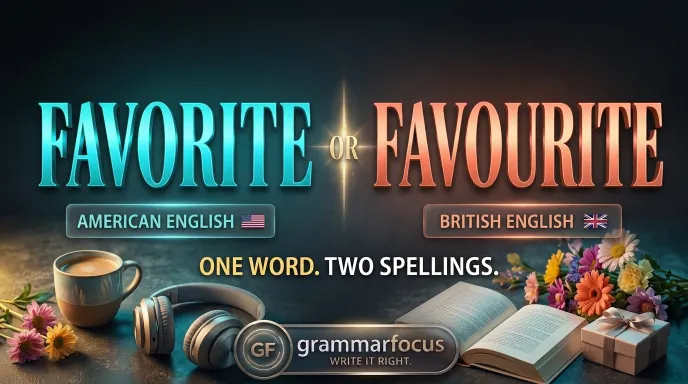
Favorite or favourite are both correct spellings. Favorite is the standard American English spelling, while favourite is used in British English and many other countries that follow British spelling rules.
Both words have the same meaning: a person, thing, or activity that someone likes more than others. The only difference is the spelling, so your choice depends on your audience.
Favorite or Favourite: Quick Answer
Use favorite when writing in American English and favourite when writing in British English. Both spellings are correct and have the same meaning.
| Word | English Variety | Example |
| Favorite | American English | Pizza is my favorite food. |
| Favourite | British English | Pizza is my favourite food. |
Quick tip: Choose the spelling that matches your audience and use it consistently throughout your writing.
Pronunciation and Word Form
Both spellings have the same meaning and are pronounced similarly, although accents can affect the exact sound.
- Favorite (US): /ˈfeɪ.vɚ.ɪt/
- Favourite (UK): /ˈfeɪ.vər.ɪt/
- Part of speech: Noun and adjective
As a noun, the word identifies a person or thing someone likes best. As an adjective, it describes something especially liked.
Examples:
- Noun: This song is my favorite.
- Adjective: She wore her favourite dress.
Definition and Meaning of Favorite or Favourite
Favorite and favourite mean the same thing: a person or thing that someone likes best or prefers over others. The word can describe food, books, movies, colors, sports, people, places, and many other things.
Examples:
- Favorite food: Pasta is my favorite food.
- Favourite book: That is my favourite book of the year.
- Favorite color: Blue is his favorite color.
- Favourite activity: Walking is her favourite activity.
The word can also describe a person who is expected to win a competition.
Example: She is the favorite to win the tennis tournament.
In this context, favorite or favourite means the person most likely to win.
The Origin of Favorite or Favourite
The word favorite came into English through French and Italian, ultimately relating to the idea of being favored or preferred. The spelling developed differently across English speaking regions. American English commonly uses favorite, while British English retains the u in favourite.
This difference is part of a wider pattern in English spelling. Similar examples include color/colour, honor/honour, and neighbor/neighbour. Both forms remain correct in their respective spelling systems.
British English vs American English Spelling
The main difference between favorite and favourite is regional spelling.
| English Variety | Preferred Spelling | Example |
| American English | Favorite | My favorite movie is a comedy. |
| British English | Favourite | My favourite film is a comedy. |
| Australian English | Favourite | Chocolate is my favourite treat. |
| Canadian English | Favourite is common | It is my favourite season. |
American English generally drops the u in words such as favorite and color. British English usually keeps it. Canadian English often follows British spelling for these words, although individual publications may have their own style rules. Neither spelling is wrong. The best choice depends on the type of English you are using.
Common Mistakes with Favorite or Favourite
Writers sometimes mix American and British spellings without realizing it. These simple tips can help you avoid common errors.
Mistake 1: Treating One Spelling as Incorrect
Both forms are correct, so avoid marking favorite or favourite as wrong without considering the English variety.
- American English: This is my favorite restaurant.
- British English: This is my favourite restaurant.
Mistake 2: Mixing Spelling Styles
Using favorite in one paragraph and favourite in another can make an article look inconsistent.
Tip: Choose American or British English before writing, especially for articles, school assignments, and professional documents.
Mistake 3: Forgetting Related Spellings
The same regional difference appears in related words.
| American English | British English |
| Favorite | Favourite |
| Favorites | Favourites |
| Favor | Favour |
| Favorable | Favourable |
Remembering this pattern makes it easier to maintain consistent spelling.
Mistake 4: Confusing Favorite with Favourite as Different Words
These spellings do not have different meanings. You do not need to choose one based on what you want to say.
The meaning stays the same; only the regional spelling changes.
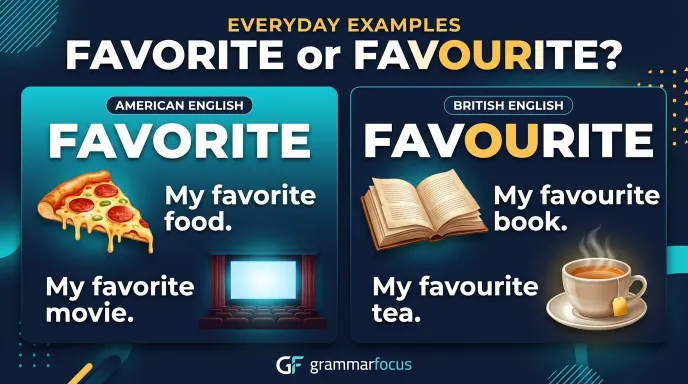
Everyday Examples of Favorite or Favourite
These examples show how to use both spellings naturally in everyday writing.
Everyday Conversation
- Chocolate cake is my favorite dessert.
- What is your favourite song?
- My favorite season is autumn.
- That is my favourite place to relax.
Emails and Messages
- My favorite part of the trip was visiting the museum.
- Could you share your favourite book with me?
- This is my favorite option for the project.
- The blue design is our favourite choice.
School and Formal Writing
- The author is one of my favorite writers.
- The novel became a favourite among young readers.
- This method is my favorite approach to solving the problem.
- The painting remains a favourite example of the artist’s work.
Social Media and Reviews
- This is my favorite picture from the holiday.
- One of my favourite films is available to stream now.
- That café serves my favorite coffee.
- This has quickly become a favourite destination for visitors.
Which Spelling Should You Use?
Your choice should depend on your audience and the spelling style you want to follow.
- Use favorite for American readers, US publications, and American English assignments.
- Use favourite for British readers and publications that follow British spelling.
- For international content, select the spelling that suits your main audience and remain consistent.
If you are writing for a specific website, school, or organization, check its style guide first. Consistency matters more than choosing one spelling over the other.
Key Takeaways
- Favorite is the standard American English spelling.
- Favourite is the standard British English spelling.
- Both words have the same meaning and pronunciation.
- The word can function as a noun or an adjective.
- Choose one spelling style and use it consistently.
Frequently Asked Questions
Q1. Is it favorite or favourite?
Answer. Both spellings are correct. Favorite is used in American English, while favourite is preferred in British English.
Q2. What does favorite or favourite mean?
Answer. It means a person, thing, or activity that someone likes or prefers more than others.
Q3. Is favourite British or American?
Answer. Favourite is the standard British English spelling. American English generally uses favorite.
Q4. Why does favorite have no “u”?
Answer. American English spelling commonly omits the u in words such as favorite, color, and honor. British English usually retains it.
Q5. Is favorite correct in British English?
Answer. Favorite is widely understood, but favourite is the preferred spelling in standard British English. Follow the spelling conventions of your audience or publication.
Q6. Is favourite correct in American English?
Answer. Americans will understand favourite, but favorite is the standard American spelling. Use favorite when following US English conventions.
Q7. Is favorite a noun or an adjective?
Answer. Favorite can be both a noun and an adjective. As a noun, it refers to a person or thing someone likes best. As an adjective, it describes something especially liked.
Q8. What is the plural of favorite or favourite?
Answer. The plurals are favorites in American English and favourites in British English.
Conclusion
Favorite is the American English spelling, while favourite is the British English spelling. Both have the same meaning and can describe something or someone you like best.
Choose the spelling that matches your readers or writing style. The key is to stay consistent throughout your article or document.
Learn More About Grammar:
- Modeled or Modelled: Which Spelling Should You Use?
- Somber or Sombre? The Simple Rule You Need to Know!
- Sees or See’s: The One Grammar Mistake You Must Avoid! [2026]

I’m Elena Cooper, an English grammar writer with 6 years of experience explaining grammar, punctuation, sentence structure, word usage, and common English mistakes. I create clear, practical, and easy-to-follow content that helps readers understand confusing grammar rules and use English accurately and confidently.