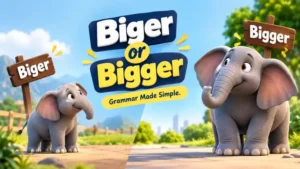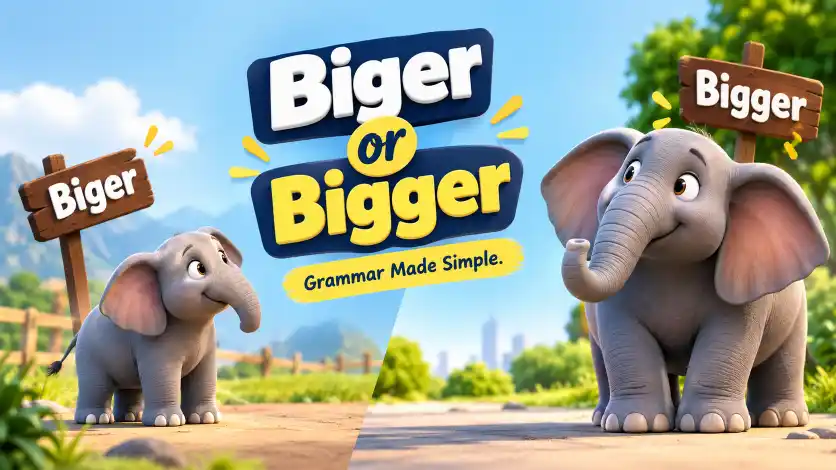
The correct spelling is bigger, not biger. Bigger is the comparative form of big, meaning “larger in size, amount, degree, or importance.” The spelling biger is a common mistake because the word is pronounced with one clear g sound, but standard English spelling requires two g’s.
For example, you can say, “This house is bigger than our old house.” The word bigger is used when comparing two people, objects, places, amounts, or situations.
It is common in everyday conversations, school writing, emails, and formal English.
This article explains the difference between biger and bigger, the spelling rule behind the double g, pronunciation, meaning, common mistakes, and practical examples.
By the end, you will know exactly when to use bigger and why biger should be avoided.
Biger or Bigger: Quick Answer
Bigger is the correct spelling. Biger is incorrect in standard English.
| Word | Correct or Incorrect? | Meaning | Example |
| Bigger | Correct | Larger than something else | My new room is bigger than my old room. |
| Biger | Incorrect | A misspelling of bigger | I want a biger house. ❌ |
Use bigger when you compare two things:
- This bag is bigger than that bag.
- Her dog is bigger than mine.
- We need a bigger table.
- The problem is becoming bigger.
The simple rule is:
Big + ger = bigger
The final consonant is doubled before adding -er, so big becomes bigger, not biger.
Pronunciation and Word Form
Bigger
- US pronunciation: /ˈbɪɡər/
- UK pronunciation: /ˈbɪɡə/
- Part of speech: Adjective
- Base word: Big
- Comparative form: Bigger
Example:
This box is bigger than the other one.
In American English, the ending may sound like “er” in bigger. In British English, the final r is usually not pronounced unless the next word begins with a vowel sound.
Biger
- Standard pronunciation: Not applicable because biger is not a correct standard English word.
- Word status: Misspelling
Writers may intend to pronounce biger like bigger, but the correct written form is always bigger.
Definition and Meaning of Bigger
Bigger means larger than another person, object, place, amount, or situation. It is the comparative form of the adjective big.
The word can describe physical size:
- a bigger car
- a bigger house
- a bigger bag
- a bigger room
It can also describe amounts or levels:
- a bigger salary
- a bigger problem
- a bigger opportunity
- a bigger difference
Sometimes, bigger describes importance, influence, or seriousness rather than physical size.
Examples of Meaning
- Physical size
This apple is bigger than that one. - Amount
The company needs a bigger budget. - Importance
We have a bigger issue to discuss. - Opportunity
This job may offer bigger opportunities. - Degree or intensity
The second wave caused a bigger impact.
The meaning depends on the context, but the central idea is always comparison: one thing is greater or larger than another.
The Spelling Rule: Why Big Becomes Bigger
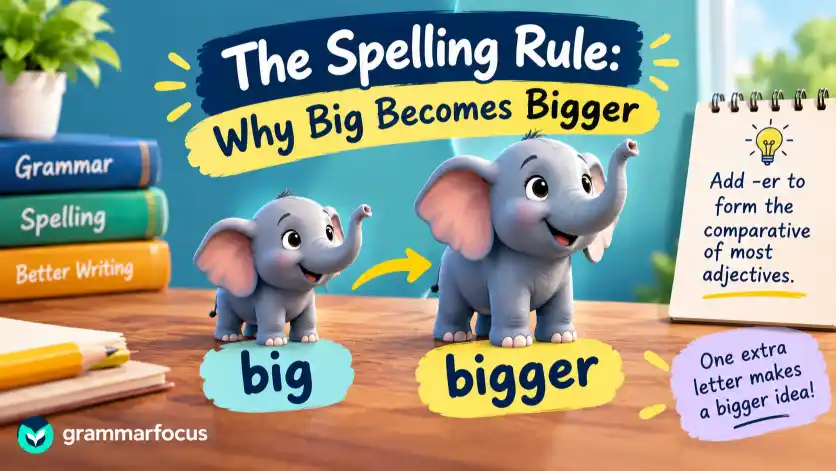
The word bigger follows an important English spelling rule.
When a one-syllable adjective ends in:
- one vowel
- followed by one consonant
the final consonant is usually doubled before adding -er or -est.
The word big has this pattern:
- b = consonant
- i = vowel
- g = consonant
Therefore, the final g is doubled:
- big + er = bigger
- big + est = biggest
Similar Examples
| Base Word | Comparative | Superlative |
| big | bigger | biggest |
| hot | hotter | hottest |
| thin | thinner | thinnest |
| sad | sadder | saddest |
| wet | wetter | wettest |
| fit | fitter | fittest |
The same spelling pattern explains why bigger contains two g’s.
Why Biger Is Incorrect
The spelling biger removes one of the required g’s. Although it may look shorter, it does not follow the standard spelling rule.
Incorrect:
My brother is biger than me.
Correct:
My brother is bigger than me.
Bigger in British English and American English
The spelling bigger is the same in both British English and American English.
| English Variety | Correct Spelling | Example |
| British English | bigger | This room is bigger than mine. |
| American English | bigger | This room is bigger than mine. |
There is no standard British spelling biger and no standard American spelling biger.
The pronunciation may differ slightly:
- American English: /ˈbɪɡər/
- British English: /ˈbɪɡə/
However, the written form remains bigger in both varieties.
When Should You Use Bigger?
Use bigger when comparing two things and showing that one is larger, greater, or more important.
1. Comparing Physical Objects
- This television is bigger than the old one.
- We need a bigger suitcase.
- The blue car is bigger than the red car.
2. Comparing People or Animals
- My brother is bigger than me.
- That horse is bigger than the other horse.
- The older dog has bigger paws.
3. Comparing Places
- London is bigger than many towns.
- They moved into a bigger apartment.
- We need a bigger classroom for the students.
4. Comparing Amounts
- The second bill was bigger than the first.
- She received a bigger payment this month.
- The business made a bigger profit this year.
5. Comparing Problems or Opportunities
- This is a bigger problem than we expected.
- The new project offers a bigger opportunity.
- The mistake had a bigger effect than we thought.
Common Mistakes with Biger and Bigger
Mistake 1: Writing Biger With One G
Incorrect:
We need a biger room.
Correct:
We need a bigger room.
The comparative form of big requires a double g.
Mistake 2: Confusing Bigger With Biggest
Bigger compares two things. Biggest usually describes the largest among three or more things.
Examples:
- My house is bigger than yours.
- This is the biggest house on the street.
Use bigger for a comparison between two items. Use biggest for the highest degree.
Mistake 3: Using Bigger Without a Clear Comparison
The word bigger often appears with than when the comparison is stated.
Example:
This box is bigger than that box.
However, bigger can also be used without than when the comparison is understood.
Example:
We need a bigger box.
The listener understands that the new box should be larger than the current one.
Mistake 4: Adding Only One G in Other Forms
The same doubling rule applies to related forms:
- big → bigger
- big → biggest
Incorrect:
- biger
- bigest
Correct:
- bigger
- biggest
Remember that both comparative and superlative forms keep the double g.
Bigger in Everyday Writing
The word bigger is common in everyday English. People use it when discussing size, plans, prices, goals, responsibilities, and changes.
Conversations
- Can we get a bigger table?
- Your new phone is bigger than mine.
- I need a bigger bag for my books.
- This room feels bigger with the furniture removed.
Emails
- We may need a bigger meeting room.
- Please send me a bigger version of the image.
- The team is looking for a bigger office.
- We should prepare a bigger budget for the project.
School Writing
- A blue whale is bigger than most other animals.
- The second paragraph has a bigger impact.
- Bigger cities often have more transport options.
- The experiment produced a bigger result than expected.
News and Formal Writing
- The company announced a bigger investment.
- The new policy created a bigger discussion.
- The city is planning a bigger transport network.
- The project could bring bigger benefits to the community.
Bigger With Common Grammar Patterns
Bigger Than
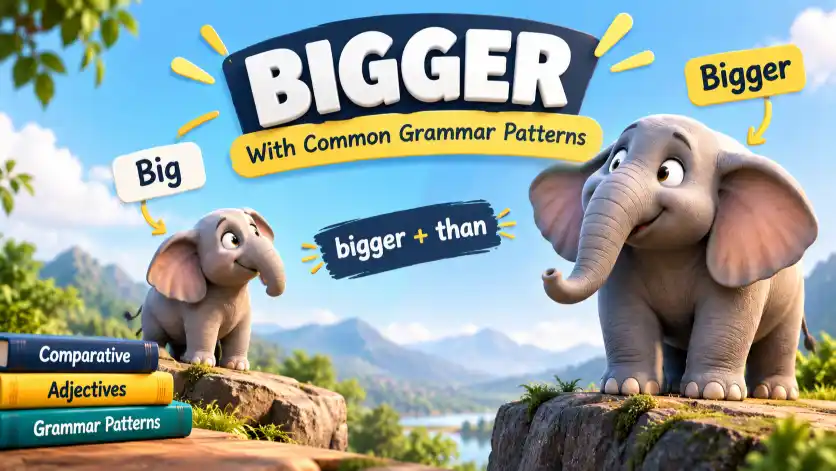
The most common pattern is:
Subject + be + bigger than + comparison
Examples:
- This house is bigger than ours.
- My school is bigger than your school.
- The new screen is bigger than the old screen.
- This problem is bigger than we expected.
A Bigger
Use a bigger before a singular countable noun.
Examples:
- We need a bigger room.
- She bought a bigger car.
- They want a bigger house.
- I ordered a bigger pizza.
Bigger and Bigger
Use bigger and bigger to describe continuous growth or change.
Examples:
- The crowd became bigger and bigger.
- Her business is getting bigger and bigger.
- The noise grew bigger and bigger.
- The problem became bigger and bigger over time.
Much Bigger
Use much bigger to emphasize a large difference.
Examples:
- This building is much bigger than the old one.
- The new project is much bigger than we planned.
- His new office is much bigger than his previous office.
Slightly Bigger
Use slightly bigger when the difference is small.
Examples:
- This shirt is slightly bigger than that one.
- Choose the slightly bigger box.
- The second room is slightly bigger.
Bigger vs. Big vs. Biggest
These three words are related, but they do not have the same use.
| Word | Form | Use | Example |
| Big | Positive | Describes size or degree | This is a big house. |
| Bigger | Comparative | Compares two things | This house is bigger than mine. |
| Biggest | Superlative | Describes the largest in a group | This is the biggest house here. |
Big
Use big when you are describing something without making a direct comparison.
They live in a big house.
Bigger
Use bigger when one thing is larger than another.
Their new house is bigger than their old house.
Biggest
Use biggest when something is the largest or greatest in a group.
Their house is the biggest on the street.
A useful memory pattern is:
Big → Bigger → Biggest
How to Remember the Correct Spelling
You can remember bigger with this simple sentence:
Big gets bigger with two G’s.
Another memory trick is to connect the spelling with biggest:
- big
- bigger
- biggest
Both bigger and biggest contain gg.
You can also remember the spelling rule through the word pattern:
One short vowel + one final consonant = double the final consonant before -er.
For big:
- short vowel: i
- final consonant: g
- comparative ending: -er
- result: bigger
Practice: Choose Biger or Bigger
Choose the correct word in each sentence.
Q1. This room is ___ than the kitchen.
- biger
- bigger
Correct answer: Bigger
This room is bigger than the kitchen.
Q2. We need a ___ box.
- biger
- bigger
Correct answer: Bigger
We need a bigger box.
Q3. The problem became ___ after the meeting.
- biger
- bigger
Correct answer: Bigger
The problem became bigger after the meeting.
Q4. Her new car is ___ than her old car.
- biger
- bigger
Correct answer: Bigger
Her new car is bigger than her old car.
Q5. The company needs a ___ office.
- biger
- bigger
Correct answer: Bigger
The company needs a bigger office.
Frequently Asked Questions About Biger or Bigger
Q1. Is “biger” a correct English word?
Answer: No. Biger is a misspelling. The correct word is bigger, with two g’s.
Q2. Why does bigger have two G’s?
Answer: The final consonant in big is doubled before adding -er. Therefore, big + er becomes bigger.
Q3. Is bigger the comparative form of big?
Answer: Yes. Bigger is the comparative form of big. It is used to compare two things.
Example:
This bag is bigger than that bag.
Q4. Is “bigger” the same as “biggest”?
Answer: No. Bigger compares two things, while biggest usually describes the largest among three or more things.
Example:
My car is bigger than yours.
This is the biggest car in the showroom.
Q5. Does British English use “biger”?
Answer: No. British English uses bigger, just like American English. The spelling does not change between the two varieties.
Q6. Can I use bigger without than?
Answer: Yes. You can use bigger without than when the comparison is understood.
Example:
We need a bigger room.
The sentence means that the room should be larger than the current room.
Q7. What is the superlative form of bigger?
Answer: The superlative form is biggest. The complete pattern is:
Big → Bigger → Biggest
Q8. What is an easy way to remember bigger?
Answer: Remember this phrase:
Big gets bigger with two G’s.
This helps you avoid the incorrect spelling biger.
Conclusion: Biger or Bigger?
The correct spelling is bigger. The form biger is incorrect because the final g in big must be doubled before adding -er.
Use bigger when comparing two people, objects, places, amounts, or situations. Remember the complete word family:
Big → Bigger → Biggest
The easiest rule is:
Big gets bigger with two G’s.
Whenever you need the comparative form of big, write bigger, never biger.
Learn More About Grammar:
- Leasor or Lessor: Which Spelling Is Correct?
- Resetted or Reset? The Grammar Mistake Everyone Makes (2026)
- Licensed vs Licenced: Stop Getting This Wrong (2026)
- Happiness or Happyness? The Correct Spelling Explained (2026)

I’m Alex Morgan, an American English writer with 6 years of experience exploring grammar, punctuation, sentence structure, and everyday English usage. I enjoy turning confusing grammar rules into clear, practical explanations that help readers write and communicate with confidence.