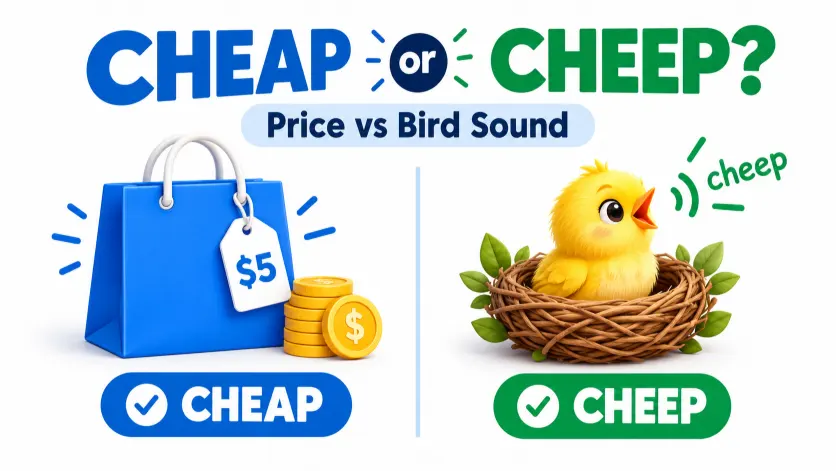
Cheap or cheep? Cheap means costing little money or being inexpensive, while cheep means the short, high-pitched sound made by a young bird. Both are correct English words, but they have different meanings and uses.
If you are writing about prices, shopping, or saving money, you need cheap. If you are describing a baby bird’s sound, you need cheep.
These two words often confuse English learners because they sound alike in many varieties of English.
They are homophones, which means they have the same pronunciation but different spellings and meanings. A single letter can change the meaning of a sentence completely.
For example, “I found a cheap hotel” means the hotel costs little money. However, “I heard a bird cheep” describes a bird making a small, high-pitched sound. The difference is easy to understand once you connect each spelling with its meaning.
In this guide, you will learn the definitions, pronunciation, origins, common mistakes, and practical examples of cheap and cheep. Let’s begin with the simple answer.
Cheap or Cheep: Quick Answer
Cheap and cheep are both correct words, but they do not mean the same thing.
| Word | Meaning | Example |
| Cheap | Inexpensive or costing little money | This shirt is cheap. |
| Cheep | A short, high-pitched sound made by a young bird | The baby bird began to cheep. |
When to use cheap
Use cheap when you are talking about:
- Low prices.
- Inexpensive products.
- Affordable services.
- Something that costs little money.
- A person or action that seems unfair or ungenerous, depending on context.
Examples:
- I bought a cheap phone.
- This restaurant serves cheap meals.
- He found a cheap flight to London.
When to use cheep
Use cheep when you are talking about:
- A baby bird’s sound.
- The short, high-pitched call of a small bird.
- A bird making a series of small sounds.
Examples:
- The chicks began to cheep.
- I heard a soft cheep outside my window.
- The baby bird cheeped for food.
Memory tip: Cheap is about money. Cheep is about birds.
Quick Comparison Table
| Version | Meaning | Correct? | Region | Example |
| Cheap | Inexpensive or low-priced | Yes | British, American, Canadian, Australian, and international English | This bag is cheap. |
| Cheep | A short, high-pitched bird sound | Yes | British, American, Canadian, Australian, and international English | The chick began to cheep. |
| Cheep | Inexpensive | No | Not standard English for this meaning | This phone is cheep. |
| Cheap | A bird sound | No | Not standard English for this meaning | I heard a cheap from the nest. |
Important spelling rule
There is no standard British-versus-American spelling change between cheap and cheep.
Both words are correct, but they must be used in the right context.
Pronunciation and Word Form
Cheap and cheep are pronounced the same in standard English. They differ in spelling and meaning, not in their usual pronunciation.
Cheap
| Feature | Details |
| Word | Cheap |
| Part of speech | Adjective |
| US pronunciation | /tʃiːp/ |
| UK pronunciation | /tʃiːp/ |
| Meaning | Inexpensive or costing little money |
Example: This book is cheap.
Cheep
| Feature | Details |
| Word | Cheep |
| Part of speech | Verb and noun |
| US pronunciation | /tʃiːp/ |
| UK pronunciation | /tʃiːp/ |
| Meaning | A short, high-pitched sound made by a young bird |
Example: The chicks cheeped in the nest.
Are cheap and cheep homophones?
Yes. Cheap and cheep are homophones because they have the same pronunciation but different meanings and spellings.
For example:
- Cheap: The shoes are cheap.
- Cheep: The chicks cheep loudly.
The sound is the same, but the meaning comes from the context.
What Does Cheap Mean?
Cheap is an adjective that usually means costing little money. It describes something with a low price compared with other similar things.
For example:
I bought a cheap jacket for winter.
This sentence means the jacket did not cost much money.
Cheap as an adjective
Cheap is commonly used to describe products, services, and experiences.
Examples:
- A cheap laptop.
- A cheap hotel.
- Cheap food.
- Cheap tickets.
- A cheap car.
These phrases all describe things that cost relatively little.
Cheap can have a negative meaning
Cheap does not always mean good value. Sometimes it suggests poor quality or a lack of generosity.
Compare these sentences:
1. The bag is cheap.
This may simply mean the bag costs little money.
2. The bag looks cheap.
This may suggest that the bag appears poorly made or low-quality.
3. He is cheap.
This can mean that he is unwilling to spend money or share expenses fairly. The meaning depends on the situation.
Cheap vs inexpensive
Cheap and inexpensive are often similar, but they can carry different feelings.
| Word | Meaning | Example |
| Cheap | Low in price, sometimes with a negative suggestion | This watch looks cheap. |
| Inexpensive | Low in price, often more neutral or positive | This watch is inexpensive. |
Writing tip: Use inexpensive when you want to describe a low price in a neutral or professional way.
What Does Cheep Mean?
Cheep is a verb and a noun connected with the small, high-pitched sound made by a young bird.
Cheep as a verb
As a verb, cheep means to make a short, high-pitched sound.
Examples:
- The baby birds cheeped in the nest.
- The chicks cheep whenever they are hungry.
- I could hear the birds cheeping outside.
The verb can describe one sound or repeated sounds.
Cheep as a noun
As a noun, a cheep is the sound itself.
Examples:
- I heard a tiny cheep from the nest.
- The room was filled with the cheeps of baby birds.
- A soft cheep came from the garden.
Cheep vs chirp
Cheep and chirp are related, but they are not always interchangeable.
- Cheep: Often suggests a short, high-pitched sound, especially from a young bird.
- Chirp: A broader word for a short bird sound, often associated with repeated calls.
Example:
The baby chicks cheeped while the adult birds chirped in the trees.
This sentence uses both words naturally.
The Origin of Cheap or Cheep
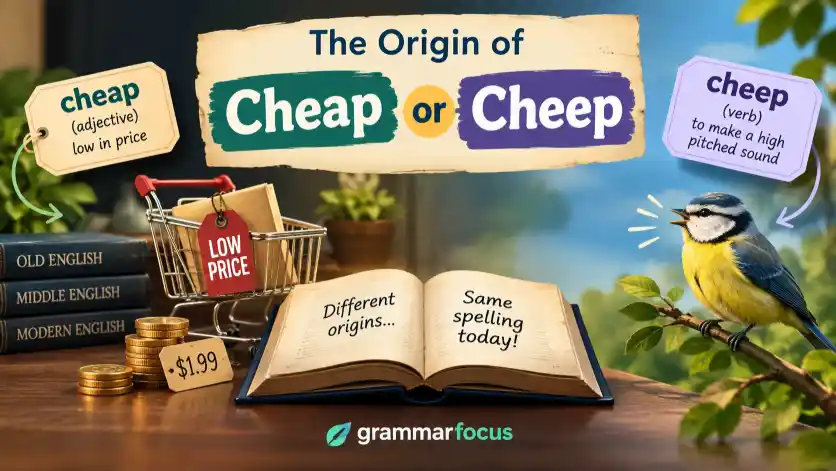
Cheap and cheep have different histories, even though they now sound alike.
The origin of cheap
The word cheap comes from Old English ċēap, which was connected with buying, selling, and trade.
Over time, its meaning developed from the idea of a bargain or a price into the modern sense of something costing little money.
Today, cheap is used in everyday English for prices, products, services, and sometimes behavior.
The origin of cheep
The word cheep developed as a word imitating the sound of a small bird. This type of word is called an onomatopoeia, which means a word that resembles or represents a sound.
The spelling reflects the short, high-pitched sound associated with birds.
Why do they sound the same?
Cheap and cheep became homophones because their pronunciations developed into the same sound in standard English.
Their spellings remain different because they have different histories and meanings.
Important: The fact that two words sound alike does not mean they should be spelled alike.
British English vs American English
Cheap and cheep have the same standard spellings in both British and American English.
Unlike words such as colour and color, there is no standard British spelling cheep that becomes cheap in American English. Both words keep their own spelling in both varieties.
| Word | British English | American English | Example |
| Cheap | Cheap | Cheap | This hotel is cheap. |
| Cheep | Cheep | Cheep | The chick began to cheep. |
Regional differences
The spelling difference between cheap and cheep is not a British-versus-American spelling difference. It is a difference in meaning.
A British writer uses cheap for low prices and cheep for a bird’s sound. An American writer follows the same distinction.
What about pronunciation?
Both words are commonly pronounced /tʃiːp/ in British and American English.
Regional accents can affect speech sounds, but the standard pronunciation of these two words is the same.
Writing advice
For academic writing, business writing, and everyday communication, choose the spelling that matches the intended meaning.
- Talking about prices? Use cheap.
- Talking about bird sounds? Use cheep.
Which Version Should You Use?
The correct word depends on what you want to say, not on the country where you are writing.
United States
Use cheap for low prices and cheep for bird sounds.
Examples:
- I found a cheap apartment.
- The baby birds began to cheep.
United Kingdom
British English follows the same distinction.
Examples:
- This shop sells cheap clothes.
- The chicks cheeped in the nest.
Canada
Canadian English also uses cheap for low prices and cheep for bird sounds.
Australia
Australian English follows the same standard spelling distinction.
International English
For international readers, the easiest approach is to use the word that clearly matches the meaning.
If you are describing a low-cost product, use cheap. If you are describing a bird sound, use cheep.
Academic writing
In academic writing, precision matters. Avoid choosing a word only because it sounds right.
Correct:
The study examined the effects of cheap housing on local communities.
Incorrect meaning:
The study examined the effects of cheep housing on local communities.
The second sentence changes the intended meaning because cheep refers to a bird sound.
Business writing
Use cheap when discussing prices, offers, or costs.
Example:
We are looking for a cheap and reliable supplier.
Use cheep only when the subject is a sound.
Example:
The report describes the cheep of a young bird.
Common Mistakes
Mistake 1: Using cheep for low prices
Incorrect:
This phone is very cheep.
Correct:
This phone is very cheap.
Explanation: Cheap means inexpensive. Cheep refers to a bird sound.
Memory tip: Think of the word cheap as connected to shopping and prices.
Mistake 2: Using cheap for a bird sound
Incorrect:
The baby birds began to cheap.
Correct:
The baby birds began to cheep.
Explanation: Cheep is the verb used for the short, high-pitched sound made by young birds.
Memory tip: Cheep sounds like a tiny bird call.
Mistake 3: Confusing cheap and cheep in the same sentence
Incorrect:
I heard a cheap from the nest.
Correct:
I heard a cheep from the nest.
Explanation: When you mean a sound, use the noun cheep. The adjective cheap describes something that costs little money.
Mistake 4: Assuming the words have different regional spellings
Incorrect assumption:
British English uses cheep for low prices, while American English uses cheap.
Correct explanation:
Both British and American English use cheap for low prices and cheep for bird sounds.
Memory tip: This is a meaning difference, not a regional spelling difference.
Mistake 5: Using cheap when you mean low quality
Example:
This product looks cheap.
This sentence can mean the product looks poorly made, not simply that it costs little money.
Better neutral wording:
This product is inexpensive.
Use inexpensive when you want to focus on price without suggesting poor quality.
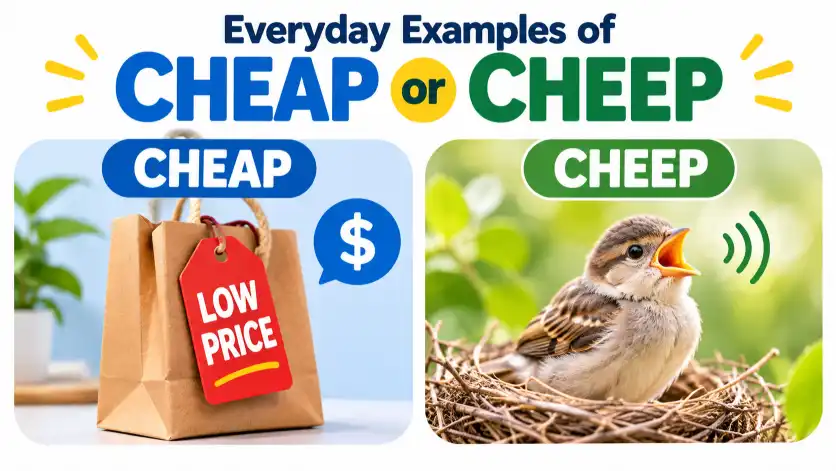
Everyday Examples of Cheap or Cheep
Understanding the difference between cheap and cheep becomes easier when you see how people use these words in real writing.
1. Emails
Cheap is useful when discussing prices, budgets, or affordable options.
Hi Sarah, I found a cheap hotel near the conference center. Would you like me to book it?
Cheep is used when describing a bird sound.
I heard a cheep from the garden this morning. There may be a baby bird nearby.
2. Business Writing
In business writing, cheap often describes a low-cost product or service.
Example:
We are looking for a cheap supplier that can deliver reliable products.
For a more professional tone, you may choose cost-effective or inexpensive when appropriate.
Cheep example:
The wildlife report recorded the cheep of several young birds.
3. News Headlines
News headlines may use cheap when discussing prices or affordability.
Example:
Cheap Flights Help Travelers Save Money
A nature-related headline may use cheep.
Example:
Baby Birds Cheep as Spring Arrives
The spelling depends on the subject of the headline.
4. Blogs
Cheap example:
Looking for a cheap laptop? Compare prices before you buy.
Cheep example:
The soft cheep of birds made the morning feel peaceful.
5. Social Media
Cheap:
Found a cheap pair of sneakers today! 👟
Cheep:
These baby birds are making the cutest little cheeps! 🐣
6. Academic Writing
Academic writing needs accurate word choice.
Cheap example:
Researchers examined the effects of cheap housing on urban communities.
Cheep example:
The researchers recorded the cheep of young birds during the observation period.
7. Daily Conversation
Cheap:
Where can I find a cheap place to eat?
Cheep:
Did you hear that cheep? I think a bird is nearby.
8. Creative Writing
Writers may use both words in a single passage.
The traveler found a cheap room beside the old garden. At dawn, a tiny cheep came from the nest outside the window.
This example shows how two homophones can appear in different contexts without confusion.
Google Trends & Modern Usage
People search for “cheap or cheep” because the two words sound alike and are easy to confuse when writing.
Why do people confuse cheap and cheep?
The main reasons include:
- Both words are pronounced /tʃiːp/.
- They have different spellings.
- Cheap is common in shopping and everyday writing.
- Cheep is less common and is usually linked to birds.
- Spellcheckers may not catch a wrong word if it is spelled correctly.
For example, “This product is cheep” contains a real English word, but it is the wrong word for the intended meaning.
Regional popularity
Cheap is widely used in English-speaking regions because people often discuss prices, shopping, travel, and budgets.
Cheep appears less often in everyday writing because it describes a more specific sound. It is common in nature writing, children’s books, and descriptions of birds.
Modern usage patterns
Modern English uses cheap in several common ways:
- Cheap products.
- Cheap flights.
- Cheap hotels.
- Cheap meals.
- Cheap deals.
Cheep remains connected to bird sounds, especially young birds.
Search intent
A person searching “cheap or cheep” may want to know:
- Which spelling means inexpensive?
- How do you spell cheap correctly?
- Is cheep a real English word?
- Are cheap and cheep homophones?
- What is the difference between cheap and cheep?
The answer is simple: Cheap relates to price. Cheep relates to a bird’s sound.
Exact Google Trends statistics are not included here because no verified trend data has been collected for this keyword.
The usage discussion above describes general English patterns, not measured search-volume results.
Key Takeaways
- Cheap means costing little money.
- Cheep means a short, high-pitched sound made by a bird.
- Both words are pronounced /tʃiːp/.
- Cheap and cheep are homophones.
- Cheap can sometimes suggest poor quality or a lack of generosity.
- Cheep can function as a noun or verb.
- Both British and American English use the same spellings.
- Use context to choose the correct word.
FAQs About Cheap or Cheep
Q1. What is the difference between cheap and cheep?
Answer. Cheap means inexpensive or costing little money. Cheep means a short, high-pitched sound made by a young bird. Both words sound the same in standard English, but their meanings and spellings differ. Use cheap when discussing prices and cheep when describing bird sounds.
Q2. Is cheap the correct spelling for something that costs little money?
Answer. Yes. Cheap is the correct spelling when you mean something costs little money. For example, “I found a cheap restaurant near my home.” You can also use inexpensive or affordable when you want a more neutral or positive description of a low price.
Q3. Is cheep a real English word?
Answer. Yes. Cheep is a real English word. It can be a verb meaning to make a short, high-pitched sound, or a noun referring to that sound. For example, “The baby birds cheeped in the nest.” It is not the standard spelling for something inexpensive.
Q4. Are cheap and cheep homophones?
Answer. Yes. Cheap and cheep are homophones because they have the same pronunciation but different spellings and meanings. Cheap relates to low prices, while cheep relates to a bird’s sound. When you hear either word, the surrounding sentence helps you understand which meaning is intended.
Q5. How do you remember the spelling of cheap?
Answer. Connect cheap with shopping, prices, and money. For example, “This shirt is cheap.” You can also remember that cheap is the spelling used in phrases such as cheap flights, cheap food, and cheap hotels. If you are describing a bird sound, choose cheep instead.
Q6. Is cheap a negative word?
Answer. Cheap can be neutral or negative depending on context. “This book is cheap” may simply mean it costs little money. However, “This product looks cheap” may suggest poor quality. Calling a person cheap can suggest that they are unwilling to spend money or share expenses fairly.
Q7. What is the difference between cheap and inexpensive?
Answer. Cheap and inexpensive can both mean costing little money. Cheap is common in everyday speech but can sometimes suggest poor quality. Inexpensive usually sounds more neutral or positive. For example, “This laptop is inexpensive” focuses on its price without necessarily suggesting that it is poorly made.
Q8. Do British and American English spell cheap and cheep differently?
Answer. No. Both British and American English use cheap for something inexpensive and cheep for a bird sound. These words do not have a standard regional spelling difference. The important distinction is their meaning. Use cheap for prices and cheep for sounds.
Conclusion
Cheap or cheep? The correct spelling depends on the meaning you want to express. Cheap means inexpensive or costing little money.
Cheep describes the short, high-pitched sound made by a young bird. Both words are correct, but they belong in different contexts.
The easiest way to remember the difference is to connect cheap with shopping and cheep with birds. You might buy a cheap phone, find a cheap hotel, or enjoy a cheap meal. A baby bird, however, may cheep from its nest.
These words are homophones, so they sound the same in standard English. Their spelling remains different in British and American English.
When writing emails, essays, business documents, or social media posts, always check the meaning before choosing the spelling.
If you are describing price, use cheap. If you are describing a bird sound, use cheep. For a neutral professional description of low cost, inexpensive or affordable may be a better choice.
Remember: Cheap is about money, and cheep is about birds.
Learn More About Grammar:
- Pavilion or Pavillion? Stop Adding That Extra “L” (2026)
- Biger or Bigger? Know the Correct Spelling (2026)
- Leasor or Lessor: Which Spelling Is Correct?

I’m Elena Cooper, an English grammar writer with 6 years of experience explaining grammar, punctuation, sentence structure, word usage, and common English mistakes. I create clear, practical, and easy-to-follow content that helps readers understand confusing grammar rules and use English accurately and confidently.






3 thoughts on “Cheap or Cheep? Same Sound, Totally Different Meaning (2026)”