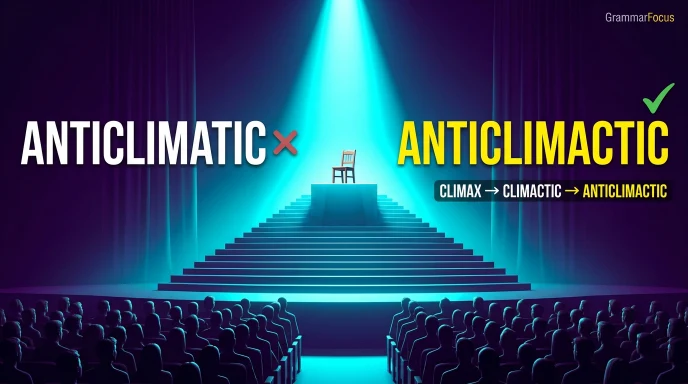
Anticlimactic is the correct spelling when you mean something that is disappointing or less exciting than expected, especially after a build up toward an important or dramatic moment. Anticlimatic is a common spelling mistake.
The confusion usually happens because the correct word contains climactic, which comes from climax.
A climax is the most exciting, important, or intense point of an event, story, or situation. When something is anticlimactic, it does not provide the expected impact after that build-up.
You might use this word when describing a movie ending, a sports event, a surprise, a speech, a competition, or even an everyday situation.
For example, if everyone expects a dramatic announcement but the announcement turns out to be something ordinary, the moment may feel anticlimactic.
The spelling can be tricky because anticlimactic is pronounced smoothly, making it easy to leave out the second c.
However, remembering the connection between climax, climactic, and anticlimactic makes the correct spelling much easier to remember.
Anticlimactic or Anticlimatic: Quick Answer
Anticlimactic is the correct spelling.
It describes something that happens after a build-up but feels less exciting, dramatic, or important than expected.
Anticlimatic is generally considered a misspelling when you intend to use the word anticlimactic.
Example
The movie had an exciting beginning, but the ending was anticlimactic.
Here, the ending was not as powerful or satisfying as the audience expected.
Another example:
Everyone waited for the big announcement, but the result was anticlimactic.
A simple way to remember the spelling is:
climax → climactic → anticlimactic
The correct word keeps the c from climactic.
Anticlimactic vs Anticlimatic: Quick Comparison
| Word | Correct? | Meaning |
| Anticlimactic | Yes | Less exciting or dramatic than expected |
| Anticlimatic | No, generally a misspelling | Usually intended to mean anticlimactic |
The correct spelling is anticlimactic, with climactic inside the word.
anticlimactic ✅
anticlimatic ❌
Pronunciation and Word Form
Anticlimactic
- US pronunciation: /ˌæn.ti.klaɪˈmæk.tɪk/
- UK pronunciation: /ˌæn.ti.klaɪˈmæk.tɪk/
- Part of speech: Adjective
- Example: The final scene was surprisingly anticlimactic.
Anticlimatic
Anticlimatic is generally treated as a misspelling of anticlimactic, so it does not have a separate standard English pronunciation or word form in this usage.
When you want to describe a disappointing or underwhelming ending, use anticlimactic.
Definition and Meaning of Anticlimactic
Anticlimactic is an adjective used to describe something that is less exciting, dramatic, impressive, or satisfying than people expected.
It often refers to a moment that follows a strong build up.
For example:
The audience expected a shocking ending, but the final scene was anticlimactic.
The story created high expectations, but the ending did not match them.
Anticlimactic in Simple English
You can think of anticlimactic as:
A big build-up + a weak or disappointing result = anticlimactic
For example, imagine that a company announces that it will reveal a major secret. Everyone waits eagerly for the announcement. The company finally reveals that it has simply changed its office logo.
The announcement might feel anticlimactic because the result was much less dramatic than expected.
What Does Anticlimactic Mean in a Story?
In storytelling, anticlimactic describes an ending or event that does not deliver the level of excitement or importance that the earlier parts of the story seemed to promise.
A story may gradually build tension and make readers expect a major event. If that event turns out to be ordinary, rushed, or disappointing, the ending can feel anticlimactic.
For example:
The mystery built suspense for ten chapters, but the final explanation was anticlimactic.
The word does not necessarily mean that something is objectively bad. It focuses on the difference between expectation and result.
Anticlimactic vs Disappointing
Anticlimactic and disappointing are related, but they are not exactly the same.
Disappointing means something did not meet your expectations.
Anticlimactic specifically suggests that there was a build-up toward an important or exciting moment, but the final result lacked the expected impact.
Compare:
The restaurant was disappointing.
This simply says the restaurant did not meet expectations.
After hours of waiting for the famous performance, the short show felt anticlimactic.
This sentence emphasizes the build-up and the weak result.
Therefore, something can be disappointing without being anticlimactic.
Anticlimactic vs Climactic
Understanding climactic makes anticlimactic much easier to spell and understand.
Climactic
Climactic describes something related to or forming a climax, the highest or most intense point of an event or story.
The final battle was the climactic scene of the movie.
Anticlimactic
Anticlimactic describes something that fails to provide the expected impact after a build-up.
The final battle was surprisingly anticlimactic.
The two words have opposite ideas:
- Climactic → reaches an important or exciting peak
- Anticlimactic → fails to deliver the expected peak or impact
Why Is Anticlimactic Spelled with “Climactic”?
The spelling comes from the word climax and the adjective climactic.
The basic relationship is:
climax → climactic → anticlimactic
This is important because many people write anticlimatic after hearing the word. They may not realize that climactic is part of the spelling.
Look closely:
anti + climactic = anticlimactic
The correct spelling contains:
c-l-i-m-a-c-t-i-c
So the complete word is:
a-n-t-i-c-l-i-m-a-c-t-i-c
Remembering the base word climactic is one of the easiest ways to avoid the spelling mistake.
Common Mistake: Anticlimatic
One of the most common errors is writing:
The ending was anticlimatic. ❌
The standard spelling is:
The ending was anticlimactic. ✅
The incorrect version leaves out the c in climactic.
Easy Spelling Check
When you are unsure, break the word into two parts:
anti + climactic
That gives:
anticlimactic
This method is more reliable than trying to remember the whole word letter by letter.
Anticlimactic in Everyday Sentences
Here are some simple examples:
- The ending of the movie was anticlimactic.
- The surprise party turned out to be anticlimactic.
- After such a long wait, the announcement felt anticlimactic.
- The final match was unexpectedly anticlimactic.
- Everyone expected an exciting conclusion, but it was anticlimactic.
- The big reveal was rather anticlimactic.
- The ending seemed anticlimactic after all the suspense.
- The event became anticlimactic when the main speaker left early.
How to Use Anticlimactic Correctly
Anticlimactic is usually used when there is a clear difference between what people expect and what actually happens.
The word often describes a moment that should feel important but does not have enough impact.
For example:
We expected the final episode to answer every question, but it felt anticlimactic.
The sentence suggests that the story created strong expectations, but the final result did not match them.
Anticlimactic in Movies and TV Shows
Movies and television shows often create suspense before a major event. If the final reveal is too simple or does not match the build-up, viewers may describe it as anticlimactic.
Examples:
The villain’s defeat was anticlimactic.
The final episode had an anticlimactic ending.
After so much suspense, the reveal felt anticlimactic.
The word can describe the ending itself or the experience of watching it.

Anticlimactic in Real Life Situations
The word is not limited to fiction. It can describe ordinary events too.
Imagine waiting all morning for an important delivery. When it arrives, you discover that the package contains something very ordinary.
You might say:
The whole experience was anticlimactic.
Another example is a long meeting that is expected to end with an important decision but finishes without any major announcement.
The meeting was surprisingly anticlimactic.
In both cases, the expectation was much greater than the final moment.
Anticlimactic in Sports
Sports can also produce anticlimactic moments.
A competition may build excitement for hours, only for the final result to arrive in an unexpectedly ordinary way.
For example:
The championship match ended in an anticlimactic penalty.
Or:
After such a close season, the final game felt anticlimactic.
The word does not mean that the event had no importance. It means that the final moment did not create the level of excitement or drama that people expected.
Anticlimactic in Formal and Informal Writing
Anticlimactic works in both casual and formal English.
Informal Example
That ending was so anticlimactic!
Formal Example
The conclusion was somewhat anticlimactic because it did not resolve the central conflict.
In formal writing, you can use the word when discussing stories, speeches, events, presentations, reports, or other situations involving a noticeable build-up.
Common Grammar Patterns with Anticlimactic
Anticlimactic is an adjective, so it commonly appears before a noun or after a linking verb.
Before a Noun
an anticlimactic ending
an anticlimactic conclusion
an anticlimactic result
an anticlimactic finish
After a Linking Verb
The ending was anticlimactic.
The final scene seemed anticlimactic.
The announcement felt anticlimactic.
These patterns make the word easy to use in everyday sentences.
Anticlimactically: The Adverb Form
The adverb anticlimactically can be used when you want to describe how something happens.
For example:
The story ended anticlimactically.
This means the story ended in a way that lacked the expected dramatic impact.
Another example:
The investigation concluded anticlimactically after months of suspense.
The adverb is less common than the adjective anticlimactic, but it is grammatically possible.
Anticlimactic vs Anti Climactic
You may sometimes see anti climactic with a hyphen, particularly in older or informal writing.
However, anticlimactic as one word is the standard modern spelling.
For current general writing, use:
anticlimactic ✅
Rather than:
anti-climactic ⚠️
The one-word form is the safest choice for modern English.
How to Remember the Correct Spelling
A useful spelling strategy is to remember the middle of the word rather than the whole word.
Start with:
climax
Then remember:
climactic
Finally add:
anti + climactic
The result is:
anticlimactic
This prevents the common mistake of writing anticlimatic.
A quick mental check is:
Does your spelling contain “climactic”?
If it does, you have the correct form:
anti + climactic = anticlimactic
More Examples of Anticlimactic
Here are additional examples from different situations:
- The highly anticipated announcement was anticlimactic.
- The final chapter felt anticlimactic compared with the earlier chapters.
- The team’s victory was followed by an anticlimactic celebration.
- The presentation ended on an anticlimactic note.
- After building suspense for weeks, the announcement seemed anticlimactic.
- The final scene was intentionally anticlimactic.
- The long-awaited meeting turned out to be anticlimactic.
- The ending was not terrible, but it was definitely anticlimactic.
- The dramatic build-up made the simple conclusion seem anticlimactic.
- The audience expected a major revelation, so the small announcement felt anticlimactic.
FAQs About Anticlimactic or Anticlimatic
Q1. Is anticlimactic or anticlimatic correct?
Answer. Anticlimactic is the standard correct spelling. Anticlimatic is generally a misspelling of anticlimactic.
Q2. What does anticlimactic mean?
Answer. Anticlimactic describes something that is less exciting, dramatic, impressive, or satisfying than expected, especially after a strong build-up.
Q3. Why do people spell anticlimactic as anticlimatic?
Answer. People often leave out the c because the pronunciation can make the spelling difficult to hear clearly. Remembering climactic helps prevent this mistake.
Q4. Is anticlimactic a positive or negative word?
Answer. Anticlimactic usually expresses disappointment or a lack of expected impact, although the exact feeling depends on the context. An intentionally anticlimactic ending, for example, may be a deliberate creative choice.
Q5. Can anticlimactic describe a person?
Answer. Anticlimactic normally describes an event, result, ending, moment, or experience rather than a person’s general character. It can describe something a person does if that action creates an unexpectedly weak ending.
Q6. What is the opposite of anticlimactic?
Answer. Depending on the context, words such as climactic, dramatic, exciting, or satisfying can express the opposite idea. Climactic is especially closely related because it describes a point that reaches an important or intense peak.
Q7. What is the adverb form of anticlimactic?
Answer. The adverb form is anticlimactically. For example: “The story ended anticlimactically.”
Q8. Is anticlimactic one word?
Answer. Yes. Anticlimactic is normally written as one word in modern English. The form anti-climactic may appear in some writing, but the one-word spelling is the standard choice.
Conclusion
Anticlimactic is the correct spelling when you want to describe something that falls short of the excitement, drama, or impact people expected after a build-up.
The incorrect spelling anticlimatic is easy to make because the middle of the word can be difficult to hear. The best way to remember the correct spelling is to connect it with climactic:
climax → climactic → anticlimactic
Use anticlimactic when describing an ending, result, announcement, event, or moment that feels weaker than expected.
So, when choosing between the two spellings, write:
Anticlimactic ✅
and avoid:
Anticlimatic ❌
Learn More About Grammar:
- Debur vs. Deburr: Correct Spelling, Meaning & Usage
- Rewinded or Rewound: A Simple Grammar Guide for 2026
- Cheap or Cheep? Same Sound, Totally Different Meaning (2026)

I’m Elena Cooper, an English grammar writer with 6 years of experience explaining grammar, punctuation, sentence structure, word usage, and common English mistakes. I create clear, practical, and easy-to-follow content that helps readers understand confusing grammar rules and use English accurately and confidently.








3 thoughts on “Anticlimactic or Anticlimatic: Which Spelling Is Correct?”