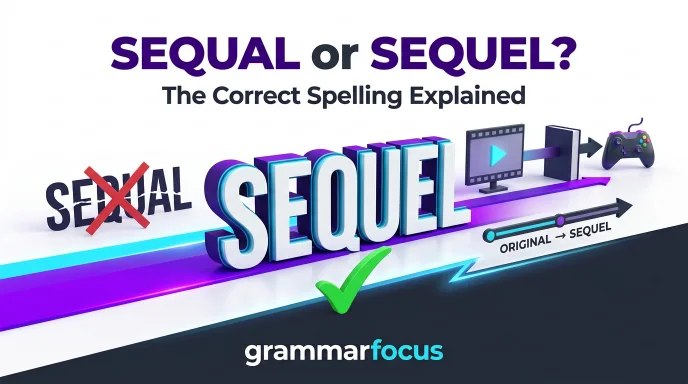
Sequel is the correct spelling, while sequal is a common spelling mistake. A sequel is a story, film, book, game, or other work that continues the events of an earlier work.
The word appears frequently in entertainment, publishing, gaming, and everyday conversation, so knowing the correct spelling helps you write clearly and professionally.
The confusion usually comes from pronunciation. When people hear sequel, the final sound can make sequal seem like a logical spelling.
English, however, does not always spell words exactly as they sound. In this case, sequel is the standard spelling in both American and British English.
You may encounter sequal in online comments, social media posts, informal messages, or other user generated writing.
Seeing it frequently does not make it a standard alternative. If you are writing an article, review, school assignment, email, or professional document, sequel is the form to use.
This guide explains the difference between sequal and sequel, their meanings, pronunciation, word forms, origins, spelling pattern, and common mistakes.
Sequal or Sequel: Quick Answer
Sequel is the correct word. Sequal is a misspelling.
A sequel is a work that continues or follows an earlier story, especially a movie, book, television series, or video game.
Correct:
- The studio announced a sequel to the movie.
- The author is writing a sequel to her bestselling novel.
- Fans are waiting for the sequel.
Incorrect:
- The studio announced a sequal to the movie.
- The author is writing a sequal.
- Fans are waiting for the sequal.
Quick Comparison
| Word | Status | Meaning | Example |
| Sequel | ✅ Correct | A continuation of an earlier work or story | The sequel was released two years later. |
| Sequal | ❌ Incorrect | Common misspelling of sequel | Avoid this spelling in standard English. |
The key point is simple: always use sequel in standard English.
Pronunciation and Word Form
Sequel
US pronunciation: /ˈsiːkwəl/
UK pronunciation: /ˈsiːkwəl/
Part of speech: Noun
Example:
The sequel continues the story of the original film.
The first syllable sounds like “see,” followed by a sound similar to “kwəl.”
Sequal
US pronunciation: Not a standard English word
UK pronunciation: Not a standard English word
Part of speech: None in standard English
Example:
Sequal is a misspelling of sequel.
Because sequal is not the standard spelling, it does not have a separate standard pronunciation or grammatical role. Writers normally intend sequel when they use this form.
Definition and Meaning of Sequel
A sequel is something that follows an earlier work and continues its story, characters, events, or fictional world.
The word is especially common in entertainment.
Sequel in Movies
A film sequel continues the story introduced in an earlier movie.
For example:
- The director is planning a sequel to the successful film.
- The sequel introduces several new characters.
- Many fans preferred the sequel to the original.
A sequel does not necessarily repeat the exact same plot. It usually builds on what happened previously.
Sequel in Books
The term also applies to novels and other written works.
For example:
- The writer published a sequel to her first novel.
- Readers are excited about the sequel.
- The sequel picks up several years after the first book.
Sequel in Video Games
Video games can have sequels too.
For example:
- The developers released a sequel with new characters.
- The sequel adds several new features.
- Players are waiting for the next sequel.
The meaning remains the same: the newer work follows an earlier one.
Sequel vs. Original
Understanding sequel becomes easier when you compare it with original.
The original is the earlier work that introduces the story, characters, or concept. A sequel comes afterward and continues from that earlier work.
For example:
Original: A movie introduces a fictional hero and establishes the main story.
Sequel: A later movie continues that hero’s story.
This relationship can be described in a simple pattern:
Original → Sequel
For example:
- The first film was the original.
- The second film was its sequel.
A sequel can sometimes become more successful than the original, but the word itself only describes its position in the series. It does not automatically mean the later work is better or worse.
Why Is “Sequal” Wrong?
The spelling sequal looks reasonable at first glance because English has many words ending in -al. However, the standard spelling is sequel, with the letters -quel at the end.
The correct structure is:
S + E + Q + U + E + L
So the word is:
SEQUEL ✅
Not:
SEQUAL ❌
One useful detail is the letter Q. In sequel, the q is followed by u, creating the familiar /kw/ sound.
The spelling can feel unusual because the ending is not pronounced exactly as it looks. That difference between spelling and pronunciation is one reason learners sometimes write sequal.
Common Mistakes With Sequel
Mistake 1: Writing “Sequal”
The most common error is replacing -quel with -qual.
❌ The sequal will be released next year.
✅ The sequel will be released next year.
Mistake 2: Treating Sequal as an Alternative Spelling
Sequal is not a standard British or American spelling variant. It should not be treated like pairs such as colour/color or centre/center.
There is only one standard spelling:
sequel
Mistake 3: Using “Sequel” for Any Later Event
A sequel normally refers to a work that continues an earlier work. It is not simply another event that happens later.
For example:
❌ The meeting tomorrow is the sequel to today’s meeting.
✅ The new movie is a sequel to the original film.
The word is most natural when discussing stories, creative works, or related narrative productions.
Mistake 4: Confusing Sequel With Sequence
Sequel and sequence look somewhat similar, but their meanings are different.
A sequel continues an earlier work.
A sequence is a series of related events, actions, or things arranged in a particular order.
For example:
- The movie has a sequel.
- The opening sequence is very dramatic.
These words should not be used interchangeably.
Sequel in Different Contexts
The word sequel appears in several areas of modern English.
Movies and Television
This is one of the most common uses.
- The sequel is expected to continue the original storyline.
- The television series received a sequel.
Books and Literature
Authors may continue a successful story in a later book.
- The sequel follows the same main character.
- Readers have been waiting for the sequel.
Video Games
Gaming companies frequently use the term when a later game continues an earlier title.
- The sequel introduces a larger world.
- The developers confirmed a sequel.
General Storytelling
The word can also be used more broadly for something that continues an earlier narrative or work.
- The novel’s sequel explores the character’s later life.
In each context, the central idea remains continuation of an earlier work.
Sequel in Everyday English
You may hear or read sequel in casual conversations as well as formal writing.
Common expressions include:
- a sequel to a movie
- a sequel to a novel
- the movie’s sequel
- the highly anticipated sequel
- a direct sequel
- a sequel series
- the upcoming sequel
- the original and its sequel
Examples:
- Did you watch the sequel?
- I liked the original more than the sequel.
- The sequel comes out next summer.
- They’re discussing plans for a sequel.
- The sequel follows the same characters.
These patterns make sequel easy to use naturally once the spelling is remembered.
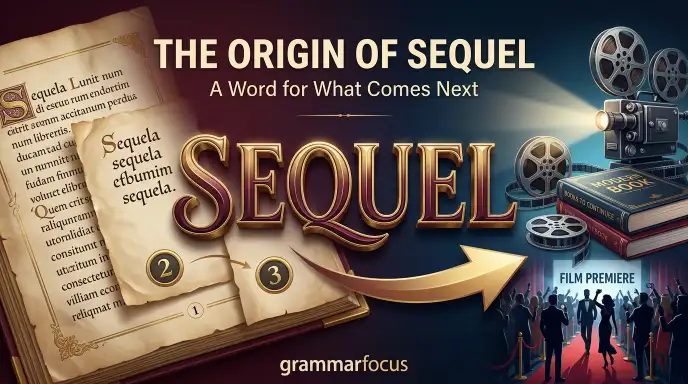
The Origin of Sequel
The word sequel has an interesting connection with Latin.
It comes from the Latin word sequela, meaning something that follows or comes afterward. The word entered English through French and developed into the modern English sequel.
Its original idea is closely connected to the meaning we use today: something that follows something else.
Over time, English speakers began using sequel especially for a literary work that continues an earlier story.
Later, the term became extremely common in the entertainment industry, particularly for movies, television programs, and video games.
This history also helps explain why the spelling is sequel rather than sequal. The modern form developed from older forms connected with sequela, not from the English word equal.
Sequel, Prequel, and Follow Up
These three terms are related, but they describe different relationships between works.
Sequel
A sequel comes after an earlier work and generally continues its story.
Original → Sequel
Example:
The second movie is a sequel to the first.
Prequel
A prequel tells a story that takes place before an earlier work, even though the prequel itself may have been released later.
Prequel → Original
Example:
The new film is a prequel that explores the character’s early life.
Follow Up
Follow up is a broader expression. It can describe something that comes after an earlier work, event, discussion, or development.
Example:
The author published a follow-up to her first novel.
A follow-up does not always have to be a direct continuation of the same fictional story. That makes it broader than sequel.
Direct Sequel vs. Standalone Continuation
Not every later work uses the same storytelling structure.
A direct sequel usually continues events from the previous story and may bring back major characters, locations, or unresolved conflicts.
A later work can also exist in the same fictional world without continuing the exact same storyline.
In such cases, terms such as spin off, follow up, or related work may be more appropriate depending on the project.
For example, imagine a fictional series:
Book 1: A detective solves a major case.
2: The same detective investigates another case.
Book 2 can function as a sequel because it continues the character’s story.
If another book follows a completely different character in the same fictional world, it may instead be described as a spin off.
These distinctions are useful when writing reviews or describing books, films, and games accurately.
Useful Expressions With Sequel
Several expressions commonly appear with sequel.
Sequel to
This is one of the most useful patterns.
The film is a sequel to the original.
She is writing a sequel to her first novel.
Sequel in a Series
When several works belong to one continuing story, writers may describe a particular title as part of a series.
The game is the third sequel in the franchise.
However, third installment is often a clearer choice when describing a numbered entry in a series.
Highly Anticipated Sequel
This expression is common in entertainment writing.
Fans are waiting for the highly anticipated sequel.
Direct Sequel
Use this phrase when a new work directly continues the previous story.
The studio described the movie as a direct sequel.
Sequel Series
A television project that continues or develops an earlier story may be described using this expression.
The sequel series brings several familiar characters back.
Sequel in Reviews and Entertainment Writing
The word appears frequently in movie reviews, book reviews, gaming articles, and entertainment news.
Writers may discuss if a sequel expands the original story, introduces new characters, changes the setting, or develops an existing character.
For example:
- The sequel expands the fictional world.
- This sequel introduces a new antagonist.
- The latest installment builds on ideas from the original.
- The sequel takes the story in a different direction.
- The new entry connects several earlier plot points.
These sentences work well because they describe specific features of the later work instead of using sequel as a vague synonym for “another one.”
Sequel in Formal and Academic Writing
Sequel is perfectly acceptable in formal English when the context calls for it.
You might use it in:
- literary analysis
- film criticism
- media studies
- publishing discussions
- cultural writing
- academic research about storytelling
For formal writing, provide enough context for the reader to understand which work you mean.
Instead of:
The sequel was successful.
You could write:
The novel’s sequel continues the protagonist’s development several years after the first book.
The second version gives the reader more useful information and makes the relationship between the works clear.
How to Remember the Correct Spelling
A simple spelling trick can help you remember sequel.
Focus on the middle and ending:
SE + QUEL
The word contains QU, not QUA.
Think:
SEQUEL = something that follows
You can also connect it with the word sequence. Both words contain sequ-, although their meanings are different.
A quick visual reminder is:
SEQUEL ✅
SEQUAL ❌
If you are writing about a movie, book, game, or other continuing story, sequel is the spelling you want.
Sequel vs. Sequence: A Closer Look
Although these words look related, they have different jobs in a sentence.
A sequel is a later work that follows an earlier one.
A sequence is an ordered series of events, actions, numbers, or objects.
Compare:
The film received a sequel.
Here, sequel refers to another film.
The events occur in chronological sequence.
Here, sequence refers to the order in which events happen.
The words share historical roots, which helps explain their similar appearance, but replacing one with the other can change the meaning completely.
Frequently Asked Questions
Q1. Is “sequal” ever correct?
Answer. No. Sequal is not the standard spelling in English. The correct form is sequel.
Q2. What does sequel mean?
Answer. A sequel is a later work that follows an earlier work, usually by continuing its story, characters, or fictional world.
Q3. Is sequel American or British English?
Answer. Sequel is standard in both American and British English. There is no separate British spelling such as sequal.
Q4. Why do people spell sequel as sequal?
Answer. The mistake probably comes from the pronunciation and the fact that English spelling is not always predictable from sound. The ending can make sequal look plausible, but sequel is the established spelling.
Q5. What is the opposite of a sequel?
Answer. A sequel is not usually described as having a direct “opposite.” However, prequel is a closely related term for a work whose story takes place before an earlier work.
Q6. What is the difference between a sequel and a prequel?
Answer. A sequel generally continues a previous story, while a prequel tells events that occur earlier in the story’s timeline.
Q7. Can a book have a sequel?
Answer. Yes. A novel can have a sequel that continues its characters, setting, or storyline. Many book series contain multiple connected installments.
Q8. How do I spell sequel correctly?
Answer. Spell it S-E-Q-U-E-L. Remember the -quel ending rather than the incorrect -qual ending.
Conclusion
Sequel is the correct spelling, while sequal is a misspelling that should be avoided in standard English.
The word sequel refers to a later work that follows an earlier one, especially when it continues a story or develops its characters and fictional world.
The spelling becomes easier to remember when you focus on SEQU and the ending quel.
It is also helpful to separate sequel from related terms such as prequel, follow up, spin off, and sequence, because each has a different meaning.
If you are writing a movie review, discussing a novel, describing a video game, or preparing a formal article, sequel is the form you should use.
Correct: The sequel continues the original story.
Incorrect: The sequal continues the original story.
Learn More About Grammar:
- Anticlimactic or Anticlimatic: Which Spelling Is Correct?
- Inexcusable or Unexcusable: Which Word Is Correct?
- Cemetery or Cementery: Which Spelling Is Correct?

I’m Elena Cooper, an English grammar writer with 6 years of experience explaining grammar, punctuation, sentence structure, word usage, and common English mistakes. I create clear, practical, and easy-to-follow content that helps readers understand confusing grammar rules and use English accurately and confidently.






2 thoughts on “Sequal or Sequel? The Spelling Mistake You Don’t Want to Make”