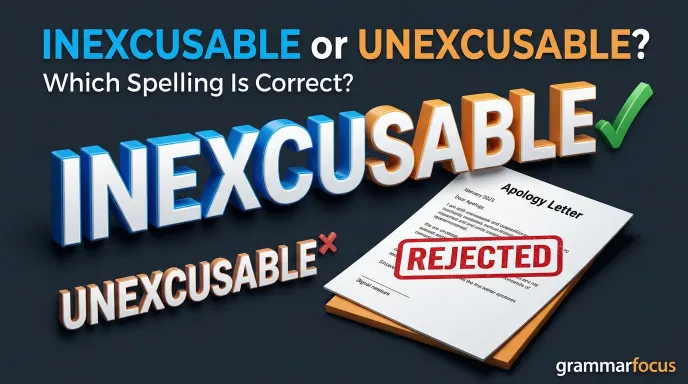
Inexcusable is the standard and widely accepted English word, while unexcusable is generally considered nonstandard or much less common. People often search for “inexcusable or unexcusable” because both forms seem possible.
The confusion comes from the negative prefixes in- and un-, which can both change an adjective into a negative form. However, English does not use these prefixes freely with every word.
Inexcusable means something is not excusable or cannot reasonably be forgiven, accepted, or justified.
For example, “His rude behavior was inexcusable.” The word is common in everyday speech, professional writing, news reports, and formal discussions.
Although some dictionaries record unexcusable, it is far less common in modern standard English, so inexcusable is the safer choice when you want natural, widely accepted usage.
This guide explains the difference between inexcusable and unexcusable, their meanings, pronunciation, origins, spelling patterns, and common mistakes.
It will help you choose the right word in schoolwork, emails, formal writing, and everyday English.
Inexcusable or Unexcusable: Quick Answer
Inexcusable is the standard choice in modern English. It means not excusable, justifiable, or acceptable.
Unexcusable does exist in some dictionaries and historical usage, but it is uncommon. In most normal writing, inexcusable is the better choice.
| Word | Standard usage | Meaning | Example |
| Inexcusable | ✅ Common and standard | Not excusable or justifiable | His behavior was inexcusable. |
| Unexcusable | ⚠️ Rare/uncommon | Not excusable | The error was unexcusable. |
Simple Examples
- Being rude to your guests is inexcusable.
- The mistake was inexcusable.
- His failure to follow the safety rules was inexcusable.
- The delay was considered inexcusable.
In these sentences, inexcusable is the natural choice.
Why Does “Unexcusable” Look Correct?
English has many adjectives that become negative with un-:
- happy → unhappy
- fair → unfair
- clear → unclear
- necessary → unnecessary
Because of this pattern, it may seem natural to create unexcusable from excusable. However, inexcusable is the established standard form used in modern English.
The important rule is:
excusable → inexcusable
not normally:
excusable → unexcusable
Comparison Table: Inexcusable vs Unexcusable
| Feature | Inexcusable | Unexcusable |
| Correct standard form | ✅ Yes | ⚠️ Rare |
| Meaning | Not excusable or justifiable | Not excusable |
| Common in modern English | Yes | No |
| Suitable for formal writing | Yes | Usually avoid |
| Prefix | in- | un- |
| Example | The conduct was inexcusable. | The conduct was unexcusable. |
| Recommended choice | ✅ Inexcusable | Avoid in most contexts |
The two forms can carry the same basic idea, but their usage is not equal. Inexcusable is far more established and natural for modern English.
Pronunciation and Word Form
Inexcusable
- US: /ˌɪnɪkˈskjuːzəbəl/
- UK: /ˌɪnɪkˈskjuːzəbəl/
- Part of speech: adjective
- Example: The delay was inexcusable.
Unexcusable
- US: /ˌʌnɪkˈskjuːzəbəl/
- UK: /ˌʌnɪkˈskjuːzəbəl/
- Part of speech: adjective
- Example: The error was described as unexcusable.
Inexcusable is the form you are most likely to see and hear in standard modern English.
Definition and Meaning of Inexcusable or Unexcusable
What Does Inexcusable Mean?
Inexcusable means not excusable. It describes an action, mistake, behavior, or situation that cannot reasonably be forgiven, accepted, or justified.
For example:
His behavior was inexcusable.
This means his behavior was so unacceptable that there was no reasonable excuse for it.
Another example is:
The company called the safety violation inexcusable.
Here, inexcusable shows that the violation was considered too serious to justify.
Simple Meaning of Inexcusable
You can understand inexcusable as:
too wrong to excuse
or:
not possible to justify
For example:
Forgetting the meeting was unfortunate, but lying about it was inexcusable.
The word often expresses strong disapproval.
What Does Unexcusable Mean?
Unexcusable is formed by adding un- to excusable. It has the same basic intended meaning: not excusable.
However, it is much less common than inexcusable in modern standard English.
If you want your writing to sound natural and conventional, use:
inexcusable
rather than:
unexcusable
Context and Usage
Inexcusable can describe many things, including:
- bad behavior
- serious mistakes
- unfair treatment
- poor conduct
- unacceptable delays
- violations of rules
- failures to meet important responsibilities
For example:
The employee’s behavior was inexcusable.
The journalist called the mistake inexcusable.
Such treatment of customers is inexcusable.
The word is often stronger than simply saying wrong, bad, or unacceptable.
Inexcusable vs Unacceptable
These words are related, but they are not exact synonyms in every situation.
Unacceptable means something does not meet an expected standard.
Inexcusable goes further. It suggests that there is no reasonable excuse or justification for the action.
Compare:
The delay was unacceptable.
This says the delay did not meet expectations.
The delay was inexcusable.
This gives a stronger judgment that there was no reasonable justification for the delay.
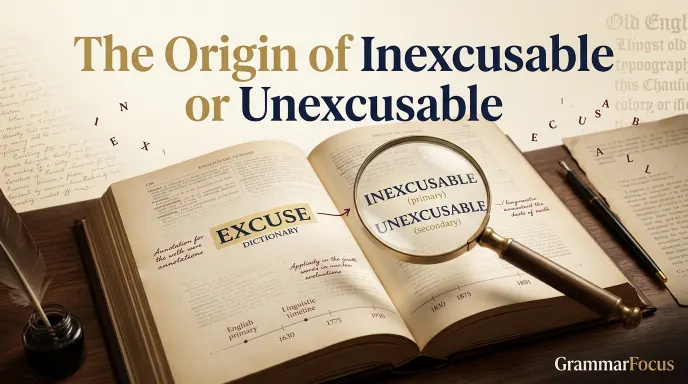
The Origin of Inexcusable or Unexcusable
Understanding the history of these words helps explain why inexcusable is the established form.
Origin of Excusable
Excusable comes from excuse, which ultimately traces back through French to Latin excusare, meaning to free from blame or provide a reason for an action.
The English word excuse developed meanings related to explaining, defending, or forgiving a fault or action.
From excuse, English formed the adjective:
excusable
meaning something that can be forgiven or justified.
How Inexcusable Was Formed
The word inexcusable combines:
in- + excusable
The prefix in- can express a negative meaning, such as “not.”
Therefore:
excusable → inexcusable
The word literally conveys the idea of something that is not excusable.
This form became established in English and is now the normal word used when describing something that cannot reasonably be excused.
Why Does English Use “In-” Here?
English has several negative prefixes, including in-, im-, il-, ir-, and un-.
Their use depends partly on the history and development of individual words. English speakers cannot always choose whichever negative prefix seems logical.
For example:
- possible → impossible
- legal → illegal
- regular → irregular
- excusable → inexcusable
This is why unexcusable may look reasonable but does not have the same standard status as inexcusable.
Origin of Unexcusable
Unexcusable is a possible English formation using the productive prefix un-, and the form can be found in historical and dictionary records. However, it has never become as common or established as inexcusable in modern standard English.
This is an important distinction: unexcusable is not simply meaningless, but it is much less usual.
For normal modern writing, inexcusable is the clear and conventional choice.
British English vs American English Spelling
There is no major British-American spelling difference between inexcusable and unexcusable.
Both British and American English use inexcusable as the normal form.
| Usage | American English | British English |
| Standard adjective | inexcusable | inexcusable |
| Less common form | unexcusable | unexcusable |
| Recommended form | inexcusable | inexcusable |
| Meaning | Not excusable | Not excusable |
American English Example
His conduct was inexcusable.
British English Example
The treatment of the customer was inexcusable.
The spelling remains the same in both varieties. The main issue is not American versus British English. It is choosing the established form inexcusable instead of the much less common unexcusable.
Which Spelling Should You Use?
For most readers and writers, inexcusable is the form to use. It is the familiar and established choice in modern English.
For American English
Use inexcusable in:
- School assignments
- Business emails
- Reports
- Articles
- Formal documents
- Everyday conversations
Example:
His failure to follow the instructions was inexcusable.
For British and Commonwealth English
The same advice applies. Use inexcusable in British English and other varieties of English that follow similar standard usage.
Example:
The delay was completely inexcusable.
There is no need to change the spelling to unexcusable for British English.
For Global English
If you write for an international audience, inexcusable is the clearest choice. It is widely recognized and avoids an unusual or distracting word form.
A simple rule is:
Use “inexcusable” in normal modern English.
Common Mistakes with Inexcusable or Unexcusable
The biggest mistake is assuming that un- can always be added to an adjective to create its opposite.
Mistake 1: Writing Unexcusable in Formal English
❌ His behavior was unexcusable.
✅ His behavior was inexcusable.
Although unexcusable can be found in some usage, inexcusable is the standard choice for most formal and everyday writing.
Mistake 2: Adding a Double Negative
Another problem occurs when writers use not inexcusable without considering the meaning.
For example:
His actions were not inexcusable.
This does not mean his actions were clearly acceptable. It means they were not impossible to excuse.
If you mean that something cannot be justified, say:
His actions were inexcusable.
Clear wording helps prevent confusion.
Mistake 3: Confusing Inexcusable With Excusable
These words have opposite meanings.
❌ The mistake was excusable, so nobody could forgive it.
✅ The mistake was inexcusable, so nobody could reasonably justify it.
Excusable means that there is a reasonable basis for forgiving or explaining something.
Inexcusable means there is not.
Mistake 4: Using Inexcusable for Every Small Error
Inexcusable is a strong word. It often shows serious disapproval.
For a minor problem, words such as unfortunate, avoidable, or unacceptable may fit better depending on the context.
For example:
Missing one minor detail was unfortunate.
This is softer than:
Missing the safety warning was inexcusable.
Choose the word that matches the seriousness of the situation.
Inexcusable or Unexcusable in Everyday Examples
The word inexcusable appears in many types of writing. Its exact tone depends on the situation.
In Emails
In a professional email, inexcusable can describe a serious failure or problem.
The repeated failure to provide the requested documents is inexcusable.
However, because the word is strong, use it carefully in workplace communication. A softer phrase may be more suitable when you want to solve a problem without sounding overly harsh.
In News Writing
News reports may use inexcusable when quoting a person, organization, or official who strongly criticizes an action.
The official described the treatment of the workers as inexcusable.
In this type of sentence, the word communicates a strong negative judgment.
In Social Media
People often use inexcusable to express strong personal opinions.
That kind of behavior is inexcusable.
The way they treated her was inexcusable.
Social media posts may use the word more emotionally than formal writing does.
In Formal Writing
Inexcusable can work well in formal writing when the writer needs to make a clear judgment about an action.
The failure to follow established safety procedures was inexcusable.
It is especially useful when the surrounding evidence explains why the action cannot reasonably be justified.
In Everyday Conversation
You may hear:
That was inexcusable.
His behavior is inexcusable.
Forgetting the deadline was bad, but ignoring the warning was inexcusable.
These examples show that inexcusable is common in ordinary spoken English as well as writing.
Inexcusable or Unexcusable: Google Trends & Usage Data
Searches for “inexcusable or unexcusable” usually come from people who are unsure which negative form sounds correct. The question is mainly about word formation and standard usage rather than a difference between American and British spelling.
Google Trends measures relative search interest, not the exact number of searches. Its results can change according to the selected country, date range, language, and search category.
For this keyword, usage is also influenced by the fact that inexcusable is a common adjective, while unexcusable is much less familiar to most modern English users.
What Searchers Usually Want to Know
People who search this phrase may be asking:
- Is inexcusable a real word?
- Is unexcusable correct?
- Which form should I use in formal writing?
- Why does English use in- instead of un-?
- Is there a British or American difference?
The practical usage pattern is clear: inexcusable is the normal form for modern standard English.
Search popularity can vary by country and over time, so Google Trends should be treated as a measure of relative interest rather than proof that one spelling is grammatically correct.
FAQs About Inexcusable or Unexcusable
Q1. Is inexcusable or unexcusable correct?
Answer. Inexcusable is the standard and much more common form in modern English. Use it when you mean that something cannot reasonably be excused or justified.
Q2. Is unexcusable a word?
Answer. Unexcusable can be found in dictionaries and historical usage, but it is uncommon. Inexcusable is the normal choice for modern standard English.
Q3. What does inexcusable mean?
Answer. Inexcusable means not excusable, forgivable, or reasonably justifiable. It is often used for serious mistakes, behavior, or actions.
Q4. Is inexcusable used in American and British English?
Answer. Yes. Inexcusable is used in both American and British English. There is no standard US-versus-UK spelling difference for this word.
Q5. Why is it inexcusable instead of unexcusable?
Answer. English uses different negative prefixes with different words. Inexcusable became the established form, so adding un- does not produce the usual modern form.
Q6. Is inexcusable a strong word?
Answer. Yes. Inexcusable usually expresses strong disapproval. It suggests that there is no reasonable excuse or justification for the action.
Q7. What is the opposite of inexcusable?
Answer. The direct opposite is excusable. Something excusable can reasonably be forgiven, explained, or justified.
Q8. Can I use unexcusable in an essay?
Answer. It is better to use inexcusable in an essay. It is more common, more established, and more natural in modern standard English.
Conclusion:
When choosing between inexcusable or unexcusable, inexcusable is the standard form to use in modern English.
It means that something cannot reasonably be excused, forgiven, or justified. The word can describe serious mistakes, unacceptable behavior, unfair treatment, or actions that lack a reasonable explanation.
Unexcusable is not simply meaningless. It appears in some historical and dictionary records, but it is much less common than inexcusable.
For schoolwork, professional writing, articles, emails, and everyday communication, inexcusable is the clearer choice.
There is also no important British-American spelling difference. Both varieties normally use inexcusable.
The main point to remember is that English negative prefixes do not always follow a simple rule.
Although un- is common in words such as unfair and unclear, excusable takes the established negative form inexcusable.
So, when you mean “not excusable,” choose inexcusable. This form is familiar, natural, and suitable for both formal and informal English.
Learn More About Grammar:
- Debur vs. Deburr: Correct Spelling, Meaning & Usage
- Rewinded or Rewound: A Simple Grammar Guide for 2026
- Anticlimactic or Anticlimatic: Which Spelling Is Correct?

I’m Alex Morgan, an American English writer with 6 years of experience exploring grammar, punctuation, sentence structure, and everyday English usage. I enjoy turning confusing grammar rules into clear, practical explanations that help readers write and communicate with confidence.