
Deburr is the standard spelling when you mean to remove a burr, rough edge, or sharp projection from a manufactured surface. The spelling debur may appear in some technical contexts, but deburr is the form most commonly used in standard technical and manufacturing English.
If you work with metal, plastic, machining, tools, or manufacturing, you may come across this word frequently.
Cutting, drilling, milling, grinding, and other processes can leave small unwanted edges on a part. These edges are called burrs. Removing them is known as deburring.
The word can therefore be easy to understand when you connect it with the noun burr. However, the spelling can still cause confusion because some writers leave out one of the two r letters and write debur.
This article explains the difference between debur and deburr, their meanings, pronunciation, spelling pattern, and use in technical English.
You will also see simple examples that make the correct form easier to remember.
Debur or Deburr: Quick Answer
Deburr is the preferred spelling for the verb meaning to remove a burr or rough edge from a surface.
For example:
The technician will deburr the metal part before assembly.
Workers deburr the edges after cutting the sheet.
The spelling debur can be found, but deburr is the clearer and more widely established form for standard technical writing.
A useful way to remember it is:
burr → deburr → deburring
Because the original word is burr, the double r remains in deburr.
Debur vs Deburr: Quick Comparison
| Word | Part of Speech | Meaning | Usage |
| Debur | Verb | To remove a burr | Less common variant |
| Deburr | Verb | To remove a burr or rough edge | Preferred technical form |
When writing an engineering instruction, product specification, or manufacturing procedure, deburr is the safer standard choice.
Pronunciation and Word Form
Debur
- US: /diːˈbɝː/
- UK: /diːˈbɜː/
- Word form: Verb
- Example: The operator will debur the edges before finishing.
Deburr
- US: /diːˈbɝː/
- UK: /diːˈbɜː/
- Word form: Verb
- Example: The operator will deburr the edges before finishing.
The two spellings are generally pronounced the same. The main difference is in how the word is written.
Definition and Meaning of Debur or Deburr
What Does Deburr Mean?
Deburr means to remove a burr from a surface.
A burr is a small, unwanted rough or sharp edge that can remain after a material has been cut, drilled, machined, stamped, or otherwise processed.
For example, drilling a hole in a metal sheet may leave a sharp edge around the hole. A worker can deburr that edge to make the surface smoother.
What Is a Burr?
A burr is an unwanted raised, rough, or sharp edge on a material.
For example:
The drilled hole has a sharp burr around its edge.
The next step may be:
The technician will deburr the hole.
This gives you a simple connection:
Burr = unwanted rough edge
Deburr = remove the unwanted edge
The Main Difference Between Debur and Deburr
The main difference is the spelling.
Deburr directly preserves the spelling of burr, making the relationship between the two words easy to see.
The word can be understood as:
de- + burr = deburr
The prefix de- can indicate removal or reversal, while burr identifies the rough edge being removed.
Therefore:
Deburr = remove a burr
In technical English, this form is commonly used for manufacturing instructions, machining procedures, engineering documents, and descriptions of tools or equipment.
Why Does Deburr Have Two Rs?
The answer becomes simple when you look at the base word.
The noun is:
burr
When de- is added:
de + burr = deburr
The two r letters from burr remain.
The same pattern appears in related forms:
- burr
- deburr
- deburrs
- deburred
- deburring
Keeping the double r makes these forms visibly connected to the original word burr.
Debur or Deburr in Technical English
You are most likely to encounter deburr in technical and industrial writing.
It can appear in:
- Engineering instructions
- Manufacturing procedures
- Machine-shop documents
- Product specifications
- Engineering drawings
- Assembly instructions
- Quality-control notes
- Machining guides
For example:
Deburr all edges before assembly.
This short instruction tells the worker to remove unwanted sharp or rough edges before the component is assembled.
Another example is:
Deburr the drilled holes before installation.
Here, deburr clearly describes an action that needs to be completed.
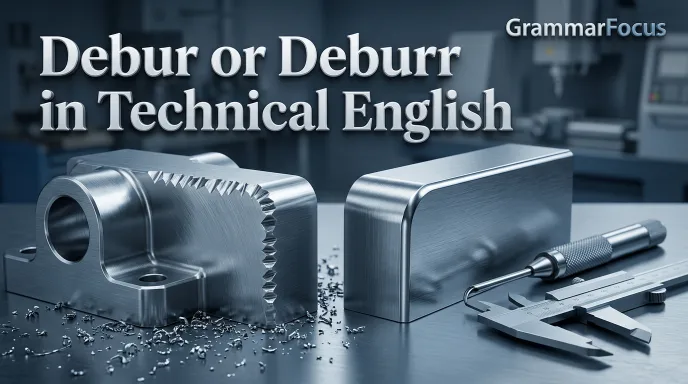
Deburr in Manufacturing
Manufacturing processes can leave small unwanted edges on finished or partly finished components.
Cutting a sheet, drilling a hole, or machining a metal part may create burrs. These edges may need to be removed before the part moves to the next stage.
For example:
After machining, the operator must deburr the component.
Another example:
All parts are inspected and deburred before assembly.
The exact deburring method depends on the material, shape, size, and manufacturing process.
Deburr as a Verb
Deburr is primarily used as a verb.
Its common forms include:
| Form | Example |
| Deburr | Workers deburr the parts. |
| Deburrs | The machine deburrs each component. |
| Deburred | The technician deburred the edges. |
| Deburring | Deburring is required before assembly. |
These forms are useful when describing a manufacturing or machining process.
Deburr in Different Work Situations
The verb deburr can be used in several practical manufacturing situations. The exact sentence depends on what material or component is being worked on.
Metal Parts
Metal components often need their edges smoothed after cutting or machining.
The technician deburred the metal plate before installation.
Drilled Holes
Drilling can leave a small sharp edge around a hole.
Please deburr the holes before fitting the screws.
Plastic Components
Plastic parts can also have unwanted edges after cutting or molding.
The operator deburred the plastic component before inspection.
Machined Components
Machining can create small raised edges that need to be removed.
Each machined component must be deburred before assembly.
Deburr in Instructions and Technical Writing
In technical writing, deburr often appears as a short instruction.
For example:
Deburr all sharp edges.
Deburr the holes after drilling.
Before assembly, deburr the component.
The surface should be deburred before applying the coating.
These instructions are direct and easy to follow. In engineering documents, clear verbs such as deburr, inspect, clean, and assemble help describe each stage of a process.
When writing a technical procedure, it is also useful to specify exactly what should be deburred.
Instead of:
Deburr the part.
A more precise instruction might say:
Deburr the outer edges and drilled holes.
This removes ambiguity and tells the worker exactly what needs attention.
Deburred and Deburring: Related Forms
Once you know deburr, the other forms become easier to recognize.
Deburred
Deburred is the past tense and past participle.
The operator deburred the component yesterday.
The parts have already been deburred.
Deburring
The term deburring is the -ing form.
As a final step, it is completed before inspection.
The company uses automated equipment for deburring.
Deburrs
Deburrs is the third-person singular present form.
This machine deburrs small metal components automatically.
These forms all retain the double r found in deburr.
Deburr vs Remove a Burr
In everyday writing, you can also express the same basic action with a longer phrase.
For example:
The worker deburred the edge.
Can also be written as:
The worker removed the burr from the edge.
The first version is more concise and particularly useful in technical contexts.
Similarly:
The technician deburred the drilled holes.
means that the technician removed the unwanted burrs created around those holes.
Everyday Technical Examples of Deburr
Here are additional examples showing how deburr works naturally in sentences:
- The manufacturer instructs workers to deburr every component.
- The edges were deburred before the parts were painted.
- The machine automatically deburrs newly cut pieces.
- The technician inspected the surface after deburring.
- Make sure to deburr the opening before inserting the fitting.
- The production team deburred the parts before packaging.
- The instructions require the operator to deburr all exposed edges.
- The company introduced a new tool for faster deburring.
- The finished components were cleaned after they were deburred.
- Proper deburring can be an important step in preparing a manufactured part.
When Should You Use Debur?
If you are writing for an engineering, manufacturing, machining, or industrial audience, deburr is the form to choose when you mean remove a burr.
It is especially appropriate in:
- Technical manuals
- Manufacturing instructions
- Engineering documentation
- Product specifications
- Workshop instructions
- Machine operating procedures
- Quality-control documentation
If you encounter debur, do not automatically assume it represents a different action. In contexts where the intended meaning is “remove a burr,” the standard spelling deburr is usually the clearer choice.
A Simple Way to Remember Deburr
The easiest memory trick is to start with the noun burr.
Think:
BURR → DEBURR
Do not remove an r when adding de-.
You can then build the other forms:
deburr → deburred → deburring
This pattern helps prevent the common spelling mistake debur.
Frequently Asked Questions
Q1. Is debur or deburr correct?
Answer. Deburr is the standard spelling for the verb meaning to remove a burr or rough edge from a surface. Debur may appear as a variant, but deburr is the preferred form in standard technical usage.
Q2. What does deburr mean?
Answer. Deburr means to remove a burr, which is a small unwanted rough, raised, or sharp edge left on a material after processes such as cutting, drilling, or machining.
Q3. What is a burr in manufacturing?
Answer. A burr is an unwanted rough or sharp edge that can remain on a manufactured component after cutting, drilling, machining, stamping, or another production process.
Q4. Is deburr one word?
Answer. Yes. Deburr is written as one word when it is used as the verb meaning to remove a burr.
Q5. What is the past tense of deburr?
Answer. The past tense is deburred.
Example:
The technician deburred the metal part before assembly.
Q6. What is the noun form of deburr?
Answer. The common noun referring to the process is deburring.
Example:
Deburring is required before the component is assembled.
Q7. Why does deburr have two Rs?
Answer. Deburr keeps the spelling of the base word burr after the prefix de- is added. Therefore, burr becomes deburr, not debur.
Q8. Is deburr used in engineering?
Answer. Yes. Deburr is commonly used in technical contexts involving machining, manufacturing, metalworking, and the preparation of manufactured parts. It often appears in instructions such as “Deburr all edges before assembly.”
Conclusion
Deburr is the preferred spelling when you mean to remove a burr or unwanted rough edge from a manufactured surface.
The word is especially common in engineering, machining, manufacturing, and technical instructions. The related forms are deburr, deburrs, deburred, and deburring.
The easiest way to remember the spelling is to connect it directly with burr:
burr → deburr
So, when you are describing the removal of a burr, choose deburr in your technical writing.
Learn More About Grammar:
- Revocable or Irrevocable: Meaning and Differences
- Envelope or Envelop? Know the One-Letter Difference (2026)
- Poppa or Papa: What’s the Difference?

I’m Alex Morgan, an American English writer with 6 years of experience exploring grammar, punctuation, sentence structure, and everyday English usage. I enjoy turning confusing grammar rules into clear, practical explanations that help readers write and communicate with confidence.








3 thoughts on “Debur vs. Deburr: Correct Spelling, Meaning & Usage”