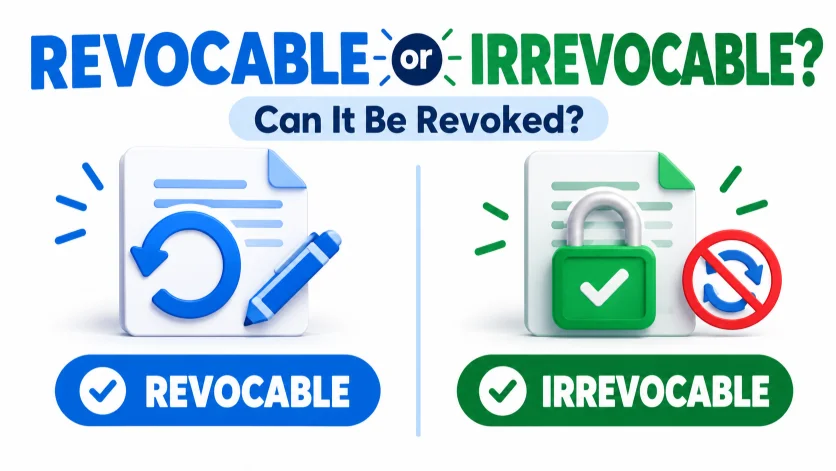
Revocable or irrevocable? Revocable means something can be changed, canceled, or withdrawn, while irrevocable means something cannot be changed, canceled, or withdrawn once it becomes effective. These words describe if a decision, permission, agreement, or legal arrangement can be reversed.
The difference is important in legal, financial, and everyday English. You may see these terms in wills, trusts, contracts, gifts, and official documents. Choosing the wrong word can change the meaning of an entire sentence.
For example, a revocable trust can generally be changed or canceled by the person who created it, subject to its terms and applicable law.
An irrevocable trust generally cannot be changed or canceled in the same way. The exact rules depend on the legal arrangement and jurisdiction.
Both words come from the same root, but they have opposite meanings. This guide explains their definitions, pronunciation, word forms, origins, and common usage.
You will also learn how to choose the right word in clear English.Let’s begin with the simple difference.
Quick Answer: Revocable or Irrevocable
Revocable means capable of being revoked, canceled, withdrawn, or taken back.
Irrevocable means not capable of being revoked, canceled, withdrawn, or taken back under the applicable terms and law.
| Word | Meaning | Example |
| Revocable | Can be revoked or changed | She created a revocable trust. |
| Irrevocable | Cannot generally be revoked or changed in the same way | He made an irrevocable decision. |
When to use revocable
Use revocable when something can be canceled, withdrawn, or changed.
Examples:
- A revocable trust can generally be changed by its creator.
- The permission is revocable.
- She gave revocable consent.
When to use irrevocable
Use irrevocable when something cannot generally be canceled or reversed.
Examples:
- The court issued an irrevocable order.
- He made an irrevocable decision.
- The gift was transferred through an irrevocable arrangement.
The easiest way to remember
Revocable = can be revoked.
Irrevocable = cannot be revoked.
The prefix ir- changes the meaning to its opposite.
Quick Comparison Table
| Version | Meaning | Correct? | Region | Example |
| Revocable | Can be revoked | Yes | British, American, Canadian, Australian, and international English | The permission is revocable. |
| Irrevocable | Cannot generally be revoked | Yes | British, American, Canadian, Australian, and international English | The decision is irrevocable. |
| Revokable | Alternative spelling sometimes used, but less suitable for formal writing | Sometimes, depending on dictionary and context | English varieties | Revocable is the safer formal choice. |
| Irrevokable | Not the standard spelling | No, for standard formal usage | English varieties | Use irrevocable. |
Important spelling rule
There is no standard British-versus-American spelling change between revocable and irrevocable.
Both words are used in formal English. The main difference is their meaning.
Pronunciation and Word Form
Revocable and irrevocable are adjectives. They describe if something can be revoked.
Revocable
| Feature | Details |
| Word | Revocable |
| Part of speech | Adjective |
| US pronunciation | /ˈrɛvəkəbəl/ |
| UK pronunciation | /ˈrɛvəkəbəl/ |
| Meaning | Able to be revoked |
Example: This permission is revocable.
Irrevocable
| Feature | Details |
| Word | Irrevocable |
| Part of speech | Adjective |
| US pronunciation | /ɪˈrɛvəkəbəl/ |
| UK pronunciation | /ɪˈrɛvəkəbəl/ |
| Meaning | Not able to be revoked |
Example: The decision was irrevocable.
How the pronunciation differs
The main difference is the beginning of the word.
- Revocable starts with rev-.
- Irrevocable starts with ir-rev-.
Irrevocable has an extra syllable at the beginning.
Both words contain the same root, revoke, which means to officially cancel or withdraw something.
What Does Revocable Mean?
Revocable is an adjective that means something can be revoked. To revoke something means to officially cancel, withdraw, or take back permission, authority, or a decision.
In simple English, revocable means changeable or cancelable, depending on the context.
Revocable in everyday English
You can use revocable to describe permission, consent, or an arrangement that can be withdrawn.
Examples:
- The license is revocable.
- Her permission was revocable.
- The agreement included revocable consent.
The exact meaning depends on what is being revoked.
Revocable in legal English
In legal writing, revocable often describes an arrangement that can be canceled or changed under specific conditions.
For example:
A revocable trust can generally be amended or revoked by the person who created it.
This is a common use in estate planning. However, the trust’s terms and applicable law determine what changes are allowed.
Revocable does not mean unlimited freedom
A revocable arrangement is not necessarily changeable at any time by anyone.
For example:
- A permission may be revocable by the person who gave it.
- A contract may allow cancellation only under certain conditions.
- A trust may be revocable by its creator but not by another person.
Always consider who has the power to revoke something.
Common phrases with revocable
- Revocable trust
- Revocable consent
- Revocable license
- Revocable permission
- Revocable agreement
- Revocable authority
Example sentence:
The owner created a revocable trust to manage her assets.
What Does Irrevocable Mean?
Irrevocable is an adjective that means something cannot be revoked or reversed in the usual way allowed by its terms and applicable law.
In simple English, irrevocable means not cancelable or not reversible.
Irrevocable in everyday English
People use irrevocable to describe decisions, actions, or changes that cannot easily be undone.
Examples:
- He made an irrevocable decision.
- The damage was irrevocable.
- She took an irrevocable step.
These sentences suggest that the action cannot be reversed.
Irrevocable in legal English
Irrevocable is common in legal and financial documents.
For example:
An irrevocable trust generally cannot be changed or canceled by its creator in the same way as a revocable trust.
This distinction matters in estate planning, but the legal effect depends on the trust terms and the law that applies.
Common phrases with irrevocable
- Irrevocable trust
- Irrevocable decision
- Irrevocable gift
- Irrevocable consent
- Irrevocable agreement
- Irrevocable letter of credit
Example sentence:
The donor transferred the property through an irrevocable arrangement.
Does irrevocable always mean absolutely impossible?
Not necessarily.
In ordinary English, irrevocable often means that you cannot undo something. However, in legal contexts, an arrangement described as irrevocable may still be subject to limited exceptions, court orders, or rules under applicable law.
Therefore, avoid treating the word as a guarantee that no legal change is ever possible.
Revocable vs Irrevocable: The Main Difference
The main difference is if something can be revoked.
| Feature | Revocable | Irrevocable |
| Basic meaning | Can be revoked | Cannot generally be revoked |
| Opposite meaning | Changeable or cancelable | Not changeable or cancelable in the same way |
| Common use | Revocable trust | Irrevocable trust |
| Legal meaning | Depends on the terms and law | Depends on the terms and law |
| Example | Revocable permission | Irrevocable decision |
Example 1: Permission
The permission is revocable.
This means the person who has the power to revoke it may withdraw the permission.
The permission is irrevocable.
This means the permission cannot generally be withdrawn in the same way.
Example 2: A decision
She made a revocable decision.
This suggests the decision can be changed or withdrawn.
She made an irrevocable decision.
This suggests the decision cannot be reversed.
Example 3: A trust
He created a revocable trust.
The creator can generally change or cancel it under the trust terms and applicable law.
He created an irrevocable trust.
The creator generally cannot change or cancel it in the same way.
Important: A revocable trust and an irrevocable trust have different legal characteristics. You should not assume their legal and financial consequences from the words alone.
The Origin of Revocable or Irrevocable
Revocable and irrevocable are related words. Both come from the Latin root connected with calling something back.

The origin of revoke
The verb revoke comes from Latin revocare, meaning “to call back.”
It developed into the English word revoke, which means to officially cancel, withdraw, or take back something.
For example:
The authority revoked his license.
This means the authority officially canceled his license.
The origin of revocable
People form “revocable” by adding the suffix “-able” to “revoke.”
The suffix -able means capable of being.
So:
Revoke + able = Revocable
The word describes something you can revoke.
The origin of irrevocable
Irrevocable adds the negative prefix ir- to revocable.
The prefix ir- means not in this word.
So:
Ir- + revocable = Irrevocable
The word describes something you cannot revoke.
Why do the words have opposite meanings?
The prefix changes the meaning.
| Word part | Meaning |
| Revoke | Cancel or withdraw |
| -able | Capable of |
| Revocable | Capable of being revoked |
| Ir- | Not |
| Irrevocable | Not capable of being revoked |
This pattern can help you understand other English words, too.
Examples:
- Reversible / irreversible
- Responsible / irresponsible
- Regular / irregular
British English vs American English
British and American English use the same spelling for revocable and irrevocable.
There is no common British spelling change such as adding an extra letter to either word.
| Word | British English | American English | Example |
| Revocable | Revocable | Revocable | The license is revocable. |
| Irrevocable | Irrevocable | Irrevocable | The decision is irrevocable. |
Pronunciation differences
Both varieties commonly pronounce revocable as /ˈrɛvəkəbəl/ and irrevocable as /ɪˈrɛvəkəbəl/.
Accent differences may affect the exact sound, but the spellings and basic meanings remain the same.
Legal writing differences
Legal terminology can vary by jurisdiction. The words themselves are standard in both British and American English, but the rules surrounding trusts, contracts, consent, and other legal arrangements may differ.
For legal documents, always follow the relevant jurisdiction and the wording of the applicable law.
Which spelling should you use?
Use revocable when you can revoke something.
Use irrevocable when you generally cannot revoke something.
The correct choice is based on meaning, not on if you are writing in British or American English.
Which Version Should You Use?
The best word depends on what you want to communicate.
United States
Use revocable for something you can generally cancel or change, and irrevocable for something you generally cannot cancel or change in the same way.
Examples:
- Revocable trust
- Irrevocable trust
These are common terms in US estate planning.
United Kingdom
Use the same spellings and meanings.
Examples:
- Revocable permission
- Irrevocable decision
Legal rules may differ from those in the United States, so do not assume that a legal arrangement has the same effect in both countries.
Canada
Canadian English uses both revocable and irrevocable.
Use the word that matches the intended meaning and the applicable legal context.
Australia
Australian English also uses both words.
For legal or financial writing, check the relevant Australian terminology and legal requirements.
International writing
For an international audience, explain the word briefly if the context is technical.
For example:
The creator of a revocable trust can generally change or cancel it.
This makes the meaning clear to readers who may not know legal vocabulary.
Academic writing
Use revocable and irrevocable precisely.
Example:
The study examined the difference between revocable and irrevocable consent.
If your topic is legal, define the terms before discussing their effects.
Business writing
Use these words when discussing permissions, contracts, authority, or financial arrangements.
Example:
The agreement includes a revocable license.
Example:
The parties signed an irrevocable commitment.
In formal writing, avoid using irrevocable simply to sound stronger. Use it only when the meaning is accurate.
Common Mistakes
Mistake 1: Confusing revocable with irrevocable
Incorrect:
You can cancel the irrevocable permission at any time.
Correct:
You can cancel the revocable permission under the applicable terms.
Explanation: Revocable describes something you can revoke. Irrevocable describes something you generally cannot revoke in the usual applicable sense.
Memory tip: Revocable allows revocation. Irrevocable does not generally allow it in the same way.
Mistake 2: Writing “irrevokable” instead of “irrevocable”
Incorrect:
The agreement is irrevokable.
Correct:
The agreement is irrevocable.
Explanation: The standard spelling is irrevocable. It comes from revoke, not from an invented form of the word.
Memory tip: Remember the ending: revocable → irrevocable.
Mistake 3: Using “revokable” in formal writing
Example:
The license is revokable.
Better formal wording:
The license is revocable.
Explanation: Revocable is the standard adjective used in formal English. Revokable may appear in some dictionaries or informal usage, but revocable is the safer choice for professional and legal writing.
Mistake 4: Assuming irrevocable means impossible to change in every situation
Incorrect assumption:
You generally cannot change an irrevocable trust in the same way you can change a revocable trust.
Correct explanation:
The creator of an irrevocable trust generally cannot change or cancel it in the same way they can change or cancel a revocable trust.
Explanation: Legal arrangements may have limited exceptions, court procedures, or other rules. The exact legal effect depends on the trust terms and applicable law.
Mistake 5: Confusing revoke with revokeable spelling patterns
Incorrect:
The authority was revoced.
Correct:
The authority was revoked.
Explanation: Revoked is the past tense of revoke. Revocable describes something you can revoke.
Memory tip: Revoke is the verb. Revoked is its past tense. Revocable is the adjective.
Everyday Examples of Revocable or Irrevocable
1. Emails
Revocable example:
Please note that this permission is revocable under the terms of our agreement.
Irrevocable example:
They made the transfer under an irrevocable arrangement.
2. Business Writing
Revocable:
The company issued a revocable license for the software.
Irrevocable:
The parties agreed to an irrevocable payment instruction.
Use these words carefully. A business document should explain the exact conditions instead of relying on the adjective alone.
3. News Headlines
Revocable:
Court Reviews Revocable License Agreement
Irrevocable:
Company Announces Irrevocable Transfer of Assets
These examples show how the words may appear in formal reporting. Actual legal or financial claims need verification from reliable sources.
4. Blogs
Revocable:
A revocable trust may give the creator flexibility when managing assets.
Irrevocable:
An irrevocable trust may involve different legal and financial considerations.
5. Social Media
Revocable:
Some permissions are revocable, so check the terms before agreeing.
Irrevocable:
Think carefully before making an irrevocable decision.
6. Academic Writing
Revocable:
The research examined if participants could withdraw revocable consent.
Irrevocable:
The paper discussed the legal meaning of irrevocable commitments.
7. Daily Conversation
Revocable:
Is this permission revocable?
Irrevocable:
I hope this decision is not irrevocable.
8. Legal and Financial Writing
Revocable:
The trust is revocable under its governing terms.
Irrevocable:
The trust is irrevocable under its governing terms.
These sentences are examples of usage, not legal advice. The words alone do not establish the rights or obligations of the parties.
Google Trends & Modern Usage
People search for “revocable or irrevocable” because these words appear in legal documents, financial discussions, and everyday writing.

Why do people confuse these words?
The main reasons include:
- Both words come from the same root, revoke.
- They look and sound similar.
- The prefix ir- changes the meaning.
- Both words appear in legal and financial documents.
- Readers may understand the general meaning but still confuse which word to use.
For example:
The permission is revocable.
This means it can be withdrawn.
The permission is irrevocable.
This means it cannot generally be withdrawn in the same way.
Modern usage patterns
Revocable and irrevocable are especially useful in these areas:
| Area | Revocable | Irrevocable |
| Estate planning | Revocable trust | Irrevocable trust |
| Contracts | Revocable agreement | Irrevocable agreement |
| Permission | Revocable consent | Irrevocable consent |
| Business | Revocable license | Irrevocable commitment |
| Everyday English | Revocable decision | Irrevocable decision |
Why do people search this keyword?
Readers may want to know:
- What is the difference between revocable and irrevocable?
- Is a revocable trust better than an irrevocable trust?
- What does irrevocable mean in simple English?
- Is irrevocable the opposite of revocable?
- How do you spell irrevocable correctly?
The correct word depends on the context. In general English, use revocable for something you can revoke and irrevocable for something you generally cannot revoke in the usual applicable sense.
Google Trends data
We have not included exact Google Trends statistics because we have not collected verified search-volume data for this keyword.
The discussion above describes general vocabulary usage, not measured search popularity. Search interest may vary by country, topic, and time.
Key Takeaways
- Revocable describes something you can revoke.
- Irrevocable describes something you generally cannot revoke in the usual applicable sense.
- The two words have opposite meanings.
- Both words are adjectives.
- The prefix ir- gives irrevocable its negative meaning.
- Revocable and irrevocable have the same standard spelling in British and American English.
- Revocable trusts and irrevocable trusts are common legal examples.
- Legal meanings depend on the exact terms and applicable law.
FAQs About Revocable or Irrevocable
Q1. What is the difference between revocable and irrevocable?
Answer. Revocable describes something you can revoke, cancel, or withdraw. Irrevocable describes something you generally cannot revoke or reverse in the same way. For example, the creator of a revocable trust can generally change it, while the creator of an irrevocable trust generally cannot change it in the same way. The exact legal rules depend on the arrangement.
Q2. Is irrevocable the opposite of revocable?
Answer. Yes. Revocable describes something you can revoke, while irrevocable describes something you generally cannot revoke in the usual applicable sense. The prefix ir- gives irrevocable its opposite meaning.You can remember the difference with this simple rule: revocable means “you can revoke it,” while irrevocable means “you generally cannot revoke it.”
Q3. What does revocable mean in simple English?
Answer. Revocable describes something you can cancel, withdraw, or take back. For example, if permission is revocable, the person with the authority to revoke it may withdraw that permission. A revocable trust is another common example. The exact rights depend on the terms of the arrangement and applicable law.
Q4. What does irrevocable mean in simple English?
Answer. Irrevocable describes something you generally cannot cancel, withdraw, or reverse in the same way. For example, you cannot easily undo an irrevocable decision. In legal writing, the word may describe trusts, gifts, or agreements. Its exact legal effect depends on the applicable rules and terms.
Q5. Is “irrevokable” the correct spelling?
Answer. The standard spelling is irrevocable. The word comes from revoke, which means to cancel or withdraw something officially. Irrevocable describes something you generally cannot revoke in the usual applicable sense. For formal writing, legal documents, and educational articles, use irrevocable rather than relying on a nonstandard spelling.
Q6. What is the difference between a revocable trust and an irrevocable trust?
Answer. The creator of a revocable trust can generally change or cancel it under the trust terms and applicable law. The creator of an irrevocable trust generally cannot change or cancel it in the same way.These arrangements may have different legal and financial consequences, so consult a qualified professional for advice about a specific trust.
Q7. Are revocable and irrevocable spelled differently in British and American English?
Answer.No. Both British and American English use revocable and irrevocable with the same standard spellings. The words have the same basic meanings in both varieties. Differences may arise in legal terminology or local rules, but the spelling of these two adjectives does not change between British and American English.
Q8. Can an irrevocable agreement ever be changed?
Answer.You generally cannot change or cancel an irrevocable agreement in the same way you can change or cancel a revocable agreement. However, the exact legal position depends on the agreement, applicable law, and any permitted exceptions. Do not assume that irrevocable means no legal remedy or change is ever possible. Seek qualified legal advice for a specific agreement.
Conclusion
Revocable or irrevocable? The correct word depends on whether you can revoke something. Use revocable for something you can cancel, withdraw, or take back. Use irrevocable for something you generally cannot revoke in the usual way.
These words are important in legal, financial, academic, and everyday English. You may see them in discussions about trusts, permissions, contracts, decisions, and agreements. The difference is simple, but the legal consequences can be significant.
The easiest way to remember the two words is to focus on the prefix. Revocable describes something you can revoke.
Irrevocable describes something you generally cannot revoke in the same way. Both words have the same standard spelling in British and American English.
When writing about a legal arrangement, always consider the exact terms and applicable law. The word alone may not explain every right, restriction, or exception.
Revocable describes something you can revoke. Irrevocable describes something you generally cannot revoke in the same way.
Learn More About Grammar:
- Envelope or Envelop? Know the One-Letter Difference (2026)
- Fly or Flies? The Grammar Rule Everyone Forgets (2026)
- Summary vs Summery: One Letter, Big Difference (2026)

I’m Alex Morgan, an American English writer with 6 years of experience exploring grammar, punctuation, sentence structure, and everyday English usage. I enjoy turning confusing grammar rules into clear, practical explanations that help readers write and communicate with confidence.








3 thoughts on “Revocable or Irrevocable: Meaning and Differences”