
Here or there can be confusing when you are learning English or trying to make your writing clearer. Both words describe places, but they point to different locations.
Here refers to the place where the speaker is or where something is happening. There refers to another place, often away from the speaker. The correct choice depends on the location you want to describe.
Once you understand this simple difference, you can use both words confidently in conversations, emails, and everyday writing.
Here or There: Quick Answer
Here means in or at this place. There means in or at that place. Use here for the speaker’s current location and there for another location.
| Feature | Here | There |
| Basic meaning | In this place | In that place |
| Location | Usually near the speaker | Usually away from the speaker |
| Word type | Adverb; also used in some other grammatical roles | Adverb; also used in some other grammatical roles |
| Example | Please come here. | Please go there. |
| Common phrase | Here you are. | There you go. |
| Opposite in location | There | Here |
Quick tip: If you mean the place where you are, use here. If you mean another place, use there.
Pronunciation and Word Form
The words here and there are easy to pronounce, but their starting sounds are different. Both can work as adverbs of place.
1. Here
- US pronunciation: /hɪr/
- UK pronunciation: /hɪə/
- Part of speech: Adverb; also a noun in some expressions
- Example: Your bag is here.
The word here points to the speaker’s location or the place being treated as the current location.
For example, someone standing in a room might say, “Come here.” The word shows that the person should move toward the speaker.
2. There
- US pronunciation: /ðer/
- UK pronunciation: /ðeə/
- Part of speech: Adverb; also used as a pronoun like introductory word in some sentences
- Example: Your bag is there.
The word there points to another place. For example, if a bag is across the room, you might say, “Your bag is there.”
The pronunciation also differs at the beginning. Here starts with an h sound, while there starts with the voiced th sound, as in this.
Definition and Meaning of Here or There
Although here and there both describe places, they do not usually refer to the same location.
What Does Here Mean?
Here means in, at, or to the place where the speaker is or where the conversation is centered. It can refer to a room, a town, a country, or even the current situation.
Examples:
- At home: I am here in the kitchen.
- At school: Your teacher is here today.
- At work: We are here to discuss the new project.
- In a conversation: Here is the information you requested.
In each example, here points to the current place or situation.
What Does There Mean?
There means in, at, or to another place. It often points to a location away from the speaker, but the exact distance depends on the situation.
Examples:
- At home: Your shoes are there by the door.
- At school: The library is over there.
- While travelling: We stayed there for two nights.
- In a conversation: There is a problem with the printer.
The last example uses there differently. In the phrase “there is,” the word introduces the existence of something. It does not simply point to a physical place.
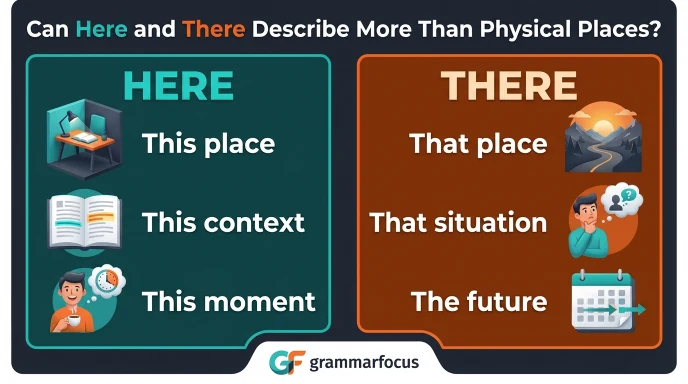
Can Here and There Describe More Than Physical Places?
Yes. Both words can refer to ideas, situations, or parts of a conversation.
For example:
- “Here is my main point.” introduces an idea.
- “There is another way to solve this problem.” introduces an option.
- “From here, we can plan the next step.” refers to the current stage of a process.
The meaning depends on how the word works in the sentence. However, the basic distinction remains useful: here connects to the current place or point, while there often refers to another place or introduces something that exists.
The Origin of Here or There
The words here and there have roots in Old English. Both have been used for centuries to describe location.
Here comes from the Old English word hēr, which meant “in this place.” Its meaning has remained close to that original sense. Today, it can refer to a physical location or the current point in a discussion.
There comes from the Old English word þǣr, which meant “in or at that place.” Over time, it also developed uses in expressions such as “there is” and “there are.”
These words are related to a wider group of English location words, including where, here, and there. They help speakers explain where something is or where an action should happen.
The easiest way to remember their difference is to connect here with your current place and there with another place. This simple rule works in many everyday situations.
British English vs. American English Usage
The words here and there have the same spelling and basic meaning in British and American English. Neither word has a regional spelling variant.
| Feature | British English | American English |
| Word for the current place | Here | Here |
| Word for another place | There | There |
| Spelling difference | None | None |
| Example | Come here, please. | Come here, please. |
| Example | Put the box there. | Put the box there. |
Pronunciation can vary slightly between speakers, but the words remain the same. The important difference is their meaning and how you use them in a sentence.
Which Word Should You Use?
Choose here or there based on the location you want to describe. Think about the speaker’s position and the place being discussed.
- Use here for the place where you are or where an activity is taking place.
- Use there for another place, often away from the speaker.
- Use here is to introduce something you are presenting, such as information or an object.
- Use there is to say that something exists or is present.
Compare these examples:
- “Please sit here.” The speaker wants someone to sit near them or in the current place.
- “Please sit there.” The speaker points to another seat or location.
- “Here is your notebook.” The speaker is presenting the notebook.
- “There is a notebook on the desk.” The sentence tells us that a notebook exists at that location.
Remember that there does not always mean a distant place. You can use it for a nearby location if the context makes that meaning clear.
Common Mistakes with Here or There
The two words are short, but using the wrong one can change the meaning of a sentence.
Mistake 1: Using here for a different location
Incorrect: “Your bag is here,” when the speaker means a bag across the room.
Clearer: “Your bag is there.”
Use here when the location is treated as the speaker’s current place.
Mistake 2: Using there for the speaker’s current location
Incorrect: “I am there,” when you mean that you are at your current location.
Correct: “I am here.”
However, “I am there” is correct when you are referring to another location in a suitable context, such as a planned meeting place.
Mistake 3: Confusing there with their or they’re
These words sound alike in many accents, but they have different meanings.
- There: Refers to a place or introduces existence.
1. The keys are there.
- Their: Shows possession.
2. Their keys are missing.
- They’re: Short for they are.
3. They’re waiting outside.
Mistake 4: Forgetting the expression there is
Incorrect: “Here is a problem with the computer,” when you simply mean that a problem exists.
More natural: “There is a problem with the computer.”
Use there is or there are to introduce something that exists. Use here is when presenting or pointing out something in the current context.
Everyday Examples of Here or There
These examples show how the words work in common situations.
Home
- “Come here and help me in the kitchen.”
- “Your shoes are over there by the door.”
At school
- “Please bring your homework here.”
- “The library is over there, next to the office.”
At work
- “I am here to discuss the report.”
- “The manager’s office is over there.”
In messages and emails
- “Here is the document you requested.”
- “You can find the full details there.”
While travelling
- “We are here at the station.”
- “We visited that village last year and stayed there for two days.”
The first word points to the current location or point of discussion. The second often refers to another place or introduces information about a location.
Key Takeaway
Here refers to the current place or point of discussion, while there usually refers to another place. Both words have the same spelling and basic meaning in British and American English.
Remember this simple rule: here means “in this place,” while there means “in that place.” Also, learn the difference between there, their, and they’re to avoid common writing mistakes.
Frequently Asked Questions
Q1. What is the difference between here and there?
Answer. Here refers to the current place, while there usually refers to another place. The exact meaning depends on the context.
Q2. Is here or there correct?
Answer. Both words are correct. Choose here for the current location and there for another location or in expressions such as “there is.”
Q3. Do here and there have different spellings in British and American English?
Answer. No. Both British and American English use the same spellings: here and there.
Q4. Can there mean a place nearby?
Answer. Yes. There can refer to a nearby place if the speaker is pointing to it or treating it as a separate location.
Q5. What is the difference between there and their?
Answer. There refers to a place or introduces existence. Their shows possession, as in “Their house is large.”
Q6. What does “here you are” mean?
Answer. “Here you are” is a common expression used when giving someone something or presenting an item they requested.
Q7. When should I use “there is” instead of “here is”?
Answer. Use there is to say that something exists or is present. Use here is when presenting or pointing out something in the current context.
Q8. How can I remember the difference between here and there?
Answer. Think of here as the place where you are and there as another place. This simple comparison works in many everyday situations.
Conclusion
The choice between here or there depends on the location or idea you want to express. Use here for the current place and there for another place. Both words are correct in British and American English, so focus on meaning rather than spelling. With regular practice, you can use them naturally in conversations, emails, and other forms of writing.
Learn More About Grammar:
- Lamb or Goat? Which One Tastes Better and Cooks Easier (2026)
- Loser or Looser: The Tiny Spelling Difference That Trips People Up
- Acceptions or Exceptions: Which Spelling Is Correct? (2026)

I’m Alex Morgan, an American English writer with 6 years of experience exploring grammar, punctuation, sentence structure, and everyday English usage. I enjoy turning confusing grammar rules into clear, practical explanations that help readers write and communicate with confidence.








2 thoughts on “Here or There: Which Word Should You Use? (2026)”