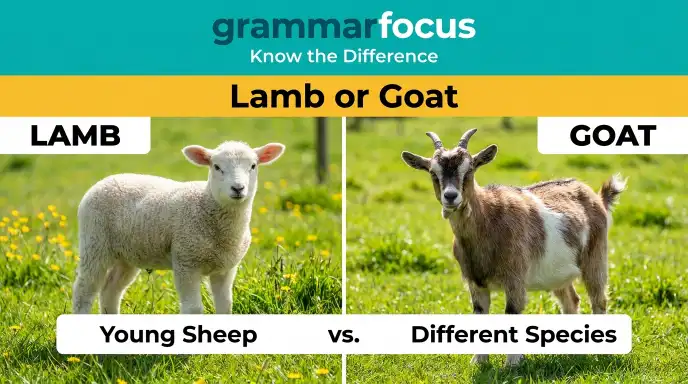
A lamb is a young sheep, while a goat is a different animal species. Both animals belong to the same family of hoofed mammals, but they have different features, behaviors, and uses.
People often confuse lamb and goat because both animals can provide meat, milk, and other products. However, the words do not mean the same thing. A lamb refers to a young sheep, while a goat can be young or fully grown.
Understanding the difference helps you choose the right word when discussing animals, farming, cooking, or food menus. The easiest way to remember it is that a lamb grows into a sheep, while a goat grows into an adult goat.
Quick Answer
| Feature | Lamb | Goat |
| Animal | Young sheep | A separate animal species |
| Adult animal | Sheep | Goat |
| Appearance | Often has a woolly coat | Often has a hair coat |
| Common food term | Lamb meat | Goat meat, sometimes called chevon |
| Typical behavior | Often stays close to its flock | Often explores and climbs |
| Example | The lamb stayed near its mother. | The goat climbed onto a rock. |
Quick rule: A lamb is a young sheep. A goat is its own animal species, regardless of age.
Pronunciation and Word Form
1. Lamb
- Pronunciation (US): /læm/
- Pronunciation (UK): /læm/
- Part of speech: Noun
- Meaning: A young sheep; also, the meat from a young sheep.
Example: The lamb followed its mother across the field.
The b in lamb is silent. Say the word like “lam,” not “lamb” with a clear b sound.
The word can refer to the living animal or its meat. For example, a farmer may raise a lamb, while a restaurant may serve roasted lamb.
2. Goat
- Pronunciation (US): /ɡoʊt/
- Pronunciation (UK): /ɡəʊt/
- Part of speech: Noun
- Meaning: A hoofed mammal raised for milk, meat, fiber, or other purposes.
Example: The goat stood beside the wooden fence.
Unlike lamb, the word goat does not identify a particular age. A young goat is called a kid, while an adult is usually called a goat.
Definition and Meaning
What Does Lamb Mean?
A lamb is a young sheep. It is usually called a lamb during its early stage of life, although the exact age at which it is considered a sheep can vary by farming practice and context.
Lambs are known for their soft coats and close bond with their mothers. They often stay with a flock as they grow. The word lamb also refers to meat from a young sheep. This meaning is common in cooking, restaurants, and grocery stores.
Examples:
- The little lamb stayed beside its mother.
- The farmer cared for several lambs.
- We ordered roasted lamb for dinner.
What Does Goat Mean?
A goat is a separate animal species from a sheep. Goats can be raised for milk, meat, fiber, and land management. Some breeds produce milk, while others are raised mainly for meat or fiber.
Goats often have narrow faces, upright tails, and hair rather than the thick woolly coats found on many sheep. Some goats have horns or beards, although these features vary by breed and individual animal.
A baby goat is called a kid.
Examples:
- The goat climbed over a low rock.
- The farmer keeps goats for milk.
- The young kid stayed close to the adult goat.
Are Lambs and Goats the Same Animal?
No. A lamb is a young sheep, but a goat belongs to a different species. Although sheep and goats are related, they have different physical traits and behaviors.
The clearest difference is their name and life stage: lamb means a young sheep, while goat names a separate animal.

The Origin of Lamb and Goat
The words lamb and goat have different histories in the English language.The word lamb comes from Old English lamb, which referred to a young sheep. Its spelling and meaning have remained fairly stable over time. Today, the word can describe both the young animal and its meat.
The word goat also comes from Old English, where forms such as gāt referred to the animal. Over the centuries, its spelling developed into the modern English word goat.These words reflect a useful distinction in English. Some animal names identify a particular stage of life, while others name the animal more generally.
For example:
- Lamb: A young sheep.
- Sheep: The animal species.
- Kid: A young goat.
- Goat: The animal species.
This distinction is especially useful when reading farm reports, animal guides, and food menus.
Key Differences
Although sheep and goats are related, several features can help you tell them apart.
| Feature | Lamb | Goat |
| Meaning | A young sheep | A member of a different species |
| Adult name | Sheep | Goat |
| Baby name | Lamb | Kid |
| Coat | Often soft and woolly | Usually covered in hair |
| Tail | Often hangs downward | Often points upward |
| Behavior | Often grazes close to its flock | Often browses leaves and shrubs |
| Common products | Meat and wool from sheep | Milk, meat, and fiber, depending on breed |
How Can You Tell Them Apart?
Look at the coat, tail, and feeding habits, but remember that breeds can differ.
Sheep often have woolly coats and spend much of their time grazing on grass. Goats usually have hair coats and often browse leaves, shrubs, and small branches. Goats are also known for climbing and exploring their surroundings.
These are common patterns, not absolute rules. Some sheep have hair instead of wool, and not every goat climbs frequently.
Lamb Meat vs. Goat Meat
The words also matter when discussing food.
Lamb meat comes from a young sheep. It is often tender and has a rich flavor. Goat meat comes from a goat and is sometimes called chevon, particularly in food and trade contexts.
Their taste and texture depend on the animal’s age, breed, diet, and cooking method. Goat meat is often leaner than lamb, while lamb can have a richer flavor because of its fat content.
For example:
- The restaurant serves grilled lamb chops.
- The family prepared a goat curry.
- The butcher labeled the products as lamb and goat meat.
Always check the menu or product label if you need to know which meat is being served.
Common Mistakes to Avoid
People sometimes use lamb and goat as if they were two names for the same animal. However, each word has a distinct meaning.
1. Calling a Young Goat a Lamb
Incorrect: The baby goat is a lamb.
Correct: The baby goat is a kid.
A lamb is a young sheep. A young goat is called a kid.
2. Calling a Young Sheep a Kid
Incorrect: The sheep’s baby is a kid.
Correct: The sheep’s baby is a lamb.
The word kid refers to a young goat, while lamb refers to a young sheep.
3. Assuming All Sheep Have Thick Wool
Many sheep grow thick wool, but some breeds have hair coats. Therefore, coat type alone cannot identify every sheep or goat.
4. Confusing Lamb Meat With Goat Meat
Lamb and goat meat come from different animals. They may be prepared in similar dishes, but they are not the same product.
5. Using the Words Interchangeably
Incorrect: The goat gave birth to a lamb.
Correct: The goat gave birth to a kid.
Using the correct animal name makes your meaning clear and accurate.
Everyday Examples
Here are simple examples that show how to use each word correctly.
On a Farm
- The lamb followed the sheep across the field.
- The goat ate leaves from a low branch.
- The farmer checked that the lamb was healthy.
- A young goat, called a kid, stayed near its mother.
In Cooking
- We ordered grilled lamb with vegetables.
- The family prepared goat curry for dinner.
- The menu offers roasted lamb and goat stew.
In Everyday Conversation
- “That lamb has a very soft coat.”
- “The goat climbed onto the rock.”
- “Is this lamb meat or goat meat?”
- “The farmer raises sheep and goats.”
These examples show the key distinction: a lamb is a young sheep, while a goat is a separate animal species.
Which One Should You Choose?
The right word depends on the animal or food you are describing. Lamb refers to a young sheep, while goat refers to a separate animal species.
Use these simple guidelines:
- When describing a young sheep: Use lamb.
1.Example: The lamb stayed close to its mother.
- When describing a goat: Use goat for the animal in general.
2.Example: The goat climbed onto a rock.
- When describing a baby goat: Use kid.
3.Example: The kid followed its mother around the farm.
- When discussing food: Use lamb for meat from a young sheep and goat meat for meat from a goat.
Example: We ordered lamb chops, while our friends chose goat curry.
Remember that lamb can refer to both the young animal and its meat. In contrast, goat can describe an animal of any age, although a baby goat is specifically called a kid.
Usage and Search Trends
People may search for lamb or goat to understand the difference between these animals, compare their meat, or identify the correct word for a young animal.
The distinction is straightforward. A lamb is a young sheep, while a goat belongs to a different species. Their meat also differs in flavor, texture, and fat content, although these qualities depend on the animal and how the meat is prepared.
Interest in these terms can vary by region, cuisine, farming practices, and seasonal food traditions. However, exact search volume figures require current trend data. Without verified figures, it would be misleading to claim that one term receives a specific number of searches.
For everyday use, focus on the meaning of each word rather than treating them as interchangeable terms.
Key Takeaway:
- Lamb means a young sheep.
- Goat refers to a separate animal species.
- A baby sheep is a lamb, while a baby goat is a kid.
- Lamb meat comes from a sheep; goat meat comes from a goat.
- Sheep often graze on grass, while goats commonly browse leaves and shrubs.
- Coat type and behavior can help identify the animals, but these traits vary by breed.
The easiest way to remember the difference is this: a lamb grows into a sheep, while a kid grows into a goat.
FAQs
Q1. What is the main difference between lamb and goat?
Answer. A lamb is a young sheep, while a goat is a different animal species. The words refer to different animals, not two names for the same one.
Q2. Is a lamb a baby goat?
Answer. No. A lamb is a young sheep. A baby goat is called a kid.
Q3. Is lamb meat the same as goat meat?
Answer. No. Lamb meat comes from a young sheep, while goat meat comes from a goat. Their flavor and texture can differ.
Q4. Which animal usually has wool, a lamb or a goat?
Answer. Sheep commonly grow woolly coats, so lambs may have soft wool. Most goats have hair coats, although coat types vary among breeds.
Q5. Which is healthier, lamb or goat meat?
Answer. Neither is automatically healthier in every situation. Goat meat is often leaner than lamb, but the nutritional value depends on the cut, fat content, portion size, and cooking method.
Q6. Do lambs and goats eat the same food?
Answer. They can eat some of the same foods, but their feeding habits often differ. Sheep mainly graze on grass, while goats often browse leaves, shrubs, and branches.
Q7. Can a goat be called a lamb?
Answer. No. A goat should be called a goat, or a kid when it is young. Lamb refers to a young sheep.
Q8. How can I tell lamb meat from goat meat?
Answer. Appearance, fat distribution, and texture may offer clues, but they are not always reliable. Check the product label or ask the butcher to confirm the type of meat.
Conclusion: Lamb or Goat
Lamb and goat refer to different animals. A lamb is a young sheep, while a goat is a separate species. Their young also have different names: a baby sheep is a lamb, and a baby goat is a kid.
These words matter in farming, cooking, and everyday conversation. Use lamb for a young sheep or its meat, and goat for the animal or goat meat for its meat. Remembering this simple distinction will help you use both terms correctly.
Learn More About Grammar:
- Parameter or Statistic: Can You Tell Them Apart?
- Loser or Looser: The Tiny Spelling Difference That Trips People Up
- Acceptions or Exceptions: Which Spelling Is Correct? (2026)

I’m Elena Cooper, an English grammar writer with 6 years of experience explaining grammar, punctuation, sentence structure, word usage, and common English mistakes. I create clear, practical, and easy-to-follow content that helps readers understand confusing grammar rules and use English accurately and confidently.





3 thoughts on “Lamb or Goat? Which One Tastes Better and Cooks Easier (2026)”