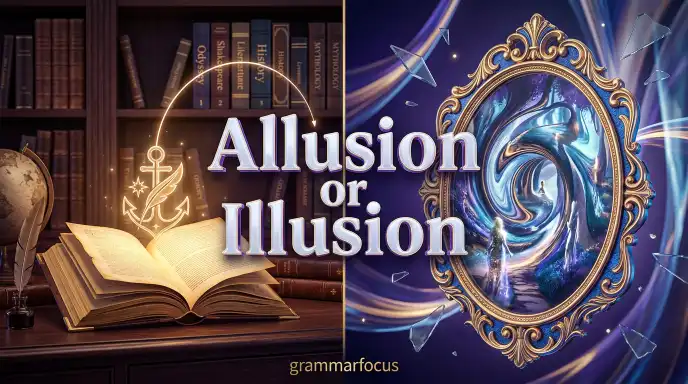
Allusion or illusion? These are two completely different words allusion means an indirect reference to a person, event, or idea, while illusion means a false or misleading appearance. Though they look and sound similar, their meanings are not related at all.
You’ll see allusion used in literature, speeches, and writing, often as a reference to something without explaining it directly.
Illusion, on the other hand, appears in discussions about magic, perception, or things that seem real but aren’t.
The spelling difference is small, but the meanings are easy to remember: think of allusion as a reference, and illusion as something that deceives.
Allusion or Illusion: Quick Answer
Allusion means an indirect reference. Illusion means a false or misleading appearance.
| Word | Meaning | Simple Connection |
| Allusion | An indirect reference | Reference |
| Illusion | A misleading appearance or perception | False appearance |
Examples
Allusion:
The author makes an allusion to Shakespeare’s Romeo and Juliet.
Illusion:
The magician created the illusion that the coin had disappeared.
A useful memory trick is:
Allusion = reference
Illusion = appearance
Quick Comparison: Allusion vs Illusion
| Feature | Allusion | Illusion |
| Part of speech | Noun | Noun |
| Main meaning | Indirect reference | False or misleading appearance |
| Common fields | Literature, writing, speech | Magic, art, perception |
| Related verb | Allude | — |
| Example | An allusion to history | An optical illusion |
The words are often confused because they differ by only one letter. Their meanings, however, are quite separate.
Pronunciation and Word Form
Allusion
- US IPA: /əˈluːʒən/
- UK IPA: /əˈluːʒən/
- Part of speech: Noun
- Meaning: An indirect reference to something
Example:
The poem contains an allusion to Greek mythology.
The related verb is allude:
The speaker alluded to the earlier disagreement.
Illusion
- US IPA: /ɪˈluːʒən/
- UK IPA: /ɪˈluːʒən/
- Part of speech: Noun
- Meaning: A false or misleading perception or appearance
Example:
The painting creates the illusion of depth.
The pronunciation difference is mainly in the first vowel sound. Allusion begins with /ə/, while illusion begins with /ɪ/.
Definition and Meaning of Allusion
An allusion is an indirect reference to something that the writer or speaker expects the audience to recognize.
The reference may point to:
- A historical event
- A famous person
- A book
- A film
- A myth
- A religious story
- A well known cultural idea
An allusion does not usually explain the subject in detail. Instead, it briefly points toward it.
Example
His journey from poverty to success was an allusion to the classic American dream.
The sentence refers indirectly to a familiar cultural idea.
Another example is:
The character’s difficult journey contains an allusion to Homer’s Odyssey.
The writer does not need to describe the entire story. The reference gives readers additional meaning if they recognize it.
Definition and Meaning of Illusion
An illusion is something that appears to be true or real but is not what it seems.
It can involve visual perception, sound, beliefs, or expectations.
Examples
The magician created the illusion of making the object disappear.
The mirror gives the illusion of a larger room.
The calm surface created an illusion of safety.
An illusion can therefore be physical or figurative.
Optical Illusion
An optical illusion is an image or visual effect that causes the eyes or brain to interpret something differently from its actual form.
For example, a picture may make two equal lines appear to have different lengths. The lines have not actually changed; the perception creates the illusion.
The Main Difference Between Allusion and Illusion
The easiest way to distinguish the words is to focus on what each one does.
Allusion points to something.
Illusion makes something seem different from reality.
Consider these examples:
The novel contains an allusion to Greek mythology.
The author is making a reference.
The painting creates an illusion of movement.
The painting produces an appearance that is not literally happening.
So, an allusion is about reference, while an illusion is about perception or appearance.
The Origin of Allusion and Illusion
Although allusion and illusion have different meanings, their histories are related through Latin roots.
Allusion comes from the Latin alludere, meaning to play with, refer to, or make an indirect reference. It entered English with the sense of referring to something without stating it directly.
Illusion comes from the Latin illusio, related to illudere, meaning to mock, deceive, or mislead. Its modern English meaning developed around false appearances and mistaken perceptions.
The similar looking forms are therefore partly connected to their historical development, but they took different paths in English.
Today, the distinction is clear:
allusion = indirect reference
illusion = misleading appearance or perception

Common Types of Allusion
Allusions can appear in many kinds of writing.
Literary Allusion
A writer may refer indirectly to another famous work.
The novel contains an allusion to Alice in Wonderland.
Historical Allusion
A speech may refer to a famous event without explaining it.
The speech included an allusion to the fall of the Berlin Wall.
Mythological Allusion
Writers often refer to Greek or Roman mythology.
Her courage is an allusion to Athena.
Cultural Allusion
A speaker may refer to a well known movie, song, or cultural event.
His comment was an allusion to a famous film.
Recognizing an allusion often helps readers understand an extra layer of meaning.
Common Types of Illusion
An illusion can appear in several forms. The word is not limited to magic tricks.
Visual Illusion
A visual illusion makes something appear different from its actual form.
The artwork creates an illusion of movement.
Magic Illusion
Magicians often use carefully designed effects to create an illusion.
The magician created the illusion that the box was empty.
Figurative Illusion
The word can also describe a mistaken belief or impression.
He lived under the illusion that success would come without effort.
In each case, something appears different from reality or is understood incorrectly.
Allusion or Illusion in Everyday Writing
Both words can appear in everyday writing, but their contexts are different.
Use allusion when someone refers indirectly to another subject.
Her speech contained an allusion to a famous historical event.
Use illusion when something creates a false impression.
The bright lighting created the illusion of a larger space.
Two useful patterns are:
allusion to + subject
illusion of + appearance or condition
These patterns can make the difference easier to remember.
Common Mistakes With Allusion and Illusion
The most common mistake is using illusion when you mean an indirect reference.
❌ The author made an illusion to the famous novel.
✅ The author made an allusion to the famous novel.
Another mistake is using allusion when discussing something that looks real but is not.
❌ The magician created an allusion of disappearance.
✅ The magician created an illusion of disappearance.
A helpful test is to ask what the sentence means.
If it means “reference”, choose allusion.
If it means “false appearance”, choose illusion.
Allusion and Illusion in Literature
Both words are useful when discussing literature, but they describe different techniques.
An allusion can add meaning by connecting a text to another story, person, event, or idea.
For example:
The writer uses an allusion to the Odyssey to highlight the hero’s difficult journey.
An illusion can describe something a literary character believes that is not true.
The character lives under the illusion that nobody has discovered his secret.
This distinction is useful in essays and literary analysis.
How to Remember Allusion vs Illusion
A simple memory trick can help:
Allusion = Alludes
Allusion is related to the verb allude, which means to refer to something indirectly.
The writer alluded to the historical event.
So:
allude → allusion → reference
Illusion = Image or Appearance
Think of an illusion as something that affects how you see or understand reality.
The mirror creates an illusion of extra space.
So:
illusion → appearance → misleading perception
Remembering these two connections makes the spelling much easier.
Allusion or Illusion: Which Word Should You Use?
Choose allusion when you mean an indirect reference to another person, event, work, or idea.
Choose illusion when you mean a false appearance, misleading perception, or mistaken belief.
Use Allusion
The poem contains an allusion to Greek mythology.
Use Illusion
The special effects created the illusion of reality.
When you are unsure, replace the word with a simpler term.
For a reference, use allusion.
When you mean a false appearance or misleading impression, choose illusion.
Frequently Asked Questions
Q1. What is the difference between allusion and illusion?
Answer. Allusion means an indirect reference, while illusion means a false or misleading appearance, perception, or belief.
Q2. Is an allusion a reference?
Answer. Yes. An allusion is an indirect reference to a person, event, work, idea, or other subject.
Q3. What is an example of an illusion?
Answer. A mirror that makes a small room appear larger creates an illusion of extra space.
Q4. How do you remember allusion and illusion?
Answer. Connect allusion with allude, meaning “refer indirectly.” Connect illusion with a false appearance or perception.
Q5. Is it an allusion to or an illusion to?
Answer. Use allusion to when you mean an indirect reference. For example, “The poem contains an allusion to Greek mythology.”
Q6. What is the verb form of allusion?
Answer. The related verb is allude. For example, “The speaker alluded to the earlier event.”
Q7. Can illusion mean a false belief?
Answer. Yes. Illusion can describe a mistaken belief or impression, as in “He had the illusion that everything was under control.”
Q8. Are allusion and illusion pronounced differently?
Answer. Yes, slightly. Allusion begins with /ə/, while illusion begins with /ɪ/. The remaining sounds are very similar.
Conclusion: Allusion or Illusion
Allusion and illusion may look and sound similar, but their meanings are different. Allusion means an indirect reference, while illusion describes a false appearance, misleading perception, or mistaken belief.
Remember the easiest distinction:
Allusion = reference
Illusion = false appearance
Use allusion when a writer or speaker points indirectly to another subject. Use illusion when something seems different from reality.
Learn More About Grammar:
- Meet or Meat: What’s the Difference?
- Revise or Correct: Meaning, Differences & Examples
- Matt or Mat? One Letter Changes Everything (2026)

I’m Alex Morgan, an American English writer with 6 years of experience exploring grammar, punctuation, sentence structure, and everyday English usage. I enjoy turning confusing grammar rules into clear, practical explanations that help readers write and communicate with confidence.






2 thoughts on “Allusion or Illusion? A Trick of the Mind vs. a Trick of Words (2026) ”