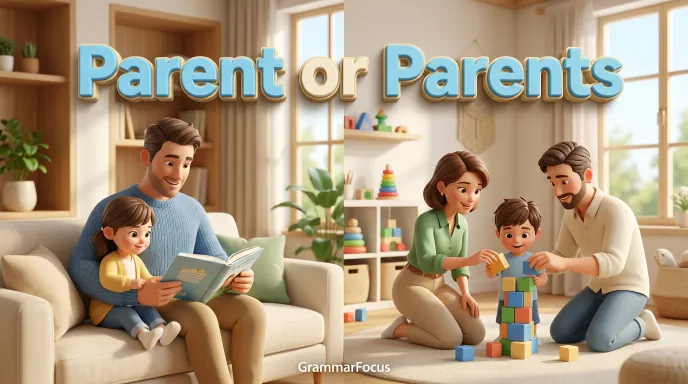
Parent or parents depends on if you mean one mother or father, or two or more parents. Parent is singular, while parents is the plural form.
Use parent when talking about one person who is a mother or father. Use parents when referring to two or more people who are a child’s mother, father, or other recognized parental figures.
This guide explains the difference between parent and parents, with clear examples, common grammar patterns, possessive forms, and everyday usage. It also shows when each form is appropriate.
Parent or Parents: Quick Answer
The main difference is number.
| Word | Number | Meaning | Example |
| Parent | Singular | One mother, father, or parental figure | My parent called me. |
| Parents | Plural | Two or more parents | My parents called me. |
The choice depends on how many people you are talking about.
Parent = one person
Parents = two or more people
For example:
- My parent is coming to the school.
- My parents are coming to the school.
The first sentence refers to one parent. The second refers to more than one.
Pronunciation and Word Form
Parent
- US: /ˈperənt/
- UK: /ˈpeərənt/
- Part of speech: Noun
Example:
Every child needs support from a parent.
Parent is a singular countable noun. It can refer to a mother, father, or another person who has a parental role.
Parents
- US: /ˈperənts/
- UK: /ˈpeərənts/
- Part of speech: Plural noun
Example:
The parents attended the school meeting.
Parents is the plural form of parent.
Definition and Meaning of Parent
A parent is a person who has a child. In everyday English, the word usually refers to a child’s mother or father.
For example:
- My parent works at a hospital.
- A parent must sign the form.
- The teacher spoke with a parent.
Because parent is singular, it refers to one person.
You can use it when you do not need to identify if the person is the mother or father.
For example:
A parent should attend the meeting.
This sentence does not specify which parent will attend.
Definition and Meaning of Parents
Parents is the plural form of parent. It normally refers to two or more people who are parents.
In many everyday situations, parents refers specifically to a child’s mother and father.
For example:
- My parents live nearby.
- Her parents are very supportive.
- The parents attended the ceremony.
The word can also refer to a larger group of people who have children.
For example:
Parents should read the instructions carefully.
Here, parents means parents in general rather than the parents of one specific child.
The Main Difference Between Parent and Parents
The difference is simple: parent is singular, while parents is plural.
Use parent for one person:
One parent attended the meeting.
Use parents for two or more people:
Both parents attended the meeting.
The verb must also agree with the noun.
Singular
Parent + is/was/has
- My parent is here.
- The parent was informed.
- The parent has signed the form.
Plural
Parents + are/were/have
- My parents are here.
- The parents were informed.
- The parents have signed the form.
This agreement is an important part of using parent and parents correctly.
When Should You Use Parent?
Use parent when you are referring to one person.
Examples:
- A parent must collect the child.
- The parent signed the permission slip.
- One parent stayed at home.
- Each parent received a message.
You can also use parent when speaking about parents generally in a singular, general sense.
For example:
A parent may worry about a child’s safety.
This does not necessarily mean one specific parent. It can describe a general situation that applies to parents.
When Should You Use Parents?
Use parents when referring to two or more parents.
Examples:
- Her parents live in Canada.
- The parents attended the meeting.
- My parents gave me good advice.
- Both parents signed the document.
You can also use parents when talking about parents as a group.
For example:
Parents often want the best for their children.
Here, parents refers to parents generally.
Parent vs Parents With Verbs
One of the easiest ways to identify the correct form is to check the verb.
With parent, use a singular verb:
- The parent is waiting.
- The parent has arrived.
- The parent was informed.
With parents, use a plural verb:
- The parents are waiting.
- The parents have arrived.
- The parents were informed.
A common mistake is using parents is or parents was when the sentence requires a plural verb.
Incorrect:
❌ My parents is at home.
Correct:
✅ My parents are at home.
Parent and Parents in Possessive Forms
Possessive forms also change depending on if you mean one parent or more than one.
One parent
Use parent’s for something belonging to one parent.
My parent’s car is outside.
This means the car belongs to one parent.
Two or more parents
Use parents’ for something belonging to multiple parents.
My parents’ car is outside.
This means the car belongs to more than one parent.
There is an important difference between parent’s and parents’:
- parent’s = belonging to one parent
- parents’ = belonging to two or more parents
Common Mistakes With Parent and Parents

Mistake 1: Using parents for one person
❌ My parents is a teacher.
If you mean one person, use parent:
✅ My parent is a teacher.
Mistake 2: Using parent with a plural verb
❌ My parent are at home.
Use the singular verb:
✅ My parent is at home.
Mistake 3: Confusing parents and parent’s
❌ My parents advice helped me.
If the advice belongs to one parent:
✅ My parent’s advice helped me.
If it belongs to both parents:
✅ My parents’ advice helped me.
Mistake 4: Confusing parents with parent’s
The apostrophe changes the meaning. Parents is simply plural, while parent’s shows possession.
Parent or Parents in Everyday English
Both forms are extremely common in everyday conversations.
Parent:
- I need to call a parent.
- The parent signed the form.
- Every parent wants their child to be safe.
Parents:
- My parents are at home.
- Her parents called yesterday.
- Parents should check the notice.
The correct choice depends mainly on if you mean one parent or more than one parent.
Parent and Parents in Different Contexts
The singular and plural forms can be used in many different situations.
In school communication, parent may refer to one adult responsible for a child:
A parent must sign the permission form.
If the message is addressed to a group, parents is more natural:
Parents must sign the permission forms.
In legal or administrative writing, the singular form is useful when a rule applies to each individual:
The parent must provide identification.
The plural form is useful when referring to several people:
Parents must provide identification.
The context tells you if the writer means one person or a group.
Parent and Parents With Each, Every, and Both
Certain words make the singular or plural choice especially clear.
Each parent
A singular noun follows each.
For example, each parent received a separate letter.
Not:
❌ Each parents received a letter.
Every parent
A singular noun also follows every.
For example, every parent should read the notice.
Not:
❌ Every parents should read the notice.
Both parents
The word both refers to two people and takes a plural noun.
For example, both parents attended the meeting.
Remember:
- each parent
- every parent
- both parents
This pattern is useful in formal and everyday English.
Parent or Parents With Children
The word parent can refer to one person responsible for a child, while parents commonly refers to multiple parental figures.
For example:
A parent may need to collect the child from school.
This sentence could refer to a mother, father, or another parent.
When referring to more than one:
The parents collected the children after school.
The plural form can also be used in general statements:
Parents play an important role in a child’s development.
This does not refer to one particular family. It discusses parents as a group.
Parent, Parents, and Parental
Parental is a related adjective. It describes something connected with parents or the role of a parent.
Examples:
- parental responsibility
- parental support
- parental guidance
- parental involvement
- parental permission
Compare:
The parent gave permission.
And:
Parental permission was required.
Parent is a noun, while parental is an adjective.
Another related word is parenting, which refers to the activity or process of raising and caring for children.
Parent vs Parents vs Parenting
These three forms have different grammatical functions.
| Word | Function | Example |
| Parent | Singular noun | The parent called the school. |
| Parents | Plural noun | The parents called the school. |
| Parenting | Noun / gerund | Parenting can be challenging. |
| Parental | Adjective | Parental support is important. |
Understanding the word form helps prevent unnecessary grammar mistakes.
Parent and Parents in Formal Writing
In formal writing, the same singular and plural rules apply.
Use parent when referring to one person:
The parent is responsible for completing the form.
Use parents when referring to more than one person:
Parents are responsible for completing the forms.
When writing instructions for a broad audience, either form may work depending on the sentence.
For example:
A parent should contact the school office.
This presents the instruction from an individual perspective.
Alternatively:
Parents should contact the school office.
This addresses parents as a group.
Both are grammatically correct.
Common Expressions With Parent and Parents
Several everyday expressions use these words.
Parent teacher meeting
A parent teacher meeting is a meeting between parents and teachers to discuss a student’s progress.
The parent-teacher meeting is next Friday.
Parents’ evening
Parents’ evening is commonly used in British English for an event where parents meet teachers.
The school is holding a parents’ evening.
Single parent
A single parent is a parent who raises a child without a partner in the household or relationship context intended by the speaker.
She is raising two children as a single parent.
New parent
A new parent is someone who has recently become a parent.
The new parents received many congratulations.
These expressions show how the singular and plural forms work naturally in different contexts.
Parent’s, Parents’, and Parents: A Quick Comparison
These three forms are easy to confuse.
| Form | Meaning | Example |
| parent | One parent | The parent arrived. |
| parents | More than one parent | The parents arrived. |
| parent’s | Belonging to one parent | The parent’s phone rang. |
| parents’ | Belonging to two or more parents | The parents’ meeting began. |
The apostrophe is important.
Parents does not contain an apostrophe when it simply means more than one parent.
Parent’s and parents’ are possessive forms.
How to Remember Parent or Parents
Use a simple number test.
Ask:
Am I talking about one person?
Use parent.
One parent attended.
Ask:
Am I talking about two or more people?
Use parents.
Both parents attended.
Then check the verb:
- parent is
- parents are
For possession:
- parent’s = one parent’s
- parents’ = two or more parents’ belongings, actions, or responsibilities
This quick check works in most everyday sentences.
FAQs About Parent or Parents
Q1. What is the difference between parent and parents?
Answer. Parent is singular and refers to one person. Parents is plural and normally refers to two or more people.
Q2. Is parents plural or singular?
Answer. Parents is plural. It is the plural form of the singular noun parent.
Q3. Should I say each parent or each parents?
Answer. Use each parent because each is followed by a singular countable noun.
Q4. Should I say every parent or every parents?
Answer. Use every parent. The word every takes a singular noun.
Q5. Is it parent is or parents are?
Answer. Use parent is for one parent and parents are for two or more parents.
Q6. What is the difference between parent’s and parents’?
Answer. Parent’s shows possession by one parent, while parents’ shows possession by two or more parents.
Q7. Is parental the same as parent?
Answer. No. Parent is a noun referring to a person, while parental is an adjective meaning related to a parent or parents.
Q8. Can parents refer to parents in general?
Answer. Yes. Parents can refer to parents as a general group, as in Parents should communicate with their children.
Key Takeaway
Parent and parents differ in number.
- Parent = one person
- Parents = two or more people
- Parent’s = belonging to one parent
- Parents’ = belonging to two or more parents
- Parental = related to a parent or parents
Use parent with singular forms such as is, was, each, and every. Use parents with plural forms such as are, were, and both.
Conclusion
The difference between parent or parents is mainly a matter of singular and plural grammar. Parent refers to one person, while parents refers to two or more people or to parents as a general group.
The possessive forms are also important: parent’s refers to one parent’s possession or responsibility, while parents’ refers to more than one parent.
Once you match the noun with the correct number, verb, and apostrophe, these forms become easy to use correctly.
Learn More About Grammar:
- Meet or Meat: What’s the Difference?
- Allusion or Illusion? A Trick of the Mind vs. a Trick of Words (2026)
- Matt or Mat? One Letter Changes Everything (2026)

I’m Elena Cooper, an English grammar writer with 6 years of experience explaining grammar, punctuation, sentence structure, word usage, and common English mistakes. I create clear, practical, and easy-to-follow content that helps readers understand confusing grammar rules and use English accurately and confidently.







3 thoughts on “Parent or Parents? Singular vs Plural Explained (2026)”