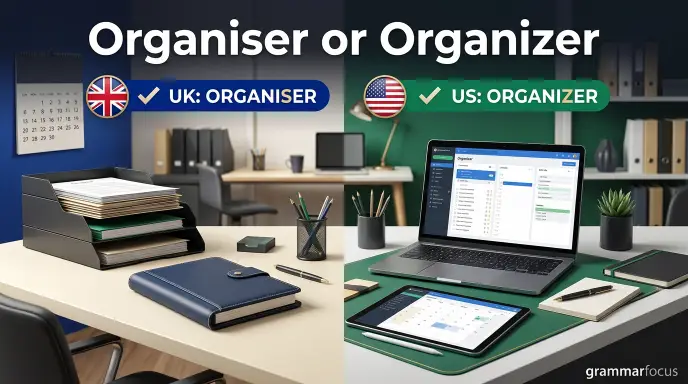
Organiser or organizer are both correct spellings of the same English word. Organizer is standard in American English, while organiser is common in British English and other varieties.
Both forms refer to a person or thing that arranges, manages, or puts something in order. For example, an organizer can plan an event, coordinate a group, or help keep items arranged.
The main difference is the spelling: American English uses -izer, while British English commonly uses -iser. Both forms have the same meaning and pronunciation.
Organiser or Organizer: Quick Answer
Organiser and organizer have the same meaning and pronunciation. The difference is mainly regional spelling.
| Word | Common usage | Meaning |
| Organizer | American English | A person or thing that arranges or manages something |
| Organiser | British English and many other varieties | A person or thing that arranges or manages something |
Examples:
- The event organizer contacted the speakers.
- The event organiser contacted the speakers.
Both sentences mean the same thing.
As a general rule:
US English → organizer
British English → organiser
Pronunciation and Word Form
Both spellings are normally pronounced the same way.
Organizer
- US: /ˈɔːrɡənaɪzər/
- UK: /ˈɔːɡənaɪzə/
- Part of speech: Noun
Example:
The organizer sent us the event details.
Organiser
- US: /ˈɔːrɡənaɪzər/
- UK: /ˈɔːɡənaɪzə/
- Part of speech: Noun
Example:
The organiser sent us the event details.
The spelling changes, but the pronunciation and basic meaning remain the same.
Definition and Meaning of Organizer
An organizer is a person who arranges or manages something.
For example, an organizer may plan:
- an event
- a conference
- a meeting
- a campaign
- a competition
- a community activity
Examples:
- The event organizer welcomed the guests.
- The conference organizer changed the schedule.
- The organizers announced the results.
Organizer can also refer to an object that helps keep things arranged.
For example:
- I bought a desk organizer.
- This drawer organizer saves space.
- She uses a jewelry organizer.
The exact meaning depends on context.
Definition and Meaning of Organiser
Organiser has the same meaning as organizer. British English commonly uses this spelling.
The word can also describe a person who plans or manages something.
- The event organiser welcomed the guests.
- The conference organiser sent an email.
- The organisers arranged additional seating.
It can also refer to an object used for arranging or storing things:
- I bought a desk organiser.
- The drawer organiser keeps everything in place.
- She uses a makeup organiser.
There is no difference in meaning between organiser and organizer.
The Main Difference Between Organiser and Organizer
The main difference is the spelling convention.
Organizer uses -izer:
organize → organizer
Organiser uses -iser:
organise → organiser
The American spelling generally uses -ize in words such as:
- organize
- organization
- organizer
- organized
British English commonly uses -ise:
- organise
- organisation
- organiser
- organised
However, British English also accepts and uses -ize in many contexts. Therefore, it is not accurate to say that -ize is always wrong in British English.
The important point is to follow the style you have chosen and remain consistent.
When Should You Use Organizer?
Use organizer when writing in standard American English.
It is the natural choice for US focused:
- websites
- business documents
- academic writing
- news content
- product descriptions
- event information
Examples:
- The event organizer confirmed the venue.
- The organizers are preparing the conference.
- I need a desk organizer for my office.
- The campaign organizer spoke to the media.
If your audience primarily uses American English, organizer is usually the appropriate spelling.
When Should You Use Organiser?
Use organiser when following a British English spelling style that uses -ise forms.
Examples:
- The event organiser confirmed the venue.
- The conference organiser contacted the speakers.
- The organisers prepared the schedule.
- I bought a desk organiser for my office.
This spelling is common in British English and is also used in several other English-speaking regions.
The word is not a different vocabulary item. It is simply another spelling of organizer.
Organiser or Organizer in American and British English
Regional spelling makes the difference easier to understand.
| English variety | Common spelling |
| American English | Organizer |
| British English | Organiser / Organizer |
| Australian English | Organiser is common |
| Canadian English | Both forms can occur |
British English has a long tradition of using -ise forms, but -ize forms are also found in British dictionaries and publications.
For American readers, organizer is the expected form. For a British-style publication, organiser may fit better.
Common Mistakes With Organiser and Organizer
A common mistake is treating one spelling as completely wrong.
❌ Organiser is always incorrect in English.
✅ Organiser is a standard spelling in British English.
Another mistake is using the two spellings randomly in one document.
For example:
The organizer contacted the organiser.
If both words refer to the same role, this can look inconsistent.
A cleaner approach is to choose one spelling style:
The organizer contacted the other organizer.
or:
The organiser contacted the other organiser.
Consistency helps your writing look polished and professional.
Organizer and Organiser in Everyday Sentences
Both forms work naturally in everyday English.
American English:
- The organizer called me this morning.
- The event organizers are ready.
- I bought a new desk organizer.
- The meeting organizer sent the agenda.
British English:
- The organiser called me this morning.
- The event organisers are ready.
- I bought a new desk organiser.
- The meeting organiser sent the agenda.
The meaning does not change. Only the spelling convention changes.
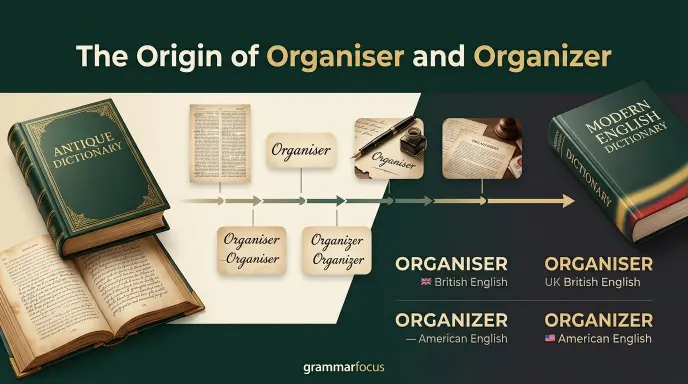
The Origin of Organiser and Organizer
Organiser and organizer come from the verb organize, which is related to the idea of arranging parts into a structured whole.
The word ultimately traces back to Greek and Latin forms connected with an organ or an organized system.
The spelling difference developed through English spelling conventions. American English generally prefers -ize, giving organize and organizer. British English commonly uses -ise, giving organise and organiser.
This difference also appears in other related words, so learning the pattern can help you recognize similar spelling pairs.
Organiser and Organizer in Different Contexts
The word can describe people who manage many different types of activities.
Events
An event organizer or organiser plans and coordinates an event.
The organisers arranged transportation for the guests.
Conferences
A conference organizer may handle schedules, speakers, registration, and venues.
The conference organizer sent the final program.
Community Activities
Community organizers bring people together around local activities or projects.
The community organisers arranged a neighborhood meeting.
Storage Products
An organizer or organiser can also be an object that keeps things arranged.
The desk organizer has several useful compartments.
The meaning becomes clear from the surrounding words.
Organizer vs Organization
These words are closely related but have different grammatical roles.
Organizer / organiser refers to a person or object that organizes something.
Organization / organisation refers to the act or process of organizing, or to a structured group.
For example:
- The organizer planned the conference.
- The organization held the conference.
Similarly:
- organize → verb
- organizer → person or thing that organizes
- organization → process or group
- organized → past form or adjective
Knowing these related forms makes the spelling pattern easier to remember.
Organizer and Organiser in Professional Writing
Both spellings can appear in professional writing. The correct choice depends mainly on the style of English being used.
For American English:
The event organizer will contact all registered participants.
For British English:
The event organiser will contact all registered participants.
Professional writers should also keep related spellings consistent. If a document uses organiser, it is natural to use organisation and organise as part of the same British-style spelling system.
Likewise, American English normally uses:
- organize
- organizer
- organization
- organized
Consistency gives a document a clear and intentional style.
Organiser and Organizer in Job Titles
Organizer and organiser can appear in descriptions of roles and responsibilities.
Examples include:
- event organizer
- community organizer
- conference organizer
- political organizer
- volunteer organizer
The spelling depends on the English variety.
For example:
She works as an event organizer in New York.
A British-style version could be:
She works as an event organiser in London.
The role itself does not change because of the spelling.
The -ize and -ise Spelling Pattern
The difference between organizer and organiser is part of a larger spelling pattern.
American English commonly uses -ize in words such as:
- organize
- recognize
- realize
- specialize
British English commonly uses -ise in these forms:
- organise
- recognise
- realise
- specialise
However, British English also permits or uses many -ize spellings. Therefore, -ise should not be treated as a universal rule for every British publication.
A style guide or dictionary can help when a specific spelling standard is required.
Related Spelling Pairs
Once you understand organiser or organizer, several similar pairs become easier to recognize.
| American English | British-style spelling |
| organize | organise |
| organizer | organiser |
| organization | organisation |
| organized | organised |
| organizing | organising |
| recognize | recognise |
| realize | realise |
| specialize | specialise |
These pairs generally have the same meanings. The difference is mainly spelling convention.
How to Choose the Right Spelling
Think about your intended audience before choosing between the two forms.
Use organizer when your content follows American English spelling.
Use organiser when your content follows a British style -ise convention.
If you are writing for a company, school, publication, or website with an established style guide, follow that guide.
FAQs About Organiser or Organizer
Q1. Is organiser or organizer correct?
Answer. Both are correct. Organizer is the standard American English spelling, while organiser is a common British English spelling.
Q2. Is organiser British or American?
Answer. Organiser is mainly associated with British English and other varieties that commonly use -ise spellings.
Q3. Is organizer American English?
Answer. Yes. Organizer is the standard spelling in American English.
Q4. Do organiser and organizer mean the same thing?
Answer. Yes. Both refer to a person or thing that arranges, manages, or puts something in order.
Q5. Which spelling should I use in a US article?
Answer. Use organizer when following standard American English spelling.
Q6. Which spelling should I use in British English?
Answer. Organiser is a common British English choice, although organizer is also found in British English.
Q7. Is organization British or American spelling?
Answer. Organization is the standard American spelling. Organisation is commonly used in British English.
Q8. Can I use organiser and organizer in the same article?
Answer. You can, but it is better to choose one spelling system and use it consistently unless you are intentionally discussing regional differences.
Key Takeaway
Organiser and organizer have the same meaning. The main difference is the spelling convention.
- Organizer → standard American English
- Organiser → common British English spelling
- Both can describe a person or an object that arranges or manages something.
- Related forms include organize/organise and organization/organisation.
- British English can also use -ize forms, so organizer is not automatically incorrect in British writing.
For clear writing, choose the form that matches your target variety of English and keep the spelling consistent.
Conclusion
The choice between organiser or organizer is mainly a matter of regional spelling. Both words have the same pronunciation, meaning, and grammatical function.
Use organizer for standard American English, while organiser is a common choice in British English and other varieties that favor -ise spellings.
The same pattern appears in related words such as organize/organise and organization/organisation.
The most important rule is simple: match your spelling to your audience and stay consistent throughout your writing.
Learn More About Grammar:
- Why Americans Write “Focused” and Brits Write “Focussed”
- Empower or Enpower: Only One Is a Real Word
- Binkie or Binky: Does It Even Matter Which You Use? (2026)

I’m Elena Cooper, an English grammar writer with 6 years of experience explaining grammar, punctuation, sentence structure, word usage, and common English mistakes. I create clear, practical, and easy-to-follow content that helps readers understand confusing grammar rules and use English accurately and confidently.







3 thoughts on “Organiser vs Organizer: The “S” vs “Z” Debate Explained (2026)”