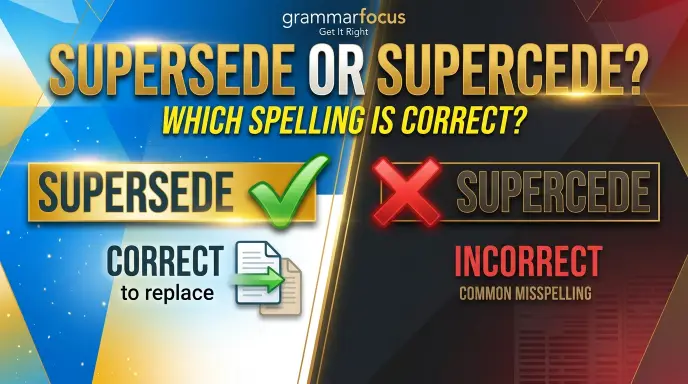
Supersede or Supercede: Supersede is the correct spelling in standard English, while supercede is a common misspelling. If you mean to replace something or take its place, use supersede.
The spelling can be confusing because the word sounds like it could end in -cede. However, the correct ending is -sede, which makes supersede the right choice in emails, reports, business writing, and formal documents.
Supersede or Supercede: Quick Answer
The correct spelling is supersede.
| Word | Correct? | Meaning | Example |
| Supersede | ✅ Yes | To replace or take the place of something | The new policy will supersede the old one. |
| Supercede | ❌ No | Common misspelling of supersede | Avoid supercede in formal writing. |
Supersede is the standard spelling used in modern English. Supercede is usually treated as an error.
Definition and Meaning of Supersede or Supercede
Supersede
Supersede is a verb. It means to replace something that was used or accepted before.
For example:
- The new law will supersede the old law.
- Digital records have superseded many paper records.
- This version supersedes the previous edition.
The word often appears when a new rule, system, product, or decision takes the place of an older one.
Supercede
Supercede is a common spelling mistake for supersede.
It looks reasonable because many English words end in -cede, such as:
- precede
- concede
- recede
- proceed
However, supersede is different. Its standard spelling ends in -sede.
The Origin of Supersede or Supercede
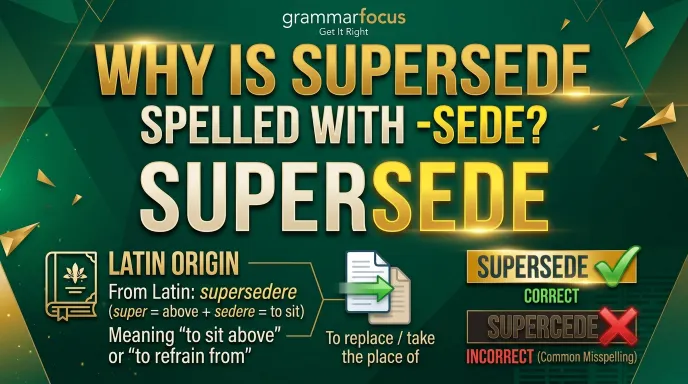
Supersede comes from Latin supersedere, meaning “to sit above” or “to sit upon.”
It entered English through Old French and later developed into the modern spelling supersede.
The spelling has stayed unusual because it does not follow the pattern of many other English words ending in -cede.
This history also explains why people sometimes write supercede. The spelling looks more familiar, but supersede is the established form.
Why Is Supersede Spelled With -Sede?
The ending is the main reason this word causes confusion.
The correct form is:
super + sede = supersede
Not:
super + cede = supercede
A useful way to remember it is to focus on the final four letters:
SUCCEED? No. SUPERSede.
The word supersede ends with s-e-d-e.
For example:
- ✅ The new rule will supersede the old rule.
- ❌ The new rule will supercede the old rule.
Remembering the unusual -sede ending is the easiest way to avoid this spelling mistake.
British English vs American English Spelling
Unlike some British and American spelling differences, supersede has the same standard spelling in both varieties of English.
| English Variety | Correct Spelling |
| American English | supersede |
| British English | supersede |
| Canadian English | supersede |
| Australian English | supersede |
There is no standard British spelling supercede. The correct form remains supersede.
Which Spelling Should You Use?
Use supersede in all standard English writing.
It works well in:
- Business emails
- Reports
- Academic writing
- Legal documents
- News articles
- Technical writing
- Everyday formal communication
If you are writing about a new policy replacing an old one, for example, write:
The updated policy will supersede the previous policy.
Do not write:
The updated policy will supercede the previous policy.
The second spelling is a common error.
Common Mistakes With Supersede or Supercede
1. Writing Supercede
The most common mistake is adding c instead of s in the middle of the word.
❌ The new system will supercede the old system.
✅ The new system will supersede the old system.
2. Following the Pattern of Other Words
Words such as precede and recede can make supercede look correct.
However, supersede follows its own spelling pattern.
3. Using the Wrong Form in Formal Writing
Because supercede is common online, writers may assume both spellings are accepted.
For standard formal English, choose supersede.
Everyday Examples of Supersede
In an Email
The revised schedule will supersede the version sent yesterday.
In Business Writing
The new contract will supersede the existing agreement.
In News Writing
The updated regulations are expected to supersede the previous rules.
In Technical Writing
Version 3.0 will supersede the older software version.
In Formal Writing
The court’s new decision may supersede the earlier ruling.
In each example, supersede means that something new replaces something older.
Supersede or Supercede: Google Trends & Usage Data
Searches for supersede and supercede often show the same spelling confusion found in everyday writing. Supersede is the standard form, while supercede is mainly searched because people want to check which spelling is correct.
The difference is easy to remember: supersede means to replace something, and its spelling ends in -sede.
Google Trends can show interest in spelling questions over time, but search interest does not change the standard spelling. For formal writing, supersede remains the correct choice.

Supersede in Everyday English
Supersede is most useful when one thing replaces another. It often appears with words such as policy, law, rule, system, version, agreement, and decision.
Here are a few simple examples:
- The new policy will supersede the old one.
- This update supersedes the previous version.
- The new agreement superseded the earlier contract.
- Modern technology has superseded many older methods.
The word is more common in formal writing than casual conversation. In everyday speech, people often use replace instead.
For example:
Formal: The new policy will supersede the old policy.
Simple: The new policy will replace the old policy.
Both sentences express the same basic idea.
Supersede or Supercede: A Simple Memory Trick
The unusual spelling can be easier to remember with one simple rule:
Supersede = replace
And remember:
Supersede ends with -sede.
You can also break the spelling into parts:
SUPER + SEDE = SUPERSEDE
Do not change the s to c.
❌ supercede
✅ supersede
This small spelling check can help when writing reports, emails, applications, and other formal documents.
Is Supercede Ever Correct?
Supercede is widely recognized as a misspelling of supersede. Some dictionaries may record it as a historical or variant form, but it is not the standard spelling you should choose in modern formal English.
If you want clear and correct writing, use supersede.
For example:
❌ The new rule will supercede the old rule.
✅ The new rule will supersede the old rule.
When in doubt, remember that the standard word has -sede.
Key Takeaway: Supersede or Supercede
The difference is simple:
- Supersede is the standard spelling.
- Supercede is generally considered a misspelling.
- Supersede means to replace or take the place of something.
- The word ends in -sede, not -cede.
- The spelling is the same in British and American English.
- Use supersede in formal and professional writing.
A quick memory tip is: “New things supersede old things.”
FAQs About Supersede or Supercede
Q1. Is supersede or supercede correct?
Answer. Supersede is the standard spelling. Supercede is generally considered a misspelling.
Q2. What does supersede mean?
Answer. Supersede means to replace something or take its place.
Q3. Why is supersede spelled with an S?
Answer. Supersede comes from Latin and has kept its unusual -sede ending. It does not follow the spelling pattern of words such as precede.
Q4. Is supercede a word?
Answer. Supercede appears in some historical or variant uses, but it is not the spelling normally recommended for modern standard English.
Q5. Is supersede the same in British and American English?
Answer. Yes. Supersede is the standard spelling in both British and American English.
Q6. What is a simple synonym for supersede?
Answer. Replace is the simplest common synonym. Depending on the context, take the place of can also work.
Q7. How do you remember the spelling of supersede?
Answer. Remember that the word ends in -sede: super + sede = supersede.
Q8. Can supersede be used in a sentence?
Answer. Yes. For example: The new policy will supersede the old policy.
Conclusion:
Supersede is the correct standard spelling when you mean to replace or take the place of something. The spelling can be confusing because many similar English words use -cede, but supersede uses -sede.
Supercede is a common spelling mistake. For clear and professional writing, always choose supersede.The easiest rule is simple: if something replaces something older, it supersedes it.
Learn More About Grammar:
- Cataloged or Catalogued: Which Is Correct in US and UK English?
- Organiser vs Organizer: The “S” vs “Z” Debate Explained (2026)
- Shiny or Shiney: Which Is Correct? Spelling Explained in 2026

I’m Alex Morgan, an American English writer with 6 years of experience exploring grammar, punctuation, sentence structure, and everyday English usage. I enjoy turning confusing grammar rules into clear, practical explanations that help readers write and communicate with confidence.








1 thought on “Supersede or Supercede: One Letter, One Common Error”