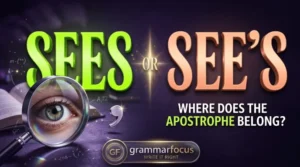
Sees is the correct spelling when you mean that someone looks at or notices something. See’s is usually incorrect because verbs do not take an apostrophe to form the third-person singular. The right choice depends on the meaning of the sentence.
Many people confuse sees and see’s because they sound the same. However, the apostrophe changes how the word is used. In standard English, sees is the present tense form of see used with he, she, or it. For example, “She sees a bird.”
The form see’s may appear in a name or as an unusual possessive form, but it is not the correct way to write the verb in a normal sentence. This guide explains the difference between sees and see’s, shows common mistakes, and gives simple examples to help you use the correct form.
Sees or See’s: Quick Answer
Use sees as the verb form. Do not use see’s when you mean that someone looks at something.
| Word | Correct Use | Example |
| Sees | Present-tense verb with he, she, or it | He sees the moon. |
| See’s | Usually incorrect as a verb | He see’s the moon. ❌ |
Quick rule: Use sees without an apostrophe when the subject is he, she, or it.
Definition and Meaning of Sees or See’s
What Does Sees Mean?
Sees is the third person singular present-tense form of the verb see. It means to notice something with your eyes, understand something, or meet someone.
Examples:
- She sees a cat in the garden.
- He sees the problem clearly.
- Maria sees her doctor every month.
The word can also describe understanding or recognizing an idea.
Example: “He sees why the plan failed.”
What Does See’s Mean?
See’s is not the standard spelling of the verb sees. In normal sentences, the apostrophe is unnecessary and incorrect.
Incorrect: “She see’s the sign.”
Correct: “She sees the sign.”
However, See’s can be correct in special cases, such as a proper name or a possessive construction involving a singular noun called See. For example, a business name may use an apostrophe as part of its official spelling.
Why Do People Confuse Sees and See’s?
The two forms sound the same when spoken. This can make it hard to notice the spelling difference. People may also think that an apostrophe is needed whenever a word ends in s. That is not true.
Apostrophes show possession or mark contractions. They do not form ordinary verb endings.
For example:
- Correct: She sees the bus.
- Incorrect: She see’s the bus.
The Origin of Sees or See’s
Where Does the Word See Come From?
The word see comes from Old English sēon, which meant to see or perceive with the eyes. It has Germanic roots and is related to similar words in other Germanic languages. Over time, see developed several meanings. It can refer to eyesight, understanding, meeting someone, or checking something.
For example, “I see your point” means “I understand your point.”
How Did Sees Become the Correct Form?
English verbs usually add -s or -es when the subject is he, she, or it in the simple present tense.
Examples:
- I see.
- You see.
- He sees.
- She sees.
- They see.
This rule explains why sees has no apostrophe.
Why Is See’s Usually Incorrect?
The apostrophe does not belong in the regular verb form. It is not used to join see and s in this case. Writers may add it because they confuse verb endings with possessive forms. However, the standard spelling is sees.
British English vs American English Spelling
Is Sees Spelled Differently in British and American English?
No. Sees is spelled the same way in British and American English. The same grammar rule applies in both varieties.
| Feature | British English | American English |
| Correct verb | Sees | Sees |
| Incorrect verb form | See’s | See’s |
| Base form | See | See |
| Past tense | Saw | Saw |
| Past participle | Seen | Seen |
| Example | She sees the train. | She sees the train. |
Does See’s Ever Work in Either Variety?
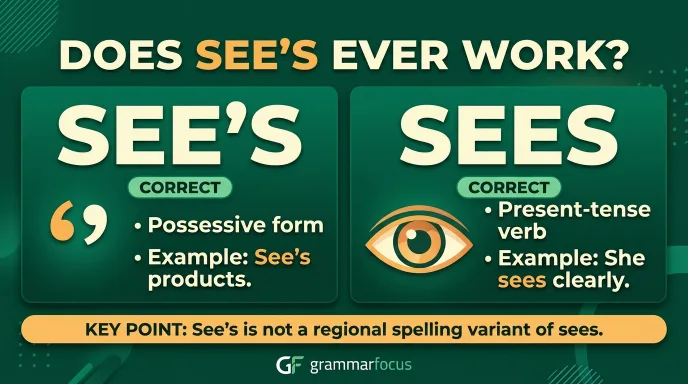
Yes, but only in special contexts where the apostrophe has a separate purpose. For example, See’s Candies is the name of an American candy company. The apostrophe is part of the brand’s official name. That does not make see’s correct as an ordinary verb.
Which Spelling Should You Use?
Use sees in standard writing when describing what he, she, or it sees. This rule applies to schoolwork, business emails, reports, articles, and everyday messages in both American and British English.
Which Spelling Should You Use?
For American Readers
Use sees when the subject is he, she, or it.
Example: “She sees the mountains from her window.”
Do not add an apostrophe to the verb.
For British Readers
Follow the same rule. Sees is correct in British English, too.
Example: “He sees his friends after school.”
For Global Readers
If you write for an international audience, use sees as the normal verb form. The spelling is standard across major English varieties, so there is no need to choose a regional version.
For Names and Brands
Some names and brands include apostrophes. In those cases, copy the official spelling. For example, See’s Candies uses an apostrophe in its name. This is a proper name, not an example of the verb sees.
Remember: ordinary verbs do not need an apostrophe to form their present-tense endings.
Common Mistakes with Sees or See’s
Mistake 1: Adding an Apostrophe to the Verb
Incorrect: “He see’s the car.”
Correct: “He sees the car.”
The verb needs -s, not an apostrophe.
Mistake 2: Using Sees with I or You
In the simple present tense, sees is used with he, she, or it.
Incorrect: “I sees the problem.”
Correct: “I see the problem.”
Also correct: “She sees the problem.”
Mistake 3: Confusing Sees with Saw
Sees describes the present. Saw is the simple past tense.
Present: “She sees the doctor today.”
Past: “She saw the doctor yesterday.”
Choose the form that matches the time.
Mistake 4: Confusing Sees with Seen
Seen usually needs a helping verb, such as has, have, or had.
Incorrect: “He seen the movie.”
Correct: “He has seen the movie.”
Use sees for the simple present and seen in the appropriate perfect-tense forms.
Mistake 5: Using an Apostrophe for a Plural
Apostrophes are not normally used to make words plural.
Incorrect: “She see’s birds every morning.”
Correct: “She sees birds every morning.”
The apostrophe is not needed.
Sees or See’s in Everyday Examples
In Emails
Correct: “The manager sees the report every Monday.”
Incorrect: “The manager see’s the report every Monday.”
In News Writing
Correct: “The new policy sees a rise in public support.”
In this sentence, sees means experiences or witnesses.
On Social Media
Correct: “She sees every comment on her post.”
Incorrect: “She see’s every comment on her post.”
In Formal Writing
Correct: “The study sees a clear link between sleep and learning.” A more natural alternative may be “The study shows a clear link between sleep and learning,” depending on the intended meaning.
In Daily Conversation
- “He sees his family every weekend.”
- “She sees what you mean.”
- “My dog sees a squirrel outside.”
In all these examples, sees is the correct verb form.
Sees or See’s: Usage and Search Trends
Which Form Is Correct in Standard English?
Sees is the standard verb form. People may search for see’s because they are unsure about apostrophe rules or want to check a brand or name. Search frequency does not decide if a spelling is grammatically correct.
How Can You Compare Search Interest?
Google Trends can compare the two search terms by country and time period.
- Open Google Trends.
- Enter sees as the first term.
- Add see’s as the second term.
- Choose a country or worldwide results.
- Select a time range and review the graph.
Search results may include names, brands, and other uses. Google Trends reports relative interest rather than exact search totals. For ordinary verb use, choose sees regardless of search popularity.
Sees vs See’s: Side by Side Comparison
| Comparison Point | Sees | See’s |
| Standard verb form | Yes | No |
| Used with he, she, or it | Yes | No |
| Needs an apostrophe | No | Only in special uses |
| British English | Correct | Usually incorrect as a verb |
| American English | Correct | Usually incorrect as a verb |
| Example | She sees the dog. | She see’s the dog. ❌ |
The difference is simple: sees is the correct present-tense verb, while see’s is not correct for that purpose.
FAQs About Sees or See’s
Q1. Is It Sees or See’s?
Answer. Sees is correct when you mean that someone looks at, notices, or understands something. See’s is usually incorrect as a verb.
Q2. Why Is See’s Wrong?
Answer. The apostrophe is not needed to form the third person singular present tense of see. The correct form is sees.
Q3. Is Sees Correct in British English?
Answer. Yes. Sees is correct in both British and American English. The spelling does not change between these varieties.
Q4. Can See’s Ever Be Correct?
Answer. Yes. It may appear in a proper name, such as See’s Candies, or in a special possessive construction. It is not the standard verb form.
Q5. What Is the Difference Between See, Sees, and Saw?
Answer. See is the base form, sees is used with he, she, or it in the simple present, and saw is the simple past tense.
Q6. What Is the Past Participle of See?
Answer. The past participle is seen. It is used with helping verbs, as in “She has seen the film.”
Q7. How Can I Remember the Correct Spelling?
Answer. Remember that sees has no apostrophe when it is a verb. Use the spelling sees in sentences such as “He sees the road.”
Q8. Is See’s a Plural Form of See?
Answer. No. Sees is a verb form, not a plural noun. Adding an apostrophe does not make a word plural.
Conclusion: Sees or See’s?
Sees is the correct spelling when you mean that someone looks at, notices, or understands something. The word is used with he, she, or it in the simple present tense. Use see’s only in special cases, such as an official name. Do not add an apostrophe to the ordinary verb.
Remember: I see, you see, but he sees. This simple rule will help you avoid the mistake in emails, articles, schoolwork, and everyday writing.
Learn More About Grammar:
- Modeled or Modelled: Which Spelling Should You Use?
- Somber or Sombre? The Simple Rule You Need to Know!
- Stoped or Stopped? Fix It in 5 Seconds With This Rule

I’m Alex Morgan, an American English writer with 6 years of experience exploring grammar, punctuation, sentence structure, and everyday English usage. I enjoy turning confusing grammar rules into clear, practical explanations that help readers write and communicate with confidence.