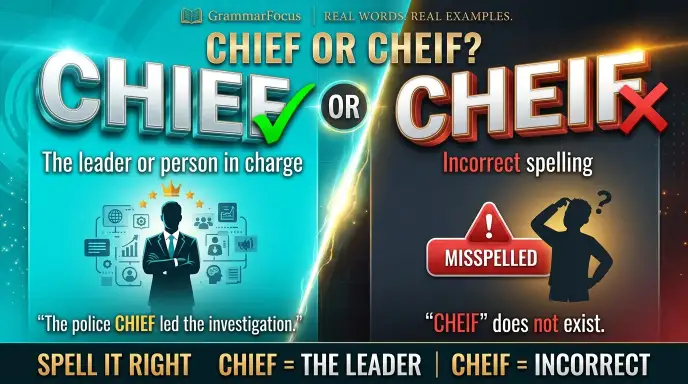
Chief is the correct spelling in English. Cheif is a common spelling mistake. The word chief refers to a leader, a person in charge, or someone with the highest rank in a group.
People often misspell this word because the letters i and e appear in an unexpected order. However, the correct spelling is always chief, with ie after the letter h.
Learning this spelling can help you write clearly in school assignments, workplace emails, news articles, and everyday messages.
Chief or Cheif: Quick Answer
| Word | Status | Meaning | Example |
| Chief | Correct | A leader or person in charge | The chief addressed the team. |
| Cheif | Incorrect | A common misspelling of chief | Write chief, not cheif. |
Remember this simple rule: chief is correct; cheif is incorrect.
Pronunciation and Word Form
Chief
- US pronunciation: /tʃiːf/
- UK pronunciation: /tʃiːf/
- Part of speech: Noun or adjective
- Example as a noun: The fire chief arrived at the scene.
- Example as an adjective: Our chief concern is safety.
The word has one syllable. It begins with the “ch” sound, followed by a long “ee” sound and an “f” sound at the end.
Cheif has no standard English pronunciation as a separate word because it is a misspelling of chief.
Definition and Meaning of Chief or Cheif

What Does Chief Mean?
Chief can be used as a noun or an adjective. Its meaning depends on how it appears in a sentence.
As a noun, chief means a leader or someone with authority over a group, team, or organization.
Examples:
- The police chief held a press conference.
- The village chief welcomed the visitors.
- The company chief announced a new plan.
As an adjective, chief means most important or main.
Examples:
- Our chief goal is to improve customer service.
- The chief reason for the delay was bad weather.
- Safety is the chief priority at the factory.
What Does Cheif Mean?
Cheif is not the standard spelling of an English word. It usually appears because someone accidentally switches the letters i and e in chief.
For example:
Incorrect: The cheif welcomed the guests.
Correct: The chief welcomed the guests.
The correct spelling is needed in formal writing, professional communication, and academic work.
The Origin of Chief or Cheif
The word chief entered English through Old French chief, which meant “head” or “leader.” It ultimately comes from the Latin word caput, meaning “head.”
Over time, chief developed several related meanings. It came to describe a person in charge, the head of an organization, or something that holds the greatest importance.
For example, a police chief leads a police department, while a chief reason is the main reason for something.
The spelling cheif does not have a separate word history in standard English. It is simply a common letter order mistake.
Chief or Cheif: Key Differences
The main difference is spelling. Only chief is correct in standard English.
| Feature | Chief | Cheif |
| Spelling | Correct | Incorrect |
| Meaning | Leader or most important | No standard meaning |
| Part of speech | Noun or adjective | Misspelling |
| Usage | Standard English | Spelling error |
| Example | The chief made a decision. | Use chief, not cheif. |
The correct word can describe a person, a position, or something important. The incorrect spelling should be avoided in essays, reports, emails, and published content.
Common Mistakes With Chief or Cheif
The most common mistake is placing the e before the i. A few simple habits can help you avoid this error.
1. Switching the Letters
Incorrect: The cheif spoke to the staff.
Correct: The chief spoke to the staff.
Keep the letters in the correct order: c-h-i-e-f.
2. Using the Wrong Spelling in Job Titles
Incorrect: She spoke with the cheif executive.
Correct: She spoke with the chief executive.
Job titles and professional documents need accurate spelling, especially when referring to senior roles.
3. Misspelling the Word in Formal Writing
Incorrect: The cheif reason for the change was cost.
Correct: The chief reason for the change was cost.
Here, chief means “main” or “most important.” Checking the spelling before submitting a document can prevent this simple mistake.
4. Assuming the “I Before E” Rule Always Works
Some learners remember the phrase “i before e, except after c.” However, English has many exceptions, and this rule does not explain every spelling.
For chief, remember the exact letter sequence instead: ie after ch.
Everyday Examples of Chief or Cheif
Here are examples of how to use chief correctly in different situations.
At Work
- The chief executive shared the company’s plans.
- Our chief responsibility is to help customers.
- The department chief reviewed the report.
News and Public Services
- The police chief answered questions from reporters.
- The fire chief explained the safety measures.
- The village chief met with local residents.
School and Everyday Writing
- My chief concern was the final exam.
- Trust is the chief reason I value our friendship.
- The team chose a new chief for the project.
In each example, chief refers to a leader or something of primary importance. The spelling cheif would be incorrect.
Chief or Cheif: Which Spelling Should You Use?
Always use chief in standard English. The spelling cheif is incorrect and should be corrected in schoolwork, professional documents, emails, and published content.
The word chief has two common uses:
- As a noun: It describes a leader or person in charge.
Example: The chief welcomed the new employees. - As an adjective: It describes something most important.
Example: Our chief concern is customer safety.
Before submitting your writing, check the order of the letters. The correct spelling is c-h-i-e-f.

How to Remember the Spelling of Chief
A simple memory trick can help you avoid writing cheif by mistake.
Remember: “The chief comes first, and IE stays together.”
Focus on the letter sequence I-E in the middle of chief. When writing about a leader or something important, check that you have used this order.
Try these examples:
- The chief officer attended the meeting.
- The chief reason for the delay was traffic.
- The police chief spoke to reporters.
You can also practise writing chief a few times. Repeated use helps the correct spelling become familiar.
Chief or Cheif: Common Search and Usage Questions
People often look up chief or cheif when checking the spelling of job titles, leadership roles, or phrases such as chief executive and chief concern.
The confusion usually comes from switching the letters i and e. However, chief is the only correct spelling in standard English.
Search interest can change over time and across regions. Without verified trend data, it is better not to claim exact search volumes or popularity figures. For practical writing, the spelling rule is clear: use chief, not cheif.
Key Takeaway: Chief or Cheif
- Chief is the correct English spelling.
- Cheif is a misspelling.
- Chief can mean a leader or something most important.
- The correct letter order is c-h-i-e-f.
- Remember the middle letters ie to avoid the common mistake.
Whenever you write this word, check the spelling before moving on. A quick review can prevent an easy to miss error.
FAQs About Chief or Cheif
Q1. Is it chief or cheif?
Answer. Chief is correct. Cheif is a common spelling mistake.
Q2. What does chief mean?
Answer. Chief can mean a leader or person in charge. As an adjective, it means main or most important.
Q3. Why do people spell chief as cheif?
Answer. People often switch the letters i and e by mistake. Remembering the correct sequence, ie, can help prevent this error.
Q4. Is cheif a real English word?
Answer. No. Cheif is not the standard spelling of an English word. The correct spelling is chief.
Q5. How do you use chief in a sentence?
Answer. You can write, “The police chief spoke to reporters.” You can also use it as an adjective: “Our chief concern is safety.”
Q6. What part of speech is chief?
Answer. Chief can be a noun or an adjective. As a noun, it refers to a leader. As an adjective, it describes something most important.
Q7. What is the plural of chief?
Answer. The plural is chiefs. For example, “The chiefs attended the annual meeting.”
Q8. What is an easy way to remember chief?
Answer. Remember the spelling c-h-i-e-f and keep the letters i and e in that order. Writing the word correctly several times can also help.
Conclusion: Chief or Cheif
The correct spelling is chief, not cheif. It can refer to a leader, such as a police chief, or describe something important, such as a chief concern.
Although the two spellings look similar, only chief is accepted in standard English. Remember the letter order ie, and you can use this word confidently in everyday and professional writing.
Learn More About Grammar:
- Spicket or Spigot: The Correct Term for a Water Tap
- Cuatro or Quatro: The Spanish Word for Four Explained
- Favour or Favor: Which Spelling Wins? British vs. American English

I’m Elena Cooper, an English grammar writer with 6 years of experience explaining grammar, punctuation, sentence structure, word usage, and common English mistakes. I create clear, practical, and easy-to-follow content that helps readers understand confusing grammar rules and use English accurately and confidently.