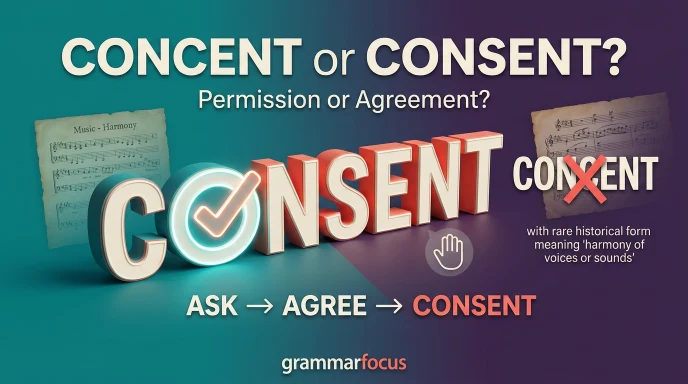
Consent is the correct spelling, while concent is generally a misspelling when you mean permission or agreement. The word consent means permission or agreement to something, especially when someone freely accepts what is proposed or requested.
It is commonly used in everyday conversations, legal documents, medical contexts, relationships, workplaces, and formal writing.
The confusion between concent and consent often happens because the two words look and sound similar.
The main difference is the letter s in consent and the c in concent. Although concent may appear in some dictionaries as a rare or historical form related to musical agreement or harmony, it is not the normal word to use when you mean permission or agreement.
For modern standard English, consent is the spelling you will usually need. Knowing the distinction can prevent mistakes in emails, school assignments, workplace documents, legal writing, and everyday communication.
This guide explains what concent and consent mean, how they differ, how to pronounce them, and how to use consent correctly.
Concent or Consent: Quick Answer
Consent is the standard word when you mean permission, approval, or agreement.
Concent is not normally used in modern everyday English for this meaning.
It can appear as a rare or historical word connected with agreement, harmony, or musical accord, but most writers who type concent are intending consent.
Correct examples
- You need your parent’s consent before participating.
- She gave her consent to the plan.
- The procedure requires informed consent.
Incorrect when meaning permission
- You need your parent’s concent.
- She gave her concent to the plan.
- The procedure requires informed concent.
Quick Comparison
| Word | Standard modern use | Meaning | Example |
| Consent | ✅ Common and correct | Permission or agreement | They gave their consent. |
| Concent | ⚠️ Rare/historical | Agreement or harmony in older usage | The term is rarely encountered today. |
The easiest rule is:
Permission or agreement → CONSENT
Pronunciation and Word Form
Consent
US pronunciation: /kənˈsent/
UK pronunciation: /kənˈsent/
Part of speech: Noun and verb
Example as a noun:
She gave her consent to the proposal.
Example as a verb:
He consented to the arrangement.
As a noun, consent refers to permission or agreement. As a verb, it means to agree to something or give permission.
Concent
US pronunciation: /ˈkɑːnsent/
UK pronunciation: /ˈkɒnsent/
Part of speech: Noun, rare/historical
Example:
The old text used “concent” to describe harmony or agreement.
The pronunciation of concent differs from consent. In concent, the first syllable is stressed, while consent normally has stress on the second syllable.
Definition and Meaning of Consent
Consent means permission or agreement given freely.
The word can describe a person’s willingness to allow something to happen or their agreement to a proposed action.
For example:
She gave her consent to the project.
This means she agreed to the project or allowed it to proceed.
Consent as a Noun
As a noun, consent identifies the permission or agreement itself.
Examples:
- The form requires written consent.
- They proceeded with his consent.
- Parental consent is required.
- She gave her consent before the interview.
Consent as a Verb
Consent can also function as a verb.
Examples:
- He consented to the request.
- They consented to the proposed changes.
- She did not consent to the arrangement.
The verb often appears with to:
consent to + noun
They consented to the terms.
consent to + -ing form
She consented to sharing the information.
What Does Concent Mean?
Concent is a much less common word in modern English.
Historically, it has been used to describe agreement, harmony, or accord, particularly in contexts involving sounds or music. It is related to the idea of things being in agreement or harmony.
For most modern readers, however, concent will look unusual. If you are trying to express the idea of permission or approval, consent is the appropriate word.
Compare these meanings:
Consent → permission or agreement
Concent → rare/historical sense of agreement or harmony
That distinction is important because replacing consent with concent in an ordinary sentence can make the sentence look like a spelling error.
Main Difference Between Concent and Consent
The biggest difference is modern usage and meaning.
Consent is an established modern English word used when someone gives permission or agrees to something.
Concent has a rare or historical use related to agreement, harmony, or accord. It is not the ordinary spelling of consent.
Consider these sentences:
The patient gave informed consent.
Here, consent means permission.
The musicians performed in concent.
The second sentence uses an unusual historical sense connected with harmony and is not typical modern wording.
For everyday English, legal documents, workplace communication, and most formal writing, consent is the word you need when discussing permission.
Common Uses of Consent
The word consent appears in many situations because permission and agreement are important in different areas of life.
Everyday Situations
People can give consent before agreeing to an action or request.
- He gave his consent to the plan.
- She asked for my consent first.
- They acted only after receiving consent.
Legal Contexts
Legal documents often use consent when a person’s permission or agreement is required.
- The contract requires written consent.
- The company obtained consent before making the change.
- The agreement cannot be modified without consent.
The exact legal meaning of consent can depend on the relevant law and circumstances.
Medical Contexts
Informed consent is an important expression in healthcare.
It refers to agreement made after a person receives relevant information about a procedure, treatment, or other healthcare decision.
Example:
The doctor explained the procedure before obtaining informed consent.
Workplace Contexts
Consent can also appear in professional communication.
- The employee gave consent to the arrangement.
- Written consent was required before the information was shared.
These examples show why the correct spelling matters in professional documents.
Consent and Permission
Consent and permission are closely related, but they are not always interchangeable in every sentence.
Permission often focuses on being allowed to do something.
I asked my manager for permission to leave early.
Consent often emphasizes agreement or willingness, especially when another person’s participation, decision, or approval is involved.
The participant gave consent before taking part.
Both words can refer to allowing something, but consent is especially common in legal, medical, ethical, and formal contexts.
A useful general pattern is:
ask for consent → give consent → obtain consent → withdraw consent
Examples:
- The researcher asked for consent.
- The participant gave consent.
- The clinic obtained consent.
- A person may withdraw consent in appropriate circumstances.
Common Mistakes With Concent and Consent
Mistake 1: Writing “Concent” for Permission
❌ We need your concent before proceeding.
✅ We need your consent before proceeding.
When the meaning is permission or agreement, use consent.
Mistake 2: Confusing Consent With Concentration
The beginning of consent can look similar to concent, but the two words are unrelated in ordinary modern usage.
Consent = permission or agreement
Concentration = focused attention or the amount of a substance in a mixture
For example:
The patient gave consent.
but:
The student needs concentration to finish the task.
Mistake 3: Treating Concent as a Standard Spelling Variant
Concent should not be treated like a normal British-versus-American spelling difference.
English does not use concent as an alternative spelling of modern consent when referring to permission.
Mistake 4: Using Consent Without Considering Context
Consent involves agreement or permission, so the surrounding context matters.
For example:
She gave consent.
This is grammatically correct, but the reader may need more information.
A clearer sentence might be:
She gave written consent to share the information.
The second sentence explains what the consent concerned.
The Origin of Consent
The word consent has a long history in English and is connected to the idea of agreeing with someone or something.
It comes from Latin consentire, meaning “to agree” or “to feel together.” The word developed through Old French before becoming part of English.
Its historical sense has remained closely connected to agreement and willingness.
Over time, consent became especially useful when describing permission given by a person. Today, it is widely used in legal, medical, academic, professional, and everyday contexts.
The historical meaning helps explain why consent can involve more than simply saying “yes.” Depending on the situation, it can describe agreement, approval, or permission to allow an action to happen.

The Origin of Concent
Concent has a different historical path.
The word is related to older forms associated with harmony, agreement, or concord. It has been used particularly in older literary and musical contexts to describe things that are in harmony or accord.
Unlike consent, this word has become uncommon in modern English.
That difference is important when editing older texts. A writer may encounter concent in historical literature or older dictionaries, but this does not make it a modern alternative spelling for consent.
For contemporary writing, especially when discussing permission, consent is the appropriate choice.
Consent vs. Agreement
Consent and agreement are closely related, but their use can differ according to context.
Agreement is a broad word for sharing the same opinion, accepting a proposal, or reaching a mutual understanding.
The two sides reached an agreement.
Consent focuses more specifically on permission or willingness to allow something.
The participant gave consent to take part.
A person can therefore agree with an idea without the situation necessarily involving consent.
Compare:
- We reached an agreement about the schedule.
- She gave consent for the information to be shared.
The first sentence emphasizes a mutual decision. The second emphasizes permission.
Consent vs. Approval
Approval can also be similar to consent, but the two words are not identical.
Approval often means that someone considers something acceptable or gives official authorization.
The committee gave approval for the project.
Consent usually highlights the person’s permission or willingness.
The participant gave consent before joining the study.
In some situations, both words may appear together because a decision can require approval from one authority and consent from another person.
The correct choice depends on what the sentence is trying to emphasize.
Useful Expressions With Consent
Several common expressions make consent easier to recognize and use.
Give Consent
This means to provide permission or agreement.
She gave consent to the arrangement.
Obtain Consent
This means to receive someone’s permission.
The researcher obtained consent from the participants.
Seek Consent
This means to ask for or try to obtain permission.
The organization must seek consent before using the information.
Written Consent
This refers to permission recorded in writing.
Written consent was required before the interview.
Informed Consent
This expression is especially common in medical and research contexts. It refers to agreement made after relevant information has been provided.
The participants provided informed consent.
Withdraw Consent
This means to take back previously given permission where the circumstances and applicable rules allow it.
Participants may be able to withdraw consent.
These expressions are common enough to be useful in both formal and professional English.
Consent in Professional Writing
The word consent is particularly common in documents where permission needs to be stated clearly.
You may see it in:
- contracts
- forms
- research documents
- workplace policies
- medical information
- privacy notices
- educational documents
- legal materials
Professional writing often uses combinations such as:
prior consent
written consent
express consent
informed consent
parental consent
For example:
The organization requires prior consent before publishing the photograph.
Parental consent may be required for certain activities.
These phrases make the purpose of the permission more specific.
Consent in Everyday Conversations
Although consent is common in formal settings, it can also appear in ordinary conversation.
Examples include:
- Did you get her consent?
- I didn’t give consent for that.
- They asked for my consent first.
- He agreed after giving his consent.
- You should ask for consent before sharing it.
In casual speech, people may sometimes use permission instead. However, consent is useful when the speaker wants to emphasize a person’s willingness or agreement.
A Simple Way to Remember Consent
A useful memory connection is:
CONSENT = permission or agreement
Focus on the ending:
con + sent
You can associate the word with the idea that someone has “consented” when they have agreed to something.
For example:
She consented to the request.
From the verb, you can remember the noun:
She gave her consent.
This connection also helps with related forms:
- consent noun/verb
- consented past tense
- consenting present participle
- consensual adjective related to agreement by consent
Remember that concent should not replace these modern forms.
Related Words and Forms
Learning related forms can make the correct spelling easier to retain.
Consent
The main noun or verb.
They gave their consent.
He consented to the proposal.
Consented
The past tense form of the verb.
She consented to the change.
Consenting
The present participle or gerund form.
The consenting parties signed the document.
Consensual
An adjective describing something based on mutual consent or agreement.
The arrangement was consensual.
These words share the consent/consens- spelling pattern, which can help reinforce the correct form.
Frequently Asked Questions
Q1. Is concent a word?
Answer. Concent has appeared as a rare or historical English word associated with agreement or harmony, particularly in older usage. It is not the normal modern word for permission.
Q2. Is concent the British spelling of consent?
Answer. No. Concent is not a British spelling variant of consent. Both British and American English use consent for permission or agreement.
Q3. What is the correct spelling for permission?
Answer. The correct spelling is consent when you mean permission or agreement. For example, The company obtained consent before using the photograph.
Q4. Is consent a noun or a verb?
Answer. Consent can function as both a noun and a verb. As a noun, it means permission or agreement. As a verb, it means to agree to something or give permission.
Q5. What is the difference between consent and permission?
Answer. Both can refer to allowing something, but consent often emphasizes a person’s agreement or willingness, while permission more generally describes authorization to do something.
Q6. What does informed consent mean?
Answer. Informed consent refers to agreement given after a person has received relevant information needed to make an informed decision. The exact requirements depend on the context.
Q7. What is the adjective form of consent?
Answer. Consensual is a related adjective. It describes something based on mutual consent or agreement.
Q8. How can I remember consent vs. concent?
Answer. Use consent when you mean permission or agreement. The spelling to remember is C-O-N-S-E-N-T, with s after the con.
Conclusion
Consent is the standard modern English word for permission, agreement, or willingness to allow something.
Concent, although found in rare or historical usage, is not the normal spelling to use when discussing permission.
The distinction becomes easier when you connect consent with familiar expressions such as give consent, obtain consent, seek consent, written consent, and informed consent.
It is also useful to separate consent from related words such as agreement and approval. They can overlap in meaning, but each word emphasizes a slightly different idea.
For modern English writing, the practical rule is simple:
Permission or agreement → consent
Concent → rare/historical usage, not the standard modern spelling for permission
If your sentence is about someone allowing, accepting, or agreeing to something, consent is the word you should normally choose.
Learn More About Grammar:
- Anticlimactic or Anticlimatic: Which Spelling Is Correct?
- Sequal or Sequel: What’s the Difference?
- Cemetery or Cementery: Which Spelling Is Correct?

I’m Elena Cooper, an English grammar writer with 6 years of experience explaining grammar, punctuation, sentence structure, word usage, and common English mistakes. I create clear, practical, and easy-to-follow content that helps readers understand confusing grammar rules and use English accurately and confidently.








3 thoughts on “Concent or Consent? Don’t Make This Common Mistake”