
Focussing or focusing is a common spelling question because both forms appear in English writing. The difference comes from regional spelling preferences, not meaning.
Focusing is the standard spelling in American English. Focussing is also accepted, especially in British English, where writers may double the final s.
Both forms come from the verb focus. However, your choice should match the spelling style you use throughout your writing.
Focussing or Focusing: Quick Answer
Focusing is the preferred spelling in American English, while focussing is an accepted variant in British English. Both forms mean directing attention toward something or making an image clearer.
| Feature | Focusing | Focussing |
| Meaning | Directing attention or adjusting clarity | Directing attention or adjusting clarity |
| American English | Standard spelling | Less common |
| British English | Common and accepted | Accepted variant |
| Spelling pattern | One s | Double s |
| Example | She is focusing on her studies. | She is focussing on her studies. |
| Best use | American and general international writing | British style writing that uses double consonants |
Pronunciation and Word Form
Both spellings have the same pronunciation and grammatical function. The only difference is the spelling.
1. Focusing
- Pronunciation (US): /ˈfoʊkəsɪŋ/
- Pronunciation (UK): /ˈfəʊkəsɪŋ/
- Part of speech: Verb form (present participle or gerund)
- Example: He is focusing on the main problem.
2. Focussing
- Pronunciation (US): /ˈfoʊkəsɪŋ/
- Pronunciation (UK): /ˈfəʊkəsɪŋ/
- Part of speech: Verb form (present participle or gerund)
- Example: She is focussing on improving her writing.
Both forms are pronounced alike. Therefore, the extra s does not change how the word sounds.
Definition and Meaning of Focussing or Focusing
The words focussing and focusing mean the same thing. They describe directing attention toward a particular subject, task, or goal. They can also refer to adjusting a camera, lens, or person’s eyes to make something clear.
The base verb is focus. Adding ing creates the form used in continuous verb tenses and as a noun like gerund.
Examples:
- Attention: Maya is focusing on her homework.
- Work: The team is focussing on the new project.
- Photography: The photographer is focusing the camera on the subject.
- Personal goals: He is focusing on building better habits.
In each example, the meaning stays the same regardless of the spelling. The choice depends mainly on the English spelling convention you follow.
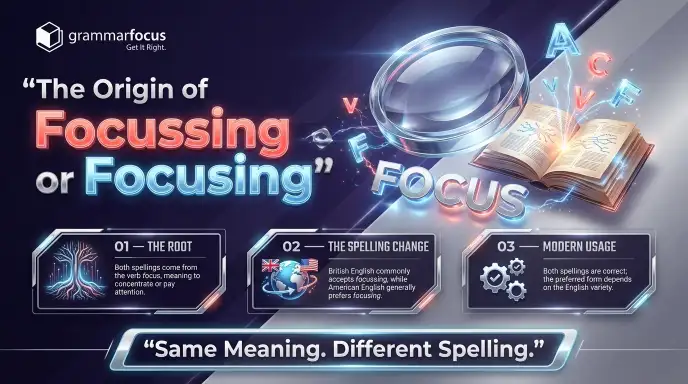
The Origin of Focussing or Focusing
The word focus comes from the Latin word focus, meaning “hearth” or “fireplace.” In later scientific use, the term became associated with the point where light rays meet. Its meaning eventually expanded to include directing attention toward a particular subject.
The verb focus developed from this idea of bringing something to a central point. When writers add ing, they can spell the result as either focusing or focussing.
This difference follows a wider spelling pattern. In American English, many verbs ending in a single vowel followed by a consonant do not double that consonant before ing when the stress and spelling rules allow it. British English often doubles the final consonant in some words, including focussing.
Both spellings have a long history of use. Neither changes the word’s meaning, and the preferred form depends on the regional style guide.
British English vs. American English Spelling
The main difference between focussing and focusing is regional preference. American English usually uses one s, while British English accepts both spellings.
| English variety | Preferred spelling | Example |
| American English | Focusing | She is focusing on her exam. |
| British English | Focusing or focussing | He is focussing on the task. |
| Canadian English | Focusing is common | They are focusing on customer needs. |
| Australian English | Both forms are used | The team is focusing on its goals. |
American dictionaries generally favor focusing. British dictionaries may list focussing as a variant alongside focusing. Usage can differ between publishers and style guides, so follow the rules required for your work.
Which Spelling Should You Use?
Choose the spelling that matches your audience and the style of your document. Both forms are correct, but consistency matters.
- Use focusing for American English. It is also a widely recognized choice for international readers.
- Use focussing if your British English style guide or publisher prefers the doubled s.
- Follow your organization’s style guide for reports, academic papers, and professional documents.
- Keep one spelling throughout your text. Avoid switching between focusing and focussing without a clear reason.
For example, an American writer would usually write, “The company is focusing on customer service.” A British writer who follows the doubled s convention may write, “The company is focussing on customer service.”
Neither sentence is wrong. The key is to match the spelling convention you have chosen.
Common Mistakes with Focussing vs. Focusing
Writers sometimes assume that one spelling is always incorrect. In fact, both forms are accepted, although their use varies by region and publication.
Mistake 1: Calling focussing incorrect in every context
Incorrect claim: “Focussing is always a spelling mistake.”
Correct explanation: Focussing is an accepted variant, particularly in British English.
Mistake 2: Using both spellings in the same article
Inconsistent: “The team is focusing on sales. Later, it is focussing on customer service.”
Better: “The team is focusing on sales. Later, it is focusing on customer service.”
Mistake 3: Changing the spelling based on meaning
Both words have the same meaning. You do not need to choose one form for attention and the other for cameras.
Mistake 4: Confusing the base verb with its ing form
The base verb is focus. Its present participle or gerund can be focusing or focussing. The spelling difference does not create a new verb.
Everyday Examples of Focussing or Focusing
These examples show how both forms work in everyday English. The spelling can change, but the meaning stays the same.
At school or university
- Emma is focusing on her final exams.
- The student is focussing on the teacher’s instructions.
At work
- Our team is focusing on the next deadline.
- The manager is focussing on improving communication.
Photography
- I am focusing the camera on the flowers.
- The photographer is focussing on the subject before taking the picture.
In personal development
- He is focusing on his health and daily routine.
- She is focussing on learning a new skill.
In formal writing
- This report is focusing on recent changes in customer behavior.
- The study is focussing on the effects of regular exercise.
These sentences use the words naturally. Choose the spelling that matches your preferred English variety.
Key Takeaway
Focusing is the standard American spelling and a widely used form internationally. Focussing is also correct, especially in British English. Both words mean directing attention or adjusting something to achieve clarity.
Remember one simple rule: choose a spelling style and use it consistently. If you are unsure, focusing is a practical choice for most readers.
Frequently Asked Questions
Q1. Is focussing or focusing correct?
Answer. Both spellings are correct. Focusing is standard in American English, while focussing is an accepted variant, especially in British English.
Q2. Is focussing wrong in American English?
Answer. It is not the usual American spelling. American writers generally use focusing, so that form is the safer choice for US audiences.
Q3. Why does focusing have one s?
Answer. American English generally uses focusing with one s. British English also uses this form, although some British writers double the final s.
Q4. Do focusing and focussing mean the same thing?
Answer. Yes. Both mean directing attention toward something or adjusting a lens or image to make it clear.
Q5. Which spelling is preferred in British English?
Answer. Both focusing and focussing are used in British English. The preferred form depends on the dictionary, publisher, or style guide.
Q6. Is focusing more common than focussing?
Answer. Focusing is widely used in American English and international writing. The relative frequency of the two forms varies by region and publication.
Q7. How do you spell the past tense of focus?
Answer. The usual past tense spelling is focused. The variant focussed is also accepted, particularly in British English.
Q8. What is the safest spelling for general writing?
Answer. Focusing is a practical choice because it is widely recognized and standard in American English. However, follow your required style guide if it specifies focussing.
Conclusion
The choice between focussing or focusing comes down to regional spelling preference. Both forms are accepted and have the same meaning. American English generally favors focusing, while British English uses both forms. For clear writing, select the spelling that suits your audience and keep it consistent throughout your work.
Learn More About Grammar:
- Begger or Beggar: Which One Is Actually Correct in 2026?
- Carrys or Carries: The Spelling Rule That Gets People Confused
- Cognisant or Cognizant: Which Spelling Is Right for You?

I’m Alex Morgan, an American English writer with 6 years of experience exploring grammar, punctuation, sentence structure, and everyday English usage. I enjoy turning confusing grammar rules into clear, practical explanations that help readers write and communicate with confidence.








1 thought on “Focussing or Focusing: Which Spelling Should You Use in 2026?”