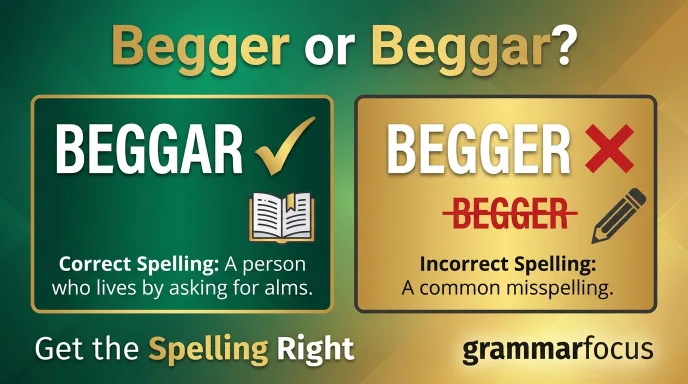
Beggar is the correct spelling in English. Begger is a common spelling mistake. A beggar is a person who asks others for money, food, or help, often because they are in need.
Many people confuse these spellings because the ending can be difficult to remember. However, the correct word uses -ar, not -er.
Learning this difference will help you avoid spelling mistakes in everyday conversations, school assignments, articles, and formal writing.
Begger or Beggar: Quick Answer
| Word | Status | Meaning | Example |
| Beggar | Correct | A person who asks others for money or help | The beggar asked for food. |
| Begger | Incorrect | A common misspelling of beggar | Write beggar, not begger. |
Remember the correct spelling: beggar has two g letters followed by ar.
Pronunciation and Word Form
Beggar
- US pronunciation: /ˈbɛɡər/
- UK pronunciation: /ˈbɛɡə/
- Part of speech: Noun
- Example: The beggar sat near the entrance and asked for help.
The word has two syllables. The stress falls on the first syllable.
Begger is not the standard spelling of this word. If you are referring to a person who begs, use beggar.
Definition and Meaning of Begger or Beggar
What Does Beggar Mean?
Beggar is a noun for someone who asks other people for money, food, or other forms of assistance. The word often refers to a person experiencing poverty or homelessness.
Examples:
- The beggar asked passersby for food.
- A local charity provided warm clothes to people in need.
- The story described a beggar who received help from a stranger.
The word can also appear in expressions with a figurative meaning. For example, the phrase “It beggars belief” means something is so surprising or difficult to believe that it seems beyond belief.
What Does Begger Mean?
Begger is generally a misspelling of beggar. It is not the standard spelling used for a person who asks others for help.
Incorrect: The begger asked for a meal.
Correct: The beggar asked for a meal.
In formal writing, use beggar to ensure your spelling is correct.
The Origin of Begger or Beggar
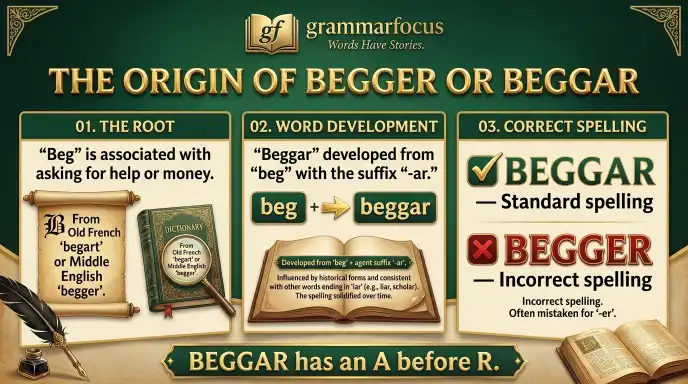
The word beggar entered English through the Middle English period. It is linked to the verb beg, which means to ask for something, especially money or assistance.
The ending -ar developed as part of the word’s historical form. Over time, beggar became the standard spelling for a person who begs.
The spelling begger likely results from applying a more familiar spelling pattern to the word. However, standard English retains the -gar ending.
A useful way to remember the connection is:
- Beg: to ask for help or something you need.
- Beggar: a person who begs.
- Begging: the act of asking for something.
Begger or Beggar: Key Differences
The main difference is that beggar is the correct word, while begger is a spelling error in standard English.
| Feature | Beggar | Begger |
| Spelling | Correct | Incorrect |
| Meaning | A person who begs | No standard meaning in this context |
| Part of speech | Noun | Misspelling |
| Base word | Beg | Intended word is beggar |
| Example | The beggar asked for water. | Use beggar, not begger. |
The ending is the key detail. Although beg becomes begging when describing the action, the noun for a person is spelled beggar.
Common Mistakes With Begger or Beggar
The most common mistake is writing -er instead of -ar. These tips can help you avoid that error.
1. Using the Wrong Ending
Incorrect: The begger needed warm clothes.
Correct: The beggar needed warm clothes.
Remember that the standard spelling ends in -gar.
2. Confusing Beggar With Begging
The words beggar and begging are related, but they serve different purposes.
- Beggar: A person who begs.
- Begging: The act of asking for something.
Examples:
- The beggar asked for food.
- The child was begging for another story.
3. Misspelling the Word in Formal Writing
Incorrect: The article explained how the begger received help.
Correct: The article explained how the beggar received help.
Always check the spelling when writing essays, reports, news stories, or educational content.
4. Assuming Every Word Ending in “-er” Follows the Same Pattern
Many English words use -er to describe a person who performs an action. However, beggar has a different ending.
Instead of relying on a general rule, remember the exact spelling: b-e-g-g-a-r.
Everyday Examples of Begger or Beggar
Here are examples showing how to use beggar correctly in different contexts.
Daily Life
- The beggar asked a passerby for food.
- A shopkeeper offered water to the beggar.
- The beggar thanked the woman for her kindness.
News and Community Reports
- Volunteers distributed meals to people experiencing homelessness.
- The report described a beggar who received support from a local charity.
- Community workers helped people in need find temporary shelter.
Stories and Literature
- The king disguised himself as a beggar.
- A wealthy traveler shared his food with a beggar.
- The story showed how a small act of kindness changed someone’s life.
Everyday Expressions
- The beauty of the view beggars description.
- The scale of the damage beggars belief.
In these expressions, beggars is a form of the verb beggar. It means that something is so remarkable or extreme that ordinary words or belief seem insufficient.
Begger or Beggar: Which Spelling Should You Use?
Always use beggar when referring to a person who asks others for money, food, or help. The spelling begger is incorrect in standard English.
The correct word can also appear in expressions such as “It beggars belief.” In this phrase, beggars means that something is extremely surprising or difficult to believe.
Here are three examples to remember:
- Correct: The beggar asked for food.
- Incorrect: The begger asked for food.
- Correct: The news beggars belief.
For everyday writing, remember that the noun ends in -ar, not -er.
How to Remember the Spelling of Beggar
A simple spelling trick can help you remember beggar.
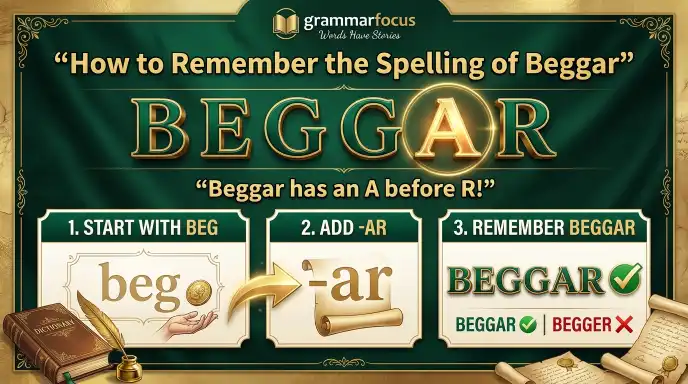
Start with the base word beg. Then remember that the noun for a person who begs ends with -gar.
Correct spelling: B-E-G-G-A-R
You can also connect the word to a familiar sentence:
“The beggar asked for help.”
Writing this sentence a few times can help you remember the correct spelling. When checking your work, pay special attention to the final two letters: ar.
Begger or Beggar: Usage and Search Trends
People often search for begger or beggar when checking the spelling of this word. The confusion usually comes from the familiar -er ending found in many English nouns.
However, beggar is the accepted spelling in standard English. The misspelling begger should be corrected in articles, schoolwork, emails, and other formal writing.
Search interest can vary by country and over time. Without verified data for a specific period, it is better not to claim exact search figures or popularity rankings.
For readers and writers, the most useful point is simple: beggar is the correct spelling.
Key Takeaway: Begger or Beggar
- Beggar is the correct spelling.
- Begger is a common misspelling.
- A beggar is a person who asks others for money, food, or help.
- The correct ending is -ar, not -er.
- In the expression “beggars belief,” the word means that something is difficult to believe.
Remember the spelling b-e-g-g-a-r to avoid this common mistake.
FAQs About Begger or Beggar
Q1. Is it begger or beggar?
Answer. Beggar is the correct spelling. Begger is a misspelling in standard English.
Q2. What does beggar mean?
Answer. A beggar is a person who asks others for money, food, or help, often because they are experiencing poverty or hardship.
Q3. Is begger a real word?
Answer. Begger is not the standard spelling for a person who begs. In this context, use beggar.
Q4. Why is beggar spelled with “ar”?
Answer. Beggar developed through the history of English from the verb beg. Its accepted spelling ends in -ar, so it is best to learn the word as a whole.
Q5. What is the plural of beggar?
Answer. The plural is beggars. For example, “The charity provided meals to several beggars.”
Q6. What is the difference between beggar and begging?
Answer. Beggar is a noun for a person who begs. Begging describes the act of asking for something, often money or help.
Q7. What does “beggars belief” mean?
Answer. “Beggars belief” means something is so surprising or unbelievable that it is difficult to accept as true. For example, “The amount of damage beggars belief.”
Q8. How can I remember the correct spelling of beggar?
Answer. Remember the letter sequence B-E-G-G-A-R. The word ends in -ar, not -er.
Conclusion:
The correct spelling is beggar, not begger. The word usually describes a person who asks others for money, food, or assistance. It also appears in expressions such as “beggars belief.”
Although the incorrect spelling may look familiar, standard English uses beggar. Remember the final -ar, and you can use the word correctly in everyday and formal writing.
Learn More About Grammar:
- Spicket or Spigot: The Correct Term for a Water Tap
- Choses or Chooses: Which Spelling Is Correct in 2026?
- Chief or Cheif: Which Spelling Is Actually Correct in 2026?

I’m Elena Cooper, an English grammar writer with 6 years of experience explaining grammar, punctuation, sentence structure, word usage, and common English mistakes. I create clear, practical, and easy-to-follow content that helps readers understand confusing grammar rules and use English accurately and confidently.








4 thoughts on “Begger or Beggar: Which One Is Actually Correct in 2026? ”