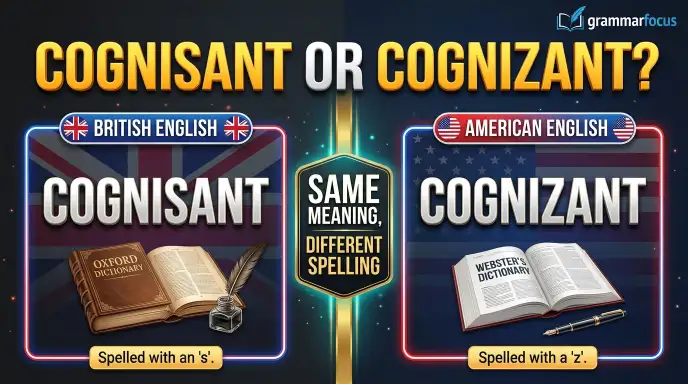
Cognisant or cognizant are both correct spellings. The main difference is regional: cognisant is more common in British English, while cognizant is the standard spelling in American English.
Both words mean being aware of something or having knowledge of a situation. The choice depends on your audience and the spelling style you follow.
Once you know this regional difference, it becomes easier to use the right form in emails, reports, and everyday writing.
Cognisant or Cognizant: Quick Answer
Use cognisant in British English and cognizant in American English. Both forms have the same meaning, pronunciation, and grammatical function.
| Feature | Cognisant | Cognizant |
| Main use | British English | American English |
| Meaning | Aware or informed | Aware or informed |
| Word type | Adjective | Adjective |
| Pronunciation | KOG nuh zunt | KOG nuh zunt |
| Example | She is cognisant of the risks. | She is cognizant of the risks. |
| Best choice | UK focused writing | US focused writing |
Pronunciation and Word Form
Both cognisant and cognizant are adjectives. They describe someone who knows about a fact, situation, or possible result.
- Cognisant: /ˈkɒɡ.nɪ.zənt/ commonly used in British English.
- Cognizant: /ˈkɑːɡ.nə.zənt/ commonly used in American English.
Pronunciation can vary slightly by accent, but the two spellings are generally pronounced alike within the same variety of English.
Word Form and Usage
Both spellings work in the same sentence patterns.
Examples:
- She is cognisant of the new rules.
- He is cognizant of the financial risks.
- They remained cognisant of the deadline.
- The manager was cognizant of the team’s concerns.
In each sentence, the adjective describes awareness or understanding. Neither spelling changes the meaning.
Definition and Meaning of Cognisant or Cognizant
What Does Cognisant Mean?
Cognisant means aware of something or having knowledge of a fact or situation. It is the preferred spelling in British English and is also used in other varieties influenced by British spelling.
For example:
- The teacher is cognisant of the students’ needs.
- We must remain cognisant of the possible risks.
- She was cognisant of the changes to the policy.
In these examples, the word shows that someone understands or recognizes an important fact.
Cognisant often appears in formal writing, workplace discussions, and academic contexts. In casual conversation, simpler words such as aware or informed may sound more natural.
What Does Cognizant Mean?
Cognizant has the same meaning as cognisant. It describes someone who is aware of a situation, understands a fact, or recognizes a possible consequence.
This spelling is standard in American English.
Examples:
- The company is cognizant of its responsibilities.
- Please remain cognizant of the safety guidelines.
- He is cognizant of the time required to finish the project.
The word is useful when you want to express awareness in a formal or professional setting. However, aware is often a simpler choice for everyday writing.

The Origin of Cognisant or Cognizant
Both spellings come from the same linguistic history. They are linked to the Latin word cognoscere, meaning “to know” or “to learn.”
The word developed through French and entered English with the sense of knowing, recognizing, or being aware of something.
Over time, different spelling conventions became established in British and American English. British English commonly uses the sant ending in cognisant, while American English generally uses the zant ending in cognizant.
These regional differences do not create a difference in meaning. Both forms express awareness or knowledge of a situation.
British English vs. American English Spelling
The main difference between cognisant and cognizant is the spelling convention used in each region. Both words have the same meaning, so you do not need to learn separate definitions.
| Region | Preferred spelling | Example |
| British English | Cognisant | She is cognisant of the risks. |
| American English | Cognizant | She is cognizant of the risks. |
| Australian English | Cognisant is common | He remained cognisant of the changes. |
| Canadian English | Cognizant is also used | The team was cognizant of the issue. |
Usage can vary, especially in countries that use more than one English spelling convention. For formal writing, follow the style guide or spelling preference used by your organization.
Which Spelling Should You Use?
Choose the spelling that matches your audience and the type of English you use.
- Use cognisant for British English and writing that follows British spelling conventions.
- Use cognizant for American English and writing that follows American spelling conventions.
- Stay consistent throughout an article, report, or document.
- Follow your style guide if your school, publisher, or workplace has a preferred spelling.
For example, a UK focused report would normally use “The team was cognisant of the risks.” An American report would usually write “The team was cognizant of the risks.”
Neither spelling is universally better. The important point is to choose the form that suits your writing context.
Common Mistakes with Cognisant and Cognizant
Both spellings are correct, but writers can still make mistakes when using them.
Mistake 1: Treating One Spelling as Incorrect
Incorrect claim: Cognisant is always wrong.
Correct explanation: Cognisant is standard in British English, while cognizant is standard in American English.
The spelling depends on the regional convention.
Mistake 2: Changing the Meaning
Some writers assume that cognisant and cognizant have different meanings.
That is not correct. Both words mean aware or informed.
For example:
- British English: She is cognisant of the problem.
- American English: She is cognizant of the problem.
Both sentences communicate the same idea.
Mistake 3: Mixing Spelling Styles
Using British and American spellings randomly can make a document look inconsistent.
For example, a document might use cognisant in one paragraph and organize in another. That combination may be acceptable in some contexts, but it can conflict with a consistent British spelling style.
Choose a style and apply it throughout your writing.
Mistake 4: Using a Formal Word When a Simple One Works
Cognisant and cognizant are useful in formal contexts, but they may sound overly formal in casual conversation.
Instead of writing “I am cognizant of the problem,” you can write “I am aware of the problem.”
Both versions are correct. The simpler option may be easier for a general audience to understand.
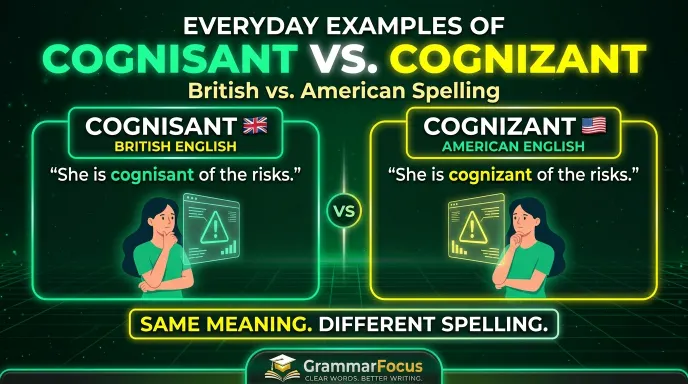
Everyday Examples of Cognisant vs. Cognizant
Here are examples showing how both spellings work in real situations.
At work
- British English: The manager is cognisant of the team’s workload.
- American English: The manager is cognizant of the team’s workload.
Education
- British English: Students should be cognisant of the assignment deadline.
- American English: Students should be cognizant of the assignment deadline.
Business
- British English: The company remains cognisant of market changes.
- American English: The company remains cognizant of market changes.
In everyday conversation
- British English: I am cognisant of your concerns.
- American English: I am cognizant of your concerns.
These examples show that the spelling changes, but the meaning and sentence structure remain the same.
Key Takeaway
Cognisant and cognizant are both correct spellings of the same word. British English generally prefers cognisant, while American English usually uses cognizant.
Choose the spelling that matches your audience, and keep it consistent throughout your writing. If you want a simpler alternative, aware is often a clear and natural choice.
Frequently Asked Questions
Q1. Is cognisant or cognizant correct?
Answer. Both are correct. Cognisant is the usual British spelling, while cognizant is the standard American spelling.
Q2. What does cognisant mean?
Answer. Cognisant means aware of something or having knowledge of a situation. It is commonly used in British English.
Q3. What does cognizant mean?
Answer. Cognizant means aware, informed, or conscious of a fact or situation. It is the preferred spelling in American English.
Q4. Do cognisant and cognizant have the same meaning?
Answer. Yes. Both words mean aware or informed. The difference is spelling, not meaning.
Q5. Which spelling is used in British English?
Answer. British English generally uses cognisant. This form is also common in other varieties that follow British spelling conventions.
Q6. Which spelling is used in American English?
Answer. American English uses cognizant. This is the preferred spelling in most US publications and formal documents.
Q7. Is cognizant a formal word?
Answer. Yes. Cognizant often appears in professional, academic, and formal writing. In everyday conversation, aware may sound more natural.
Q8. What is an easy alternative to cognisant or cognizant?
Answer. The word aware is a simple alternative. For example, “She is aware of the risks” means the same as “She is cognisant of the risks.”
Conclusion
The choice between cognisant or cognizant depends on regional spelling conventions. Both forms express the same idea of awareness or knowledge.
Use cognisant for British English and cognizant for American English. Most importantly, keep your spelling consistent and choose language that your readers can understand easily.
Learn More About Grammar:
- Begger or Beggar: Which One Is Actually Correct in 2026?
- Choses or Chooses: Which Spelling Is Correct in 2026?
- Chief or Cheif: Which Spelling Is Actually Correct in 2026?

I’m Elena Cooper, an English grammar writer with 6 years of experience explaining grammar, punctuation, sentence structure, word usage, and common English mistakes. I create clear, practical, and easy-to-follow content that helps readers understand confusing grammar rules and use English accurately and confidently.