Carrys or Carries: Carries is the correct spelling in standard English. Carrys is incorrect. The word carries is the third person singular form of the verb carry, used with he, she, or it in the present tense.
Many people confuse these spellings because they are unsure how to change words ending in y. However, English has a simple spelling rule that makes the correct form easier to remember.
For example, we write “She carries a bag,” not “She carrys a bag.” Once you learn this rule, you can use carries confidently in everyday writing.
Carrys or Carries: Quick Answer
| Word | Status | Meaning | Example |
| Carries | Correct | Takes or holds something; supports or transports something | She carries her books to school. |
| Carrys | Incorrect | A common misspelling of carries | He carries the box, not “He carrys the box.” |
Quick rule: When a verb ends in a consonant followed by y, change the y to i and add es for the third person singular form.
Carry → Carries
Pronunciation and Word Form
Carries
- US pronunciation: /ˈkæriz/
- UK pronunciation: /ˈkæriz/
- Part of speech: Verb
- Base form: Carry
- Example: He carries his lunch to work.
The word carries has two syllables, with stress on the first syllable. The ending sounds like “eez.” Carrys is not the standard spelling of this verb form. Use carries in correct English writing.
Definition and Meaning of Carrys or Carries
What Does Carries Mean?
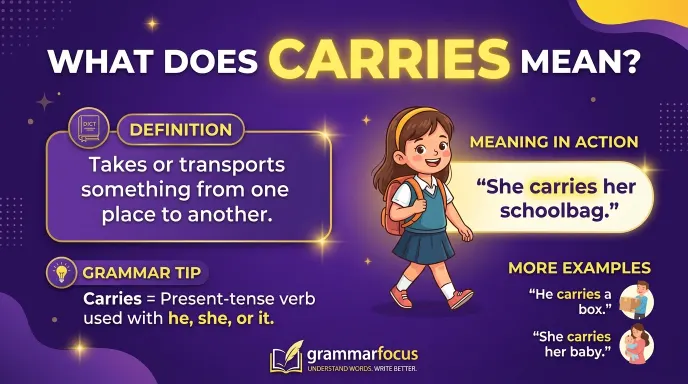
Carries is a form of the verb carry. It means to take something from one place to another, hold something, support a weight, or transmit something.
The form carries is used with singular third person subjects such as he, she, and it in the simple present tense.
Examples:
- She carries a water bottle to school.
- He carries the shopping bags into the house.
- This bridge carries heavy traffic.
- The mosquito carries certain diseases.
The exact meaning depends on the sentence. In each example, carries describes what a person, object, or living thing does.
What Does Carrys Mean?
Carrys is an incorrect spelling when you mean the verb form of carry. Standard English changes the y to i and adds es.
Incorrect: She carrys her laptop to work.
Correct: She carries her laptop to work.
This rule also applies to several other verbs, including try, study, and hurry.
- Try → Tries
- Study → Studies
- Hurry → Hurries
Learning these patterns can help you avoid similar spelling mistakes.
The Origin of Carrys or Carries
The word carry entered English through Anglo French and Old Northern French forms related to transporting or conveying something. Over time, it developed into the familiar verb used today.
The spelling carries follows a grammatical rule rather than having a separate meaning or origin. English changes the ending of certain verbs to match their subject in the simple present tense.
For verbs ending in a consonant followed by y, the usual pattern is to change y to i and add es.
For example:
- Carry → Carries
- Apply → Applies
- Reply → Replies
- Deny → Denies
The spelling carrys does not follow this standard pattern. That is why carries is the correct form.
Carrys or Carries: Key Differences
The main difference is spelling. Carries is correct, while carrys is a misspelling in standard English.
| Feature | Carries | Carrys |
| Spelling | Correct | Incorrect |
| Base verb | Carry | Intended word is carry |
| Grammar | Third person singular present tense | Not a standard verb form |
| Subject examples | He, she, it | Not used in standard English |
| Example | She carries a folder. | Write carries, not carrys. |
Remember that the base verb carry is correct when used with subjects such as I, you, we, and they.
For example:
- I carry my bag.
- They carry their bags.
- She carries her bag.
The subject determines which verb form you need.
Common Mistakes With Carrys or Carries
The spelling mistake usually happens when writers add s to carry without changing the y.
1. Adding Only “S”
Incorrect: He carrys his books every day.
Correct: He carries his books every day.
Because carry ends in a consonant followed by y, change y to i and add es.
2. Confusing “Carry” With “Carries”
Use carry with I, you, we, and they in the simple present tense.
Examples:
- I carry my lunch.
- They carry the equipment.
Use carries with he, she, or it.
Examples:
- He carries his lunch.
- The truck carries the equipment.
3. Applying the Rule to Every Word Ending in “Y”
Not every word ending in y follows the same pattern. The letter before y matters.
When a verb ends in a consonant + y, change y to i and add es:
- Carry → Carries
- Cry → Cries
- Fly → Flies
However, when a verb ends in a vowel + y, usually add s:
- Play → Plays
- Enjoy → Enjoys
- Stay → Stays
This distinction helps you spell verb forms correctly.
4. Forgetting the Subject
Incorrect: She carry the basket.
Correct: She carries the basket.
In the simple present tense, a singular third person subject usually needs a verb ending in s or es. Since carry ends in a consonant followed by y, the correct form is carries.
Everyday Examples of Carrys or Carries
Here are simple examples of the correct word in everyday situations.
Home
- She carries the laundry upstairs.
- He carries groceries into the kitchen.
- The small table carries the weight of the books.
At School
- The student carries a backpack.
- Our teacher carries extra worksheets.
- The school bus carries children to school.
At Work
- He carries his laptop to every meeting.
- This delivery truck carries packages across the city.
- The manager carries responsibility for the final decision.
In Science and Health
- A mosquito carries certain germs.
- Water carries nutrients through the plant.
- The blood carries oxygen around the body.
These examples show that carries can describe physical movement, support, responsibility, or transmission. In every case, the spelling remains the same.
Carrys or Carries: Which Form Should You Use?
Use carries with he, she, or it. Use carry with I, you, we, or they. The subject determines the correct verb form.
Follow these simple examples to choose the right spelling:
- He carries his lunch to work.
- She carries a notebook in her bag.
- The student carries several books.
- They carry their bags to school.
- We carry our own equipment.
Remember the spelling rule: when a verb ends in a consonant followed by y, change the y to i and add es for the third person singular form.
For example, carry becomes carries.
However, verbs ending in a vowel plus y usually add only s. That is why play becomes plays and enjoy becomes enjoys.Using this rule will help you avoid the incorrect spelling carrys in everyday writing.
Carrys or Carries: Usage and Search Trends
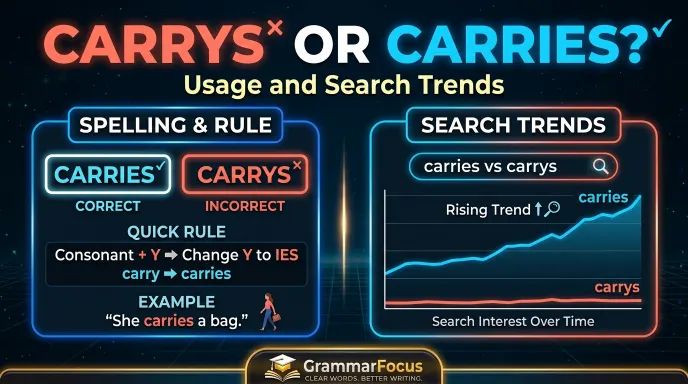
People often search for carrys or carries because the spelling rule for verbs ending in y can be confusing. Many learners expect to add s to every verb when the subject is he, she, or it.
However, English spelling rules are not always that simple. Verbs ending in a consonant plus y usually change the y to i before adding es. This pattern explains forms such as carries, tries, and studies.
The correct spelling remains carries in standard English. Search interest may change over time, but exact trend figures should be checked using current data rather than guessed.
Key Takeaway: Carrys or Carries
- Carries is the correct spelling.
- Carrys is a misspelling in standard English.
- Use carries with he, she, or it.
- Use carry with I, you, we, or they.
- Change consonant + y to i and add es: carry → carries.
- For vowel + y, usually add only s: play → plays.
The easiest way to remember the rule is to check the letter before the final y.
FAQs About Carrys or Carries
Q1. Is carrys or carries correct?
Answer. Carries is correct. Carrys is a misspelling in standard English.
Q2. Why is carrys incorrect?
Answer. The verb carry ends in a consonant followed by y. For the third person singular form, change y to i and add es. This gives you carries.
Q3. When should I use carries?
Answer. Use carries with he, she, or it, or with a singular noun. For example, “She carries her laptop to work.”
Q4. Should I write “he carry” or “he carries”?
Answer. Write “he carries” in the simple present tense. The verb needs the es ending because he is a third person singular subject.
Q5. Do we say “they carries” or “they carry”?
Answer. Say “they carry.” The pronoun they takes the base form carry, even when it refers to several people.
Q6. Why is it “plays” but “carries”?
Answer. The difference comes from the letter before y. In play, a vowel comes before y, so you add s. In carry, a consonant comes before y, so you change y to i and add es.
Q7. Is carries pronounced differently from carry?
Answer. Yes. Carry is commonly pronounced /ˈkæri/, while carries is pronounced /ˈkæriz/. The ending adds an extra syllable.
Q8. Can you give an example using carries?
Answer. Yes. “The nurse carries the medical supplies into the room.” Here, carries agrees with the singular subject the nurse.
Conclusion: Carrys or Carries
Carries is the correct spelling, while carrys is incorrect in standard English. The key is to remember the consonant + y rule: change the y to i and add es.
Use carries with he, she, or it, but use carry with I, you, we, and they. Once you learn this pattern, choosing the right form becomes much easier.
Learn More About Grammar:
- Begger or Beggar: Which One Is Actually Correct in 2026?
- Choses or Chooses: Which Spelling Is Correct in 2026?
- Cognisant or Cognizant: Which Spelling Is Right for You?

I’m Alex Morgan, an American English writer with 6 years of experience exploring grammar, punctuation, sentence structure, and everyday English usage. I enjoy turning confusing grammar rules into clear, practical explanations that help readers write and communicate with confidence.








2 thoughts on “Carrys or Carries: The Spelling Rule That Gets People Confused”