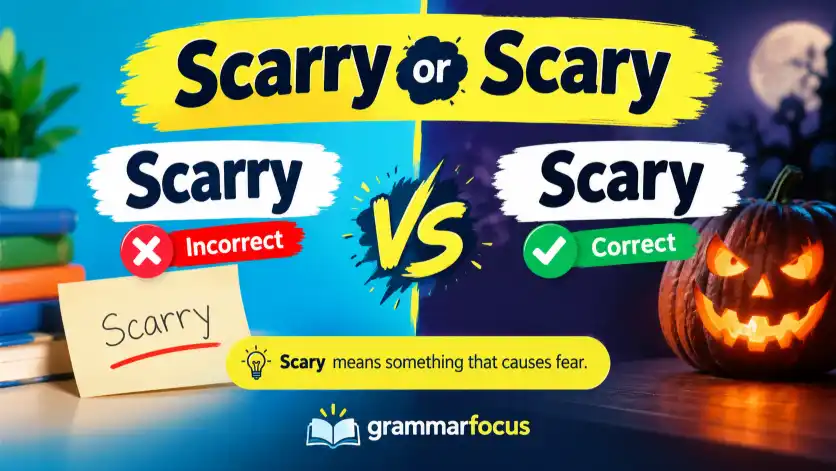
Scary is the correct spelling when you want to describe something that causes fear. Scarry is usually a misspelling of scary. The correct choice is important in schoolwork, emails, stories, and everyday writing.
Both words may look similar, but standard English uses scary to describe frightening people, places, or situations. For example, “The movie was scary” means the movie made someone feel afraid.
Learning this simple difference will help you avoid spelling mistakes. It will also make your writing clearer and easier to understand.
Scarry or Scary: Quick Answer
| Word | Correct or Incorrect? | Meaning | Example |
| Scary | Correct | Causing fear or alarm | The dark forest looked scary. |
| Scarry | Usually incorrect | A common misspelling of scary | The dark forest looked scary, not “scarry.” |
Quick rule: Use scary when describing something frightening. Remember that it has one r after the letter a and one r before the final y.
Pronunciation and Word Form
1. Scary
- Pronunciation (US): /ˈskeri/
- Pronunciation (UK): /ˈskeəri/
- Part of speech: Adjective
- Meaning: Causing fear or making someone feel frightened.
Example: The scary noise came from upstairs.
The word scary describes something that causes fear. It can refer to a person, a sound, a movie, an experience, or a situation.
2. Scarry
- Pronunciation: Often intended to sound like scary
- Part of speech: Not the standard spelling of the adjective scary
- Meaning: Usually a spelling error when the intended meaning is “frightening.”
Example:
Incorrect: The story was scarry.
Correct: The story was scary.
Note that Scarry can appear as a surname or in a proper name. However, when you mean “frightening,” the standard spelling is scary.
Definition and Meaning of Scarry or Scary
What Does Scary Mean?
Scary means frightening, alarming, or likely to make someone feel afraid. It describes something that creates fear, worry, or a sense of danger.
For example:
- The scary film kept me awake all night.
- We heard a scary sound outside the house.
- Driving through the storm was a scary experience.
- The abandoned building looked scary after dark.
In each example, scary describes something that causes fear or discomfort.
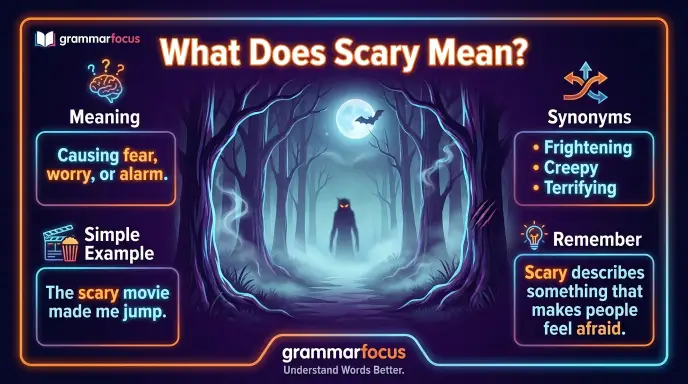
What Does Scarry Mean?
In everyday English, scarry is usually a misspelling of scary. Writers may add an extra r because they confuse the spelling or type the word too quickly.
For example:
- Incorrect: That was a scarry dream.
- Correct: That was a scary dream.
However, Scarry may be correct as a person’s surname or part of a proper name. Its spelling depends on the name itself. For the adjective meaning “frightening,” always use scary.
The Origin of Scarry or Scary
The word scary comes from scare, a verb that means to frighten someone. The verb scare developed from earlier English forms connected with frightening or causing alarm.
Over time, English formed the adjective scary by adding y to scare. The ending helps turn the idea of frightening someone into a word that describes something frightening.
Here are a few related forms:
| Word | Meaning | Example |
| Scare | To frighten someone | Loud noises scare the dog. |
| Scared | Feeling fear | I felt scared during the storm. |
| Scary | Causing fear | It was a scary storm. |
| Scaring | Causing someone to feel afraid | You are scaring the cat. |
The spelling scarry does not follow the standard spelling of this adjective. Therefore, use scary in ordinary sentences about fear.
Scarry or Scary: Key Differences
The main difference is spelling. Scary is the standard adjective, while scarry is generally incorrect when used with the same meaning.
| Feature | Scary | Scarry |
| Standard spelling | Yes | No, not for this adjective |
| Meaning | Frightening or causing fear | Usually a misspelling of scary |
| Common use | Stories, movies, events, and experiences | May appear by mistake |
| Example | The scary movie was exciting. | Use “scary movie,” not “scarry movie.” |
How to Remember the Correct Spelling
Remember the word scare. When you add y to form the adjective, the result is scary.
Scare → Scary
You do not need to double the r. This simple connection makes the correct spelling easier to remember.
Common Mistakes With Scarry or Scary
Writers often make spelling mistakes when a word sounds familiar but its letter pattern is easy to forget. Here are the most common errors involving scarry and scary.
1. Adding an Extra R
Incorrect: The haunted house was scarry.
Correct: The haunted house was scary.
The adjective scary has only one r after the a. Adding another r creates a spelling error.
2. Using Scarry in Schoolwork
Incorrect: I wrote a scarry story for class.
Correct: I wrote a scary story for class.
In essays, assignments, and other formal writing, use the standard spelling scary.
3. Confusing Scary With Scared
These words are related, but they have different meanings.
- Scary describes something that causes fear.
- Scared describes someone who feels fear.
For example, “The dog was scary” means the dog frightened people. “The child was scared” means the child felt afraid.
4. Repeating the Misspelling in Online Posts
Incorrect: That was the most scarry game ever!
Correct: That was the most scary game ever!
The more natural sentence is “That was the scariest game ever!” Remember that the comparative form of scary changes y to i before adding est.
5. Forgetting the Correct Form in Longer Words
The same spelling pattern appears in related forms:
- Scary → scarier
- Scary → scariest
For example, “This film is scarier than the last one.” These forms also use one r after the a.
Everyday Examples of Scarry vs. Scary
The word scary appears in many everyday situations. These examples show how to use it naturally.
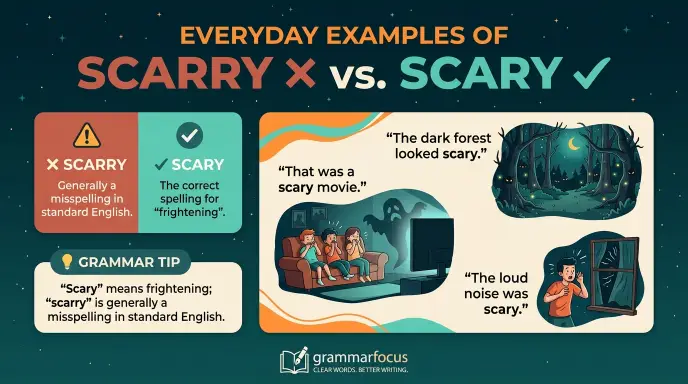
At Home
- The scary noise woke everyone up.
- That shadow looks scary in the dark.
- The thunderstorm was scary for the children.
At School
- We read a scary story in English class.
- The students wrote scary endings for their stories.
- The old school building looked scary at night.
In Movies and Games
- The scary movie had a surprising ending.
- That video game has some scary monsters.
- The final scene was scarier than I expected.
In Everyday Conversation
- “That was a scary moment!”
- “I had a scary dream last night.”
- “The road looked scary during the heavy rain.”
These examples use scary to describe something that causes fear. In each case, scary is the correct spelling.
Scarry or Scary: Which Word Should You Use?
Choose scary when you want to describe something frightening. This is the standard spelling in American English and British English.
Use these simple rules to make the right choice:
- Use scary to describe something that causes fear.
Example: The thunderstorm was scary. - Use scared to describe someone who feels afraid.
Example: The little boy was scared of the thunder. - Use scarier to compare two frightening things.
Example: This movie is scarier than the first one. - Use scariest to describe the most frightening thing in a group.
Example: That was the scariest scene in the film.
Avoid scarry when you mean “frightening.” The spelling may appear in a person’s name, but it is not the standard adjective.
Scarry or Scary: Usage and Search Trends
People may search for scarry or scary because the words look almost identical. The extra r can be easy to type by mistake, especially when writing quickly. In standard English, scary is the accepted spelling for something that causes fear.
It appears in everyday conversations, movie reviews, horror stories, school assignments, and online posts. Search interest can change with popular films, games, and seasonal topics such as Halloween.
However, exact search volume figures should come from current trend data. Without verified figures, it would be misleading to claim that searches have increased or decreased by a specific amount. For clear writing, remember the basic rule: scary is correct when you mean frightening.
Key Takeaway: Scarry or Scary
- Scary is the correct spelling for something frightening.
- Scarry is usually a misspelling when used as this adjective.
- Scary describes something that causes fear.
- Scared describes a person or animal that feels fear.
- The related forms are scarier and scariest.
- Remember the spelling pattern: scare → scary.
The simplest way to avoid this mistake is to remember that scary has only one r after the a.
FAQs About Scarry or Scary
Q1. Is scarry or scary correct?
Answer. Scary is correct when you mean frightening or causing fear. Scarry is usually a misspelling of this adjective.
Q2. Why is scarry incorrect?
Answer. Standard English spells the adjective with one r after the a. The correct spelling is scary, not scarry.
Q3. What does scary mean?
Answer. Scary means frightening or likely to make someone feel afraid. For example, “The movie was scary.”
Q4. Is scary the same as scared?
Answer. No. Scary describes something that causes fear, while scared describes someone who feels fear. For example, “The noise was scary, and I was scared.”
Q5. How do you spell the plural or comparative form of scary?
Answer. The comparative form is scarier, and the superlative form is scariest. Both forms change the final y to i before adding the ending.
Q6. Can Scarry ever be a correct spelling?
Answer. Yes. Scarry can be correct as a surname or part of a proper name. However, use scary when describing something frightening.
Q7. What is a simple sentence with scary?
Answer. “The abandoned house looked scary at night.” Here, scary describes the house and suggests that it caused fear.
Q8. Is scary spelled the same in American and British English?
Answer. Yes. Both American and British English use scary as the standard spelling of the adjective.
Conclusion: Scarry or Scary
Scary is the correct spelling when describing something frightening. Scarry is usually incorrect when used with the same meaning, although it may appear as a proper name.
Remember the connection between scare and scary. Use scary for something that causes fear and scared for someone who feels afraid. With this simple rule, you can avoid the common spelling mistake in everyday writing.
Learn More About Grammar:
- Begger or Beggar: Which One Is Actually Correct in 2026?
- Carrys or Carries: The Spelling Rule That Gets People Confused
- Cognisant or Cognizant: Which Spelling Is Right for You?

I’m Alex Morgan, an American English writer with 6 years of experience exploring grammar, punctuation, sentence structure, and everyday English usage. I enjoy turning confusing grammar rules into clear, practical explanations that help readers write and communicate with confidence.




2 thoughts on “Scarry or Scary: One Extra Letter, One Common Mistake (2026)”