
Shiny or shiney is a common spelling question, but the answer is simple: shiny is the correct standard English spelling. It describes something that reflects light or has a bright, smooth appearance. Shiney is a misspelling and should not be used in standard writing.
This confusion often happens because the word comes from shine, which ends with an “e.” However, when the suffix -y is added, the spelling becomes shiny, not shiney. The silent “e” is removed before the suffix is added.
In this guide, you will learn why shiny is correct, what it means, how it is formed, and if British and American English use different spellings. You will also see simple examples that make the rule easy to remember.
Shiny or Shiney: Quick Answer
Shiny is the correct spelling. Shiney is incorrect in standard English. Shiny is an adjective that means bright or reflective, often because a surface is smooth or polished.
For example, “She bought a shiny new car.” The word comes from shine + -y, with the final e removed.
- ✅ Shiny = correct
- ❌ Shiney = incorrect
- Shiny means bright, polished, or reflective.
- It can describe metal, shoes, cars, hair, objects, and surfaces.
- The spelling follows a common English word-formation pattern.
Examples
The floor looks shiny after cleaning.
He bought a shiny new watch.
Her shoes were clean and shiny.
The key point is that shiney keeps the final e from shine, but standard English drops that e before adding -y.
Shiny or Shiney: Quick Comparison
| Feature | Shiny | Shiney |
| Standard spelling | Yes | No |
| Meaning | Bright or reflective | Usually intended to mean shiny |
| Part of speech | Adjective | Nonstandard spelling |
| US English | Correct | Incorrect |
| UK English | Correct | Incorrect |
| Formal writing | Recommended | Avoid |
| Example | shiny shoes | shiney shoes |
| Word formation | shine + y | Incorrect spelling |
The choice is straightforward: use shiny whenever you want to describe something bright, polished, glossy, or reflective.
What Does Shiny or Shiney Mean?
What Does Shiny Mean?
Shiny is an adjective. It describes something that reflects light or has a bright, polished appearance.
For example:
- a shiny car
- shiny shoes
- shiny metal
- shiny hair
- a shiny floor
- a shiny new phone
The word can describe both physical surfaces and things that look bright or new.
The table has a shiny surface.
Here, shiny tells us that the surface reflects light.
What Does Shiney Mean?
Shiney is not the standard spelling of the adjective.
You may see shiney online, in informal writing, or in spelling mistakes. However, standard English dictionaries use shiny.
Therefore, if you are writing an essay, email, article, school assignment, business document, or professional message, use shiny.
Shiny as an Adjective
The word shiny normally appears before or after a noun.
Before a noun:
She wore shiny black shoes.
After a linking verb:
The shoes look shiny.
In both sentences, shiny describes the appearance of the shoes.
Why Is Shiny Spelled Without the E?
This is the main reason people confuse shiny and shiney.
The base word is:
shine
When -y is added to form an adjective, the final silent e is removed:
shine + y → shiny
The result is shiny, not shiney.
This pattern appears in other English words as well. When a suffix begins with a vowel, a final silent e is often removed from the base word.
For example:
- noise + y → noisy
- ice + y → icy
- spice + y → spicy
- shine + y → shiny
These examples show why the spelling shiny is natural in standard English.
The Origin of Shiny
Shiny comes from the verb shine combined with the adjective-forming suffix -y.
The verb shine has a long history in English. It comes from Old English scīnan, meaning to shine or give light. Over time, the word developed its modern forms and meanings.
The adjective shiny developed from the idea of something that shines or reflects light.
Today, shiny is widely used for surfaces that appear bright, polished, smooth, or reflective.
The spelling also follows the normal relationship between the base word and the suffix:
shine → shiny
This is why the final e is not retained.
British English vs American English
There is no spelling difference between British and American English for this word.
Both use shiny.
| English Variety | Correct Spelling | Incorrect Spelling | Example |
| American English | shiny | shiney | The car is shiny. |
| British English | shiny | shiney | Her shoes are shiny. |
| Canadian English | shiny | shiney | The floor looks shiny. |
| Australian English | shiny | shiney | He has shiny shoes. |
| International English | shiny | shiney | The surface is shiny. |
Unlike words such as color/colour or center/centre, shiny does not have a standard regional spelling.
So if you are writing for American, British, Canadian, Australian, or international readers, choose shiny.
Which Spelling Should You Use?
United States
Use shiny.
The new car has a shiny black finish.
United Kingdom
Use shiny.
She polished the silver until it was shiny.
Canada
Use shiny.
The kitchen floor looks shiny and clean.
Australia
Use shiny.
The new shoes are very shiny.
Academic Writing
Use shiny when the word is needed to describe a bright or reflective surface.
The experiment used a shiny metal surface.
Avoid shiney because it is not the standard spelling.
Business Writing
Use shiny in product descriptions, reports, emails, and marketing copy when appropriate.
The product has a smooth, shiny finish.
The same spelling applies in formal and informal English.
Common Mistakes
Mistake 1: Writing Shiney
Incorrect:
She has shiney shoes.
Correct:
She has shiny shoes.
Why?
The final e in shine is removed before adding -y.
Mistake 2: Thinking the E Must Stay
It is easy to think:
shine + y = shiney
But English spelling does not work that way here.
The correct formation is:
shine + y = shiny
Mistake 3: Using Shiney in Formal Writing
Incorrect:
The company introduced a shiney new product.
Correct:
The company introduced a shiny new product.
A spelling checker may flag shiney because it is not the standard spelling.
Easy Memory Tip
Remember this simple rule:
Shine loses the E before becoming shiny.
Think:
SHINE → SHINY
Not:
SHINE → SHINEY
Pronunciation and Word Form
The correct word shiny is pronounced /ˈʃaɪni/ in both American and British English.
| Word | US Pronunciation | UK Pronunciation | Part of Speech |
| Shiny | /ˈʃaɪni/ | /ˈʃaɪni/ | Adjective |
| Shiney | Not standard | Not standard | Misspelling |
The pronunciation of shiny is easy to remember because it sounds like shine-ee.
The car has a shiny surface.
Although shiney may be pronounced the same when someone uses the misspelling, it is not the spelling you should use in standard English.
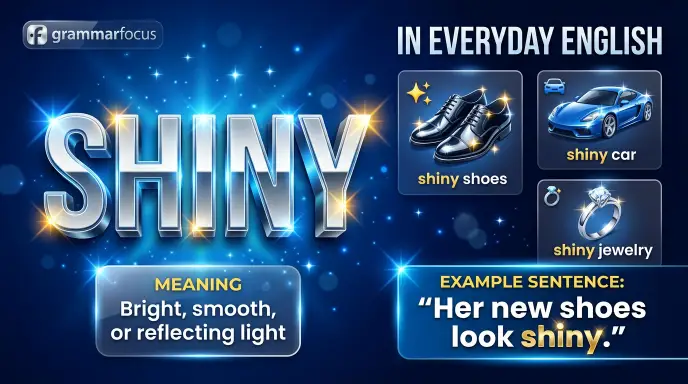
Shiny in Everyday English
Shiny is common in everyday English because people often need to describe the appearance of objects. It can refer to something polished, bright, smooth, or reflective.
Shiny Objects
She bought a shiny new watch.
The children were attracted to the shiny decoration.
Shiny Surfaces
The kitchen counter has a shiny finish.
The floor became shiny after it was cleaned.
Shiny Hair
Shiny can also describe healthy-looking or glossy hair.
Her hair looks shiny in the sunlight.
Shiny Metal
Metal objects are often described as shiny when they have a polished or reflective surface.
The mechanic cleaned the shiny metal parts.
Shiny New
The phrase shiny new is also common. It can describe something that is physically new and attractive.
He showed everyone his shiny new laptop.
Sometimes, shiny new is used more casually to describe something exciting or recently introduced.
Shiny or Shiney in Sentences
Seeing the words in context makes the spelling difference easier to remember.
| Incorrect | Correct |
| She bought shiney shoes. | She bought shiny shoes. |
| The car looks shiney. | The car looks shiny. |
| He polished the shiney surface. | He polished the shiny surface. |
| Her hair is shiney. | Her hair is shiny. |
| The floor became shiney. | The floor became shiny. |
| It has a shiney finish. | It has a shiny finish. |
The important difference is spelling, not meaning. In each incorrect example, the writer usually means the same adjective shiny.
Common Contexts Where You Need Shiny
You will commonly see shiny in descriptions of products, clothing, vehicles, furniture, technology, and personal appearance.
Product Descriptions
This phone has a shiny glass back.
Cars
The dealership displayed a shiny new vehicle.
Shoes
He wore shiny black shoes to the event.
Furniture
The table has a smooth, shiny finish.
Technology
The device has a shiny metal frame.
Appearance
Her shiny hair caught the light.
In all these situations, shiny is the standard spelling.
Is Shiney Ever Correct?
In modern standard English, shiney should generally be treated as a misspelling of shiny.
You may occasionally encounter unusual, historical, dialectal, fictional, or informal uses of spellings that differ from modern standard English.
However, that does not make shiney the standard spelling of the adjective.
For normal writing, there is no reason to choose shiney.
Use shiny in:
- School assignments
- Websites and blogs
- Emails
- Business documents
- Product descriptions
- Academic writing
- Social media posts
- Professional communication
If you see shiney in an online post, it is usually best understood as a spelling error rather than a different English word.
How to Remember Shiny
A simple memory trick can help you avoid this mistake permanently:
Shine + y = Shiny
Do not keep the final e.
Think of the word in two steps:
SHINE → remove E → SHIN → add Y → SHINY
You can also remember this sentence:
A shiny thing can shine.
The correct word starts with shin-, not shine-.
This is especially useful when writing quickly, because shiney can look tempting even though it is not the standard spelling.
Google Search and Usage Intent
People who search for shiny or shiney are usually trying to answer a spelling question quickly. They may have seen both forms and want to know which one is correct.
The search intent is therefore mainly informational and spelling focused.
The clearest answer is:
Shiny is correct. Shiney is a misspelling in standard English.
This direct distinction is useful for students, writers, editors, bloggers, and anyone checking a word before publishing.
When writing online, using the standard spelling shiny also makes your content clearer and easier for readers to understand.
Key Takeaway
Shiny is the correct standard spelling. It is an adjective used for something that reflects light or has a bright, polished, or glossy appearance.
Shiney is a common misspelling. Remember the simple pattern:
shine + y = shiny
There is no standard British-American spelling difference. Both varieties use shiny.
Frequently Asked Questions
Q1. Is shiny or shiney correct?
Answer. Shiny is correct. Shiney is a common misspelling and is not the standard spelling in modern English.
Q2. What does shiny mean?
Answer. Shiny means bright, glossy, polished, or reflective. It can describe objects such as shoes, cars, metal, floors, hair, and jewelry.
Q3. Is shiney a word?
Answer. Shiney may appear in informal or nonstandard writing, but it is not the standard spelling of the adjective. Use shiny in normal English writing.
Q4. How do you spell shiny?
Answer. The correct spelling is S-H-I-N-Y: shiny. The final e from shine is not retained.
Q5. Is shiny the same in British and American English?
Answer. Yes. Both British and American English use shiny. There is no standard regional spelling such as shiney.
Q6. Why is shiny not spelled shiney?
Answer. Shiny is formed from shine and the suffix -y. The standard spelling removes the final e, giving shiny, not shiney.
Q7. Can I use shiny in formal writing?
Answer. Yes. Shiny is a standard English adjective and is completely appropriate in formal, academic, professional, and everyday writing.
Q8. What is an easy way to remember shiny?
Answer. Remember “shine + y = shiny.” The final e is removed, so the correct spelling is shiny.
Conclusion
Shiny is the correct spelling, while shiney is a common spelling mistake. Use shiny when describing something bright, glossy, polished, or reflective.
The word works the same way in British and American English. If you are ever unsure, remember: shine → shiny, not shiney.
Learn More About Grammar:
- Cataloged or Catalogued: Which Is Correct in US and UK English?
- Organiser vs Organizer: The “S” vs “Z” Debate Explained (2026)
- Binkie or Binky: Does It Even Matter Which You Use? (2026)

I’m Alex Morgan, an American English writer with 6 years of experience exploring grammar, punctuation, sentence structure, and everyday English usage. I enjoy turning confusing grammar rules into clear, practical explanations that help readers write and communicate with confidence.