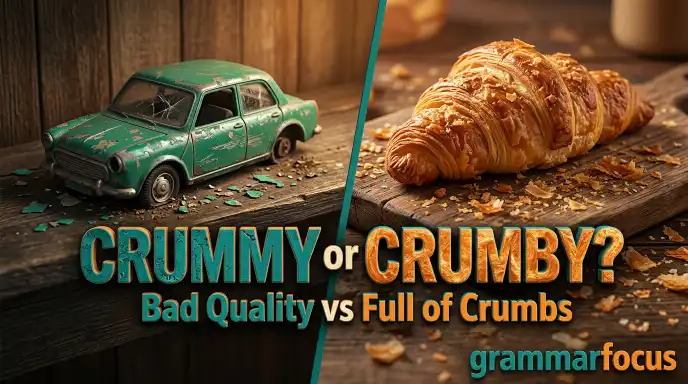
Crummy or crumby are similar looking words, but they do not have the same standard usage. Crummy is the established English adjective used to describe something poor in quality, unpleasant, or disappointing. Crumby is a less common word that can mean covered with or containing crumbs. It can also appear as a variant spelling in some contexts.
The difference becomes easier to understand when you focus on meaning. If you want to say that something is bad, unpleasant, or of poor quality, use crummy.
If you are describing something related to crumbs, crumby may be appropriate.For example, you might say that you had a crummy day when the day was unpleasant.
You might describe a table as crumby if it is covered with crumbs. These words can look almost identical, but their meanings and uses are different.
Crummy or Crumby: Quick Answer
Crummy is the common adjective meaning bad, poor quality, unpleasant, or disappointing.
Crumby is mainly related to crumbs. It can describe something containing crumbs or covered with them.
Examples:
- We stayed at a crummy hotel.
- The kitchen table is crumby after breakfast.
In most everyday situations, crummy is the word you are likely looking for when you mean bad or unpleasant.
A simple rule is:
Crummy = bad or poor quality.
Crumby = related to crumbs.
Quick Comparison: Crummy vs Crumby
| Word | Main Meaning | Part of Speech | Example |
| Crummy | Bad, unpleasant, or poor quality | Adjective | It was a crummy day. |
| Crumby | Covered with or containing crumbs | Adjective | The table is crumby. |
The two words are related in appearance, but their meanings are different.
Pronunciation and Word Form
Crummy
- US pronunciation: /ˈkrʌmi/
- UK pronunciation: /ˈkrʌmi/
- Word form: Adjective
- Example: The weather was crummy all weekend.
Crummy has two syllables: crum my.
Crumby
- US pronunciation: /ˈkrʌmi/
- UK pronunciation: /ˈkrʌmi/
- Word form: Adjective
- Example: The table became crumby after the children ate cookies.
In common pronunciation, crummy and crumby sound the same. Their spelling and meaning provide the distinction.
Definition and Meaning of Crummy
Crummy is an informal adjective that means bad, unpleasant, disappointing, or of poor quality.
It can describe many different things, including experiences, objects, places, situations, and conditions.
For example:
We had a crummy experience at the restaurant.
He bought a crummy old computer.
I had a crummy day at work.
The word is informal, so it is more common in conversations and casual writing than in highly formal documents.
Crummy for Poor Quality
You can use crummy when something does not meet a reasonable standard.
The hotel room was crummy.
This is a crummy piece of equipment.
Here, the word expresses dissatisfaction with quality.
Crummy for an Unpleasant Experience
Crummy can also describe an experience or situation.
We had a crummy trip because of the weather.
She was having a crummy morning.
In these examples, it does not necessarily mean that a physical object is poor. It describes how unpleasant the experience feels.
Definition and Meaning of Crumby
Crumby is an adjective connected with crumbs.
A crumb is a small piece of bread, cake, cookie, or another food that breaks off from a larger piece.
For example:
The kitchen floor is crumby.
This means the floor has crumbs on it.
You could also say:
The table became crumby after the children finished their snacks.
Here, crumby describes the presence of crumbs.
The word is less common than crummy, so context is important when using it.
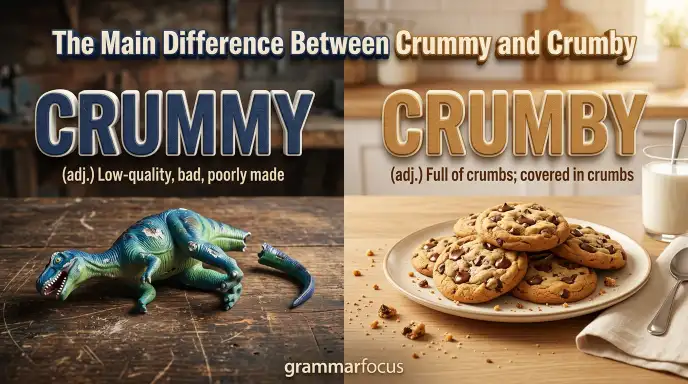
The Main Difference Between Crummy and Crumby
The main difference is their meaning.
Crummy describes something bad, unpleasant, or poor quality.
Crumby describes something associated with crumbs or covered in crumbs.
Compare these sentences:
We had a crummy breakfast.
This means the breakfast was poor or disappointing.
The table was crumby after breakfast.
This means crumbs were left on the table.
The first word gives an opinion about quality. The second describes a physical condition.
When Should You Use Crummy?
Use crummy when you want to describe something negatively in informal English.
Crummy Day
I had a crummy day at work.
The speaker means the day was unpleasant.
Crummy Weather
We had crummy weather during our vacation.
The weather was poor or disappointing.
Crummy Service
The restaurant had crummy service.
The service was considered poor.
Crummy Product
He returned the crummy product.
The product was low quality or disappointing.
Because crummy is informal, it works especially well in conversations, personal writing, reviews, and casual online communication.
When Should You Use Crumby?
Use crumby when you want to describe something that has crumbs on it or contains crumbs.
For example:
The sofa is crumby after the party.
My keyboard is getting crumby from eating snacks at my desk.
The child’s hands were crumby after eating cookies.
The word is most natural when the presence of crumbs is the main point.
In some situations, a phrase such as covered in crumbs or full of crumbs may sound more natural:
The table was covered in crumbs.
This is often clearer for a general audience than using the less common adjective crumby.
Crummy in Everyday English
Crummy is useful in casual conversations because it quickly expresses dissatisfaction.
Common combinations include:
- crummy day
- crummy weather
- crummy job
- crummy service
- crummy hotel
- crummy excuse
- crummy situation
For example:
That was a crummy excuse.
I found a crummy hotel near the station.
It has been a crummy week.
The word is usually negative, but it is not necessarily extremely strong. The exact tone depends on the situation and speaker.
Common Mistakes with Crummy and Crumby
Mistake 1: Using Crumby for “Bad”
If you mean bad or poor quality, use crummy.
Incorrect for that meaning:
We stayed in a crumby hotel.
Better:
We stayed in a crummy hotel.
Mistake 2: Using Crummy for Crumbs
If you are describing a surface covered with crumbs, crumby may be the intended word.
The table is crumby.
Here, crummy would suggest that the table itself is bad or unpleasant rather than simply covered with crumbs.
Mistake 3: Treating the Words as Exact Synonyms
Although the spellings differ by only one letter, the words serve different purposes.
Crummy expresses a negative judgment.
Crumby describes a condition involving crumbs.
Crummy or Crumby in a Sentence
A quick comparison can make the difference clear:
The restaurant was crummy, but the table was crumby.
The restaurant was poor or disappointing, while the table had crumbs on it.
Another example:
It was a crummy lunch, and my shirt became crumby afterward.
The lunch was disappointing, while the shirt had crumbs on it.
These examples show why the surrounding meaning matters when choosing between the two spellings.
The Origin of Crummy and Crumby
The two words developed from different ideas. Crummy is related to crumb and originally had connections with something made of or resembling crumbs.
Over time, its informal meaning developed into a word describing something poor, unpleasant, or low in quality.
Crumby is more directly connected to crumbs. It describes something that contains crumbs or is covered with crumbs. For example, a crumby table may have small pieces of bread or food scattered across it.
The spelling difference is therefore useful because the two forms can point to different meanings.
Crummy in Informal English
Crummy is common in informal English when someone wants to describe something negatively. It can refer to poor quality, an unpleasant experience, or an undesirable situation.
Examples include:
- We stayed in a crummy hotel.
- I had a crummy day at work.
- The old computer is pretty crummy.
- They gave us a crummy seat.
In these examples, crummy does not refer to actual crumbs. It expresses a negative opinion about something.
Because it is informal, crummy is more natural in conversation, casual writing, reviews, and dialogue than in highly formal documents.
Crumby in Food and Household Contexts
Crumby is useful when the literal idea of crumbs matters. It can describe a surface, object, or place that has crumbs on it or contains crumbs.
For example:
- The kitchen counter is crumby after breakfast.
- The children left the sofa crumby.
- This table gets crumby whenever we eat cookies.
- The plate was still crumby after the meal.
Here, the meaning is physical and closely connected to crumbs.
If you are talking about something being messy because of food particles, crumby can make the intended meaning clear.

Crummy vs Crumby in Different Contexts
The context usually makes the correct choice easy.
| Context | Better word | Example |
| Poor quality | Crummy | It was a crummy product. |
| Bad experience | Crummy | I had a crummy morning. |
| Unpleasant place | Crummy | They lived in a crummy apartment. |
| Covered with crumbs | Crumby | The table is crumby. |
| Containing crumbs | Crumby | The kitchen floor became crumby. |
| Food related mess | Crumby | The sofa is crumby after the snack. |
A simple test is to ask what you mean. If you mean bad or unpleasant, choose crummy. If you mean related to crumbs, choose crumby.
Related Words: Crumb, Crummy, and Crumby
Understanding the base word crumb makes the difference easier to remember.
Crumb is a small piece of bread, cake, cookie, or another food. From this word, English has developed several related forms.
- Crumb a small piece of food
- Crumbs more than one small piece
- Crummy usually informal and meaning poor, unpleasant, or low quality
- Crumby containing or covered with crumbs
These words look similar, but their meanings are not interchangeable in every sentence.
Crummy and Crumby in Formal Writing
In formal writing, choose the word according to its intended meaning, but remember that crummy is strongly informal.
For professional or academic writing, words such as poor, unsatisfactory, low quality, or unpleasant may communicate the idea more precisely.
For example:
- Informal: The service was crummy.
- More formal: The service was unsatisfactory.
However, crumby can still be appropriate when the literal meaning is relevant:
The surface was crumby after the food preparation.
The important point is not simply the spelling. It is the meaning you want to communicate.
Common Expressions with Crummy
Because crummy is informal, it often appears in casual expressions.
A crummy day
This means a bad or unpleasant day.
Example:
I had a crummy day because everything went wrong.
A crummy job
This can describe a job that is unpleasant, poorly paid, or otherwise undesirable.
Example:
He was tired of working a crummy job.
A crummy place
This describes a place considered poor, unpleasant, or low quality.
Example:
They moved out of that crummy place last year.
These expressions are generally conversational rather than formal.
How to Remember Crummy or Crumby
Use the crumb test:
Crumby → crumbs.
The spelling contains crumb, so think about food particles.
Crummy → miserable or poor.
Think of crummy as the informal word for something bad, unpleasant, or low quality.
For example:
- The floor is crumby. → It has crumbs.
- The floor looks crummy. → It looks bad or unpleasant.
This small meaning test can help you choose the right spelling without memorizing a complicated rule.
FAQs About Crummy or Crumby
Q1. Is crummy a correct word?
Answer. Yes. Crummy is a correct informal English adjective meaning poor, unpleasant, or low quality.
Q2. Is crumby a correct word?
Answer. Yes. Crumby can describe something containing or covered with crumbs. Its use is much more literal than the common informal meaning of crummy.
Q3. What is the difference between crummy and crumby?
Answer. Crummy usually means bad, unpleasant, or low quality, while crumby refers to something associated with crumbs.
Q4. Does crummy mean full of crumbs?
Answer. Usually, no. In modern informal English, crummy commonly means poor or unpleasant. Crumby is the more direct spelling when you mean something covered with or containing crumbs.
Q5. Can I use crummy in formal writing?
Answer. You can, but it is informal. In professional or academic writing, words such as poor, unsatisfactory, or low quality are often more appropriate.
Q6. How can I remember crummy and crumby?
Answer. Connect crumby with crumbs. Use crummy when you mean something bad, unpleasant, or low quality.
Q7. Is crummy the same as crappy?
Answer. Crummy and crappy can have similar informal meanings when describing something poor or unpleasant. However, crappy is generally more vulgar or blunt.
Q8. Which spelling should I use for crumbs?
Answer. Use crumby when you specifically mean something covered with or containing crumbs. Use crummy when you mean poor, unpleasant, or low quality.
Key Takeaway
Crummy and crumby are similar looking adjectives with different common uses. Crummy usually means bad, unpleasant, or low quality and is informal.
Crumby relates to crumbs and describes something that contains or is covered with crumbs.
Remember: crumby = crumbs, while crummy = poor or unpleasant.
Conclusion
Choosing between crummy or crumby depends on meaning, not just spelling. Use crummy for something poor, unpleasant, or low quality, especially in informal English.
Use crumby when you are talking about crumbs or something covered with them.
Once you connect crumby with crumb, the distinction becomes much easier to remember. This simple difference can help you avoid spelling mistakes in everyday conversations and writing.
Learn More About Grammar:
- Minuscule or Miniscule: Which Spelling Is Correct?
- Empower or Enpower: Only One Is a Real Word
- Concent or Consent? Don’t Make This Common Mistake

I’m Alex Morgan, an American English writer with 6 years of experience exploring grammar, punctuation, sentence structure, and everyday English usage. I enjoy turning confusing grammar rules into clear, practical explanations that help readers write and communicate with confidence.