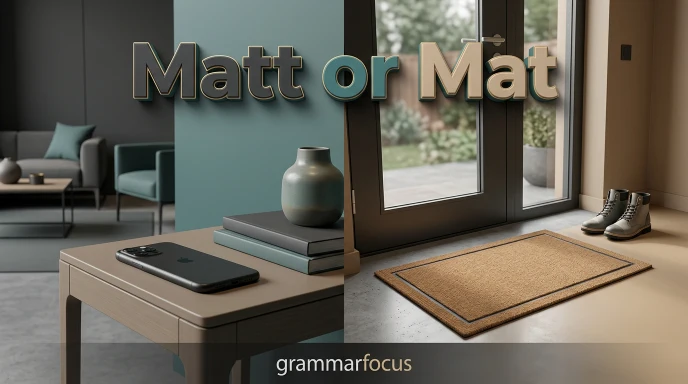
Matt or mat? Both are correct English words, but they mean different things matt describes a dull, non shiny surface (or works as a name), while mat refers to a piece of material placed on a floor, like a yoga mat or doormat.
The words look almost identical, but that extra “t” in matt changes the meaning completely. Context is key, especially since both words can relate to surfaces in different ways.
This guide covers the meanings, pronunciation, and everyday examples of matt or mat so you’ll always know which one to use.
Matt or Mat: Quick Answer
Matt and mat are different words with different common meanings.
| Word | Main meaning | Example |
| Matt | A male first name; also a variant spelling of matte | Matt is joining us for dinner. |
| Mat | A piece of material used on a floor or surface | Leave your shoes on the mat. |
There is also an important spelling point. Matte is the more common spelling for a non shiny finish in American English, while matt is also used, especially in British English.
For example:
- Matt is my colleague.
- Please stand on the mat.
- The wall has a matt finish.
The correct word depends on what you mean.
Pronunciation and Word Form
Matt
- US: /mæt/
- UK: /mæt/
- Part of speech: Proper noun; adjective in matt finish
Example:
Matt called me yesterday.
When Matt is a person’s name, it is normally written with a capital M.
Mat
- US: /mæt/
- UK: /mæt/
- Part of speech: Noun; verb
Example:
There is a mat beside the door.
The two words have the same pronunciation, which makes them easy to confuse when heard in conversation.
Definition and Meaning of Matt
Matt has two important uses.
First, Matt is a common male first name. It is often used as a short form of Matthew.
For example:
- Matt works with my brother.
- I spoke to Matt this morning.
- Matt is coming to the meeting.
As a name, Matt should normally begin with a capital letter.
Second, matt can describe a surface that is not shiny or glossy. This spelling is especially associated with British English.
For example:
- The paint has a matt finish.
- She chose a matt black surface.
- The paper has a smooth matt texture.
In American English, matte is generally the more familiar spelling for this meaning.
Definition and Meaning of Mat
A mat is usually a flat piece of material placed on a floor or another surface. Mats can be made from rubber, fabric, plastic, foam, or other materials.
Common examples include:
- a doormat at an entrance
- a bath mat in a bathroom
- a yoga mat for exercise
- an exercise mat for workouts
- a desk mat for a work surface
Examples:
- Wipe your feet on the mat.
- I bought a new yoga mat.
- The bath mat is wet.
- Put the mat under the chair.
The word mat can also be used as a verb in some contexts, especially when something becomes tangled or forms a dense mass.
For example:
The dog’s fur became matted.
The Main Difference Between Matt and Mat
The simplest difference is the meaning.
Matt can be:
- A male first name.
- A spelling of matte, meaning dull or non shiny.
Mat is usually a noun referring to a piece of material used on a floor or surface.
Compare these sentences:
- Matt is waiting outside. → a person’s name
- The mat is waiting outside. → grammatically possible, but normally refers to an object and sounds unusual without context
- The floor has a matt finish. → dull, not shiny
- The mat is on the floor. → a floor covering
Because Matt and mat are homophones, pronunciation alone does not tell you which spelling is correct.
When Should You Use Matt?
Use Matt with a capital letter when it is someone’s name.
For example:
- Matt lives next door.
- Have you met Matt?
- Matt sent the email.
- I invited Matt to the party.
Matt is commonly used as a short form of Matthew, although a person may officially use either name.
Use lowercase matt only when it is functioning as the surface finish word.
For example:
The designer selected a matt black finish.
If you are writing in American English, matte black is generally the preferred form for this meaning.
When Should You Use Mat?
Use mat when you mean a piece of material placed on a floor or another surface.
Examples:
- The welcome mat is outside the door.
- She put a mat under the exercise equipment.
- My yoga mat is in the car.
- The kitchen mat needs cleaning.
The word can describe many different types of mats.

Doormat
A doormat is placed near a door, often to help clean shoes or welcome visitors.
Yoga mat
A yoga mat provides a cushioned surface for yoga and related exercises.
Bath mat
A bath mat is placed near a bathtub or shower.
Floor mat
A floor mat protects or covers part of a floor.
Matt, Mat, and Matte
A third word is important when discussing this spelling difference: matte.
Matte usually means having a surface that is not shiny or reflective.
For example:
- She chose a matte finish for the walls.
- The phone has a matte black surface.
- The photographer used matte paper.
Matt can also have this meaning, particularly in British English.
So these forms can appear:
- mat → a piece of material
- matt → a dull or non shiny finish; also a name
- matte → a dull or non shiny finish
This is why context matters when choosing the spelling.
Common Mistakes With Matt and Mat
One common mistake is using mat when writing someone’s name.
❌ Mat is my friend.
✅ Matt is my friend.
Another mistake is using Matt when referring to a floor covering.
❌ Put your shoes on the Matt.
✅ Put your shoes on the mat.
Writers can also confuse matt and matte when describing a non shiny surface.
In British English, matt is an established spelling. In American English, matte is generally preferred.
The best choice depends on the meaning and the English variety you are following.
Matt or Mat in Everyday Sentences
Here are some simple examples:
- Matt is coming over tonight.
- Please clean the mat by the door.
- Matt sent me a message.
- The yoga mat is in the bedroom.
- The paint has a matt finish.
- The new table has a matte surface.
These examples show why the surrounding words are important. Although Matt and mat sound the same, their meanings are clear from context.
The Origin of Matt and Mat
The word mat has a long history in English and is connected with words referring to a piece of material used as a covering or floor surface.
Mats have traditionally been made from materials such as woven fibers, grass, reeds, and other natural materials.
Matt, when used as a personal name, is generally a shortened form of Matthew. Matthew comes from a Hebrew name traditionally understood to mean “gift of God.”
The surface finish meaning of matt is related to matte, which refers to a non shiny or dull surface.
English uses both matt and matte, with regional preferences affecting which form is more common.
Matt as a Name
Matt is widely used as a short form of Matthew. It is a proper noun, so it begins with a capital letter when used as someone’s name.
Examples:
- Matt works at the local office.
- I met Matt at the conference.
- Matt sent the documents yesterday.
- Have you spoken to Matt?
The name should not be confused with the common noun mat.
A useful clue is capitalization. If the word refers to a person named Matt, it normally begins with M.
Mat in Different Everyday Contexts
The word mat appears in many everyday compound nouns.
Doormat
A doormat is placed near an entrance.
The package is beside the doormat.
Bath mat
A bath mat is used on the floor near a bath or shower.
The bath mat needs to be washed.
Yoga mat
A yoga mat provides a surface for yoga exercises.
She rolled up her yoga mat after class.
Welcome mat
A welcome mat is often placed at an entrance and can also appear in the expression roll out the welcome mat, meaning to give someone a warm welcome.
The hotel rolled out the welcome mat for its guests.
Mat in Sports and Workplaces
Mat is also used for specialized surfaces in sports and workplaces.
In sports such as wrestling and martial arts, a mat provides a designated surface for training or competition.
For example:
The athletes stepped onto the mat.
In workplaces, protective mats may be placed under chairs, machines, or equipment.
For example:
The office uses floor mats to protect the carpet.
The exact type of mat depends on its purpose and location.
Matt and Matte in Design and Photography
When discussing surfaces, printing, photography, or design, you may encounter matt and matte.
A matte surface has little or no shine. It is often contrasted with a glossy surface.
For example:
- The designer chose a matte finish.
- The brochure is printed on matte paper.
- The cabinet has a matte black surface.
In British English, matt can also be used:
- The cabinet has a matt black finish.
The important distinction is that mat without the second t normally refers to the floor or surface covering, not the non shiny finish.

Matt or Mat in Formal Writing
When Matt is someone’s name, use the spelling the person uses for their name.
For example:
Please send the report to Matt.
When referring to a floor covering, use mat:
The safety instructions are printed beside the entrance mat.
When describing a non shiny finish, follow the spelling convention of your chosen English variety:
- American English: matte
- British English: matt is an established form
In professional writing, consistency is especially important when describing products, materials, or design specifications.
Common Expressions With Mat
The word mat appears in several familiar expressions.
Roll out the welcome mat
This means to give someone a warm or enthusiastic welcome.
The company rolled out the welcome mat for the new employees.
Step onto the mat
This can literally mean moving onto a mat, especially in sports.
The competitors stepped onto the mat.
Wipe your feet on the mat
This is a common practical instruction, especially when entering a building.
Please wipe your feet on the mat.
These expressions use mat as a common noun, not the name Matt.
Matt or Mat: A Simple Memory Trick
Use the person test.
If you are talking about a person named Matthew, the short form is usually:
Matt
If you are talking about something placed on a floor or surface, use:
mat
If you mean a non shiny finish, remember:
matte in common American English
matt is also established in British English
So:
Matt = person
Mat = floor or surface covering
Matte/matt = non shiny finish
This quick test can help you choose the correct spelling in everyday writing.
FAQs About Matt or Mat
Q1. Is Matt a name?
Answer. Yes. Matt is a common short form of the male name Matthew and is normally written with a capital letter.
Q2. What is a mat?
Answer. A mat is usually a flat piece of material placed on a floor or another surface. Examples include yoga mats, bath mats, and doormats.
Q3. Are Matt and mat pronounced the same?
Answer. Yes. Matt and mat are normally pronounced /mæt/ in both American and British English.
Q4. Is matt a correct spelling?
Answer. Yes. Matt is correct as a name, while matt is also an established spelling for a dull or non shiny finish, particularly in British English.
Q5. Is matte the same as matt?
Answer. Yes, when they describe a non shiny surface, matt and matte have the same basic meaning. The preferred spelling can depend on regional English conventions.
Q6. Is mat the same as matte?
Answer. Usually, no. Mat normally refers to a piece of material used on a floor or surface, while matte describes a non shiny finish.
Q7. Should I write Matt or Mat for a person’s name?
Answer. Use the spelling the person actually uses. Matt is a common short form of Matthew.
Q8. How do I remember Matt and mat?
Answer. Think Matt = person and mat = floor covering. For a non shiny finish, use matte in common American English or matt where that spelling is preferred.
Key Takeaway
Matt and mat sound the same but have different meanings.
- Matt → usually a person’s name or a spelling for a non shiny finish
- Mat → a piece of material placed on a floor or surface
- Matte → commonly used for a non shiny finish, especially in American English
- Matt as a name is normally capitalized
The easiest memory trick is Matt = person, mat = floor covering.
Conclusion
Choosing between matt or mat depends on what you mean. Use Matt for a person’s name, mat for a floor or surface covering, and matt or matte when describing a non shiny finish according to the English variety you are following.
Although the words sound identical, their meanings become clear from context.
Remembering the basic distinction between Matt, mat, and matte will help you use each form accurately in everyday and professional writing.
Learn More About Grammar:
- Meet or Meat: What’s the Difference?
- Revise or Correct: Meaning, Differences & Examples
- Foody or Foodie: What’s the Difference?

I’m Elena Cooper, an English grammar writer with 6 years of experience explaining grammar, punctuation, sentence structure, word usage, and common English mistakes. I create clear, practical, and easy-to-follow content that helps readers understand confusing grammar rules and use English accurately and confidently.