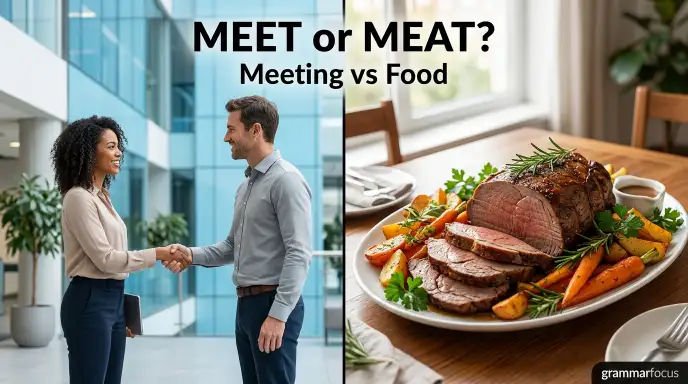
Meet or meat are different English words with different meanings. Meet means to come together with someone, while meat means the edible flesh of an animal used as food.
These words are homophones, so they sound the same but have different spellings and meanings. For example, you can meet a friend or eat meat for dinner.
Knowing the difference helps you use the correct word in everyday writing, emails, schoolwork, and recipes.
Meet or Meat: Quick Answer
Meet is mainly a verb meaning to come together with someone, encounter someone, or be introduced to someone.
It can also be a noun in the phrase a meet, especially for an organized gathering or sporting event.
Meat is mainly a noun referring to animal flesh that people eat as food.
The easiest way to remember them is:
- Meet → people come together.
- Meat → food from animals.
For example:
- I will meet my friend at the café.
- We bought fresh meat for dinner.
So, if you are talking about people coming together, use meet. If you are talking about food, use meat.
Quick Comparison: Meet vs Meat
| Word | Meaning | Part of Speech | Example |
| Meet | To come together or encounter someone | Verb; sometimes noun | I will meet Sarah tomorrow. |
| Meat | Animal flesh used as food | Noun | We bought fresh meat. |
Both words have the same pronunciation, but their meanings are completely different.
Pronunciation and Word Form
Meet
- US pronunciation: /miːt/
- UK pronunciation: /miːt/
- Word form: Mainly a verb; also a noun in some contexts
- Example: We will meet outside the station.
The vowel sound in meet is the long /iː/ sound, as in see and green.
Meat
- US pronunciation: /miːt/
- UK pronunciation: /miːt/
- Word form: Noun
- Example: She does not eat meat.
Meet and meat are pronounced exactly the same in standard English. Their different spellings are what distinguish them in writing.
Definition and Meaning of Meet
Meet is a verb that usually means to come together with another person or group.
For example:
- I will meet you after work.
- We met at school ten years ago.
- They are going to meet the new manager.
- I need to meet my doctor tomorrow.
The word can describe a planned meeting or an unexpected encounter.
For example, if you arrange to see someone at 5 p.m., you can say:
We will meet at five.
You can also use meet when you encounter someone for the first time:
I was happy to meet your family.
Meet as a Noun
Although meet is most commonly used as a verb, it can also function as a noun in certain contexts.
For example:
The athletes competed at a track meet.
Here, meet means an organized sports competition or gathering.
The noun is especially common in American English in expressions such as track meet and swim meet.
Definition and Meaning of Meat
Meat is a noun that generally refers to the edible flesh of animals.
Common examples include:
- beef
- pork
- lamb
- chicken
- turkey
For example:
We bought some meat for the barbecue.
The restaurant serves fresh meat dishes.
The word can refer to animal flesh generally or to a particular type of food, depending on the context.
For example:
Some people choose not to eat meat.
Here, meat refers to animal-based food in general.
In another sentence:
The recipe requires one pound of meat.
The specific type of meat would normally be understood from the recipe or surrounding context.
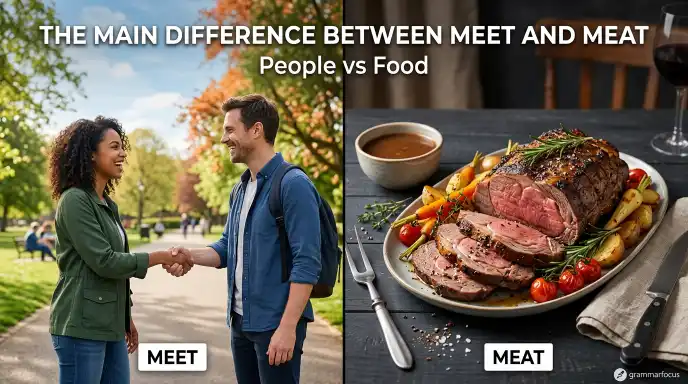
The Main Difference Between Meet and Meat
The main difference is simple:
Meet is connected with people, encounters, and coming together.
Meat is connected with food and animal flesh.
Compare these sentences:
I will meet my brother at the restaurant.
My brother ordered meat at the restaurant.
The first sentence describes an encounter between people. The second describes food.
Another useful pair is:
We meet every Friday.
We buy meat every Friday.
The pronunciation is the same, but the meaning changes completely because the spelling changes.
When Should You Use Meet?
Use meet when you are talking about seeing, joining, encountering, or coming together with someone.
Meeting Someone
Use meet for planned appointments and social gatherings.
- I will meet you at the entrance.
- She is going to meet her friends tonight.
- We met for coffee yesterday.
Meeting Someone for the First Time
Meet is also used when people are introduced to one another.
- It was nice to meet you.
- I would like you to meet my parents.
- We first met in college.
Meeting for Work
The word is common in professional English.
- We will meet with the client tomorrow.
- The team needs to meet before the presentation.
- I am meeting my manager this afternoon.
In these examples, meet refers to people coming together for a particular purpose.
When Should You Use Meat?
Use meat when you are talking about animal flesh used as food.
Talking About Food
- I do not eat meat.
- The store sells fresh meat.
- We cooked meat for dinner.
Talking About Types of Meat
The word meat can be used with the names of particular foods.
- chicken meat
- beef meat
- pork meat
- lamb meat
However, in natural English, speakers often simply say chicken, beef, pork, or lamb rather than adding meat.
For example:
We had chicken for dinner.
Is more natural than:
We had chicken meat for dinner.
The longer form can still be useful when clarification is needed.
Meet in Common Grammar Patterns
Several useful English patterns also include the word meet.
Meet Someone
Use meet + person when you come together with someone.
I need to meet my teacher tomorrow.
Meet With Someone
Meet with is especially common when discussing a planned discussion.
The manager will meet with the employees.
Meet at a Place
Use meet at when identifying a meeting location.
Let’s meet at the station.
Meet on a Date or Occasion
You can also use meet on when referring to a particular day or occasion.
We will meet on Monday.
These patterns make meet very common in everyday and professional English.
Meat in Common Grammar Patterns
Because meat is a noun, it commonly appears after determiners, adjectives, and verbs connected with food.
Some Meat
We need some meat for the recipe.
Fresh Meat
The market sells fresh meat.
Cook Meat
She knows how to cook meat properly.
Eat Meat
Do you eat meat?
Red Meat
Red meat commonly refers to meat such as beef, lamb, and similar meats.
He tries to eat less red meat.
The grammatical role of meat is therefore quite different from meet, even though the two words sound identical.
Common Mistakes with Meet and Meat
Because meet and meat are homophones, spelling mistakes are common.
Mistake 1: Using Meat for a Meeting
Incorrect:
I will meat you at six.
Correct:
I will meet you at six.
The sentence is about seeing another person, so meet is correct.
Mistake 2: Using Meet for Food
Incorrect:
We bought fresh meet for dinner.
Correct:
We bought fresh meat for dinner.
The sentence refers to food, so meat is required.
Mistake 3: Confusing Them in Messages
A spelling error can make a message look confusing:
Let’s meat at the restaurant.
The reader may understand the intended meaning because of the context, but meet is the correct spelling.
Meet or Meat in Everyday English
These words are both common in everyday English, but they appear in very different situations.
You might meet someone:
- at school
- at work
- at a restaurant
- at an airport
- at a party
- online
You might buy or eat meat:
- at a grocery store
- at a restaurant
- at home
- at a market
- at a barbecue
Consider this short example:
I will meet James at the grocery store. We need to buy meat for dinner.
Both words can appear naturally in the same sentence, but their meanings remain completely separate.
A Simple Memory Trick for Meet and Meat
A quick memory trick can help you remember the spelling.
Think:
Meet = people meet.
Meat = people eat.
The words meet and eat are connected by the idea of people coming together and interacting, while meat is something that can be eaten.
Another useful reminder is:
Meet has two e’s, like two people coming together.
This is only a memory aid, not a spelling rule, but it can make the distinction easier to remember.
The Origin of Meet and Meat
The words meet and meat have different histories even though they are pronounced the same today.
Meet comes from Old English and has a long history connected with coming together, encountering someone, or being in the presence of another person.
Its meaning developed over time and eventually gained several related uses, including meeting people, satisfying requirements, and coming together for an event.
Meat also comes from Old English. Historically, its meaning was broader than the modern meaning of animal flesh.
The word was once used more generally for food or something eaten. Over time, its meaning became more specific and came to refer primarily to the flesh of animals used as food.
This historical difference explains why two words that sound identical can have completely unrelated meanings.

Meet and Meat as Homophones
Meet and meat are classic examples of English homophones.
Homophones are words that have the same pronunciation but different meanings and spellings. English has many such pairs, including:
- see / sea
- right / write
- flower / flour
- buy / by
- meet / meat
Context usually makes the intended meaning clear when people speak. Writing is different because the spelling must identify the correct word.
For example:
I need to meet the chef.
Here, the meaning involves an encounter.
I need to buy meat from the chef’s restaurant.
Here, the meaning involves food.
The surrounding words provide clues, but the spelling still matters.
Other Meanings of Meet
Although meet commonly describes coming together with people, it has several other important meanings.
Meet a Requirement
Meet can mean to satisfy a condition, standard, or requirement.
The product must meet safety standards.
She meets all the requirements for the position.
Here, meet has nothing to do with physically seeing another person.
Meet a Need
The word can also mean to provide what is necessary.
This program helps meet the needs of local families.
Meet a Deadline
In work and academic writing, meet a deadline means to complete something by the required time.
We need to meet the deadline.
These uses show why meet is a flexible verb with meanings beyond personal meetings.
Useful Expressions with Meet
Several common expressions use meet.
Meet Someone
I am looking forward to meeting your family.
Nice to Meet You
This is a standard expression used when you are introduced to someone.
“Hi, I’m Daniel.”
“Nice to meet you.”
Meet Up
Meet up means to come together, usually in an informal or social situation.
Let’s meet up after work.
Meet the Deadline
This means to finish something on time.
The team worked late to meet the deadline.
Meet the Requirements
This means to satisfy the necessary conditions.
Applicants must meet the requirements before applying.
These expressions are useful in both everyday and professional English.
Useful Expressions with Meat
Several established expressions also use the word meat.
Meat and Potatoes
The phrase meat and potatoes can literally refer to food. However, it also works as an idiom for the most important or basic part of something.
Let’s get to the meat and potatoes of the discussion.
Red Meat
This commonly refers to meat such as beef and lamb.
Some people choose to limit their red meat consumption.
Meat-Free
Meat-free describes food or meals that do not contain meat.
The restaurant offers several meat-free options.
Processed Meat
This term refers to meat that has been changed through processes such as curing, smoking, or other preservation methods.
The article discusses different types of processed meat.
These expressions show that meat can be used in food-related descriptions as well as idiomatic language.
Meet in Formal and Professional Writing
Meet is completely appropriate in professional writing, but the exact phrase depends on the situation.
For appointments:
We would like to meet with you next week.
For business discussions:
The representatives will meet to discuss the proposal.
For requirements:
All applicants must meet the stated criteria.
For deadlines:
The team expects to meet the project deadline.
These uses are common in emails, reports, workplace documents, academic writing, and official communication.
When writing professionally, make sure you use meet, not meat, whenever the meaning involves an appointment, discussion, requirement, or deadline.
Meat in Food Writing
Meat is common in menus, recipes, grocery descriptions, nutrition discussions, and restaurant writing.
Examples include:
Add the cooked meat to the sauce.
The menu includes several meat dishes.
Store raw meat safely.
The recipe uses minced meat.
In food writing, the context usually makes the meaning obvious. However, correct spelling is still important because meet would change the meaning completely.
Meet and Meat in Digital Communication
Spelling mistakes between homophones are especially common in texting and social media because people often write quickly.
For example:
“Can we meat at 7?”
The intended meaning is obvious from the context, but the spelling is incorrect.
The correct sentence is:
“Can we meet at 7?”
Similarly:
“We bought fresh meet.”
should be:
“We bought fresh meat.”
Autocorrect can sometimes create unexpected homophone errors, so it is worth checking messages before sending them, particularly in professional communication.
Meet, Meat, and Other Confusing Homophones
Learning meet and meat can also help you recognize a larger pattern in English.
| Homophones | Correct Meaning |
| Meet / Meat | Come together / food |
| See / Sea | Use your eyes / large body of salt water |
| Buy / By | Purchase / near or through |
| Right / Write | Correct / put words on paper |
| Flower / Flour | Plant bloom / baking ingredient |
The important lesson is that pronunciation cannot always tell you which spelling to use.
When writing a homophone, first identify the meaning and then choose the spelling that matches it.
Meet or Meat: A Quick Writing Test
If you are unsure which word to use, ask yourself one simple question:
Am I talking about coming together or encountering someone?
If yes, choose meet.
I will meet my sister tomorrow.
If you are talking about food made from animal flesh, choose meat.
We bought meat for the barbecue.
For other meanings of meet, look for ideas such as requirements, needs, standards, expectations, or deadlines.
The company must meet the required standards.
This quick test can prevent most spelling mistakes.
Frequently Asked Questions About Meet or Meat
Q1. Are meet and meat pronounced the same?
Answer. Yes. Meet and meat are homophones and have the same standard pronunciation: /miːt/.
Q2. What is the difference between meet and meat?
Answer. Meet usually means to come together, encounter someone, or satisfy a requirement. Meat refers mainly to animal flesh used as food.
Q3. Is meet a verb or a noun?
Answer. Meet is mainly a verb, but it can also be a noun in expressions such as track meet and swim meet.
Q4. Is meat always related to food?
Answer. Meat is primarily associated with animal flesh used as food. It can also appear in idiomatic expressions such as meat and potatoes, where the phrase may have a figurative meaning.
Q5. Can meet mean satisfy?
Answer. Yes. Meet can mean to satisfy a requirement, standard, need, expectation, or deadline. For example, “The applicant meets the requirements.”
Q6. Why are meet and meat confusing?
Answer. They are confusing because they have identical pronunciation but different spellings and meanings. This makes them easy to mix up when writing.
Q7. What is the easiest way to remember meet and meat?
Answer. Remember meet = come together and meat = food. You can also connect meet with people and meat with eating.
Q8. Is “meat me tomorrow” correct?
Answer. No. If you mean “come together with me tomorrow,” the correct sentence is “Meet me tomorrow.” Meat refers to food.
Conclusion
Meet and meat are homophones, but they should never be treated as interchangeable words.
Meet is used for coming together, encountering people, and several related ideas such as satisfying requirements or meeting deadlines. Meat is primarily a noun for animal flesh used as food.
Their identical pronunciation makes the distinction particularly important in writing. If the sentence is about people, appointments, encounters, requirements, or deadlines, meet is likely the correct choice. If it is about food, meat is the appropriate spelling.
A simple rule is enough for most situations:
Meet = come together.
Meat = food.
Learn More About Grammar:
- Caretaker or Caregiver: What’s the Difference?
- Revise or Correct: Meaning, Differences & Examples
- Foody or Foodie: What’s the Difference?

I’m Elena Cooper, an English grammar writer with 6 years of experience explaining grammar, punctuation, sentence structure, word usage, and common English mistakes. I create clear, practical, and easy-to-follow content that helps readers understand confusing grammar rules and use English accurately and confidently.






3 thoughts on “Meet or Meat: What’s the Difference?”