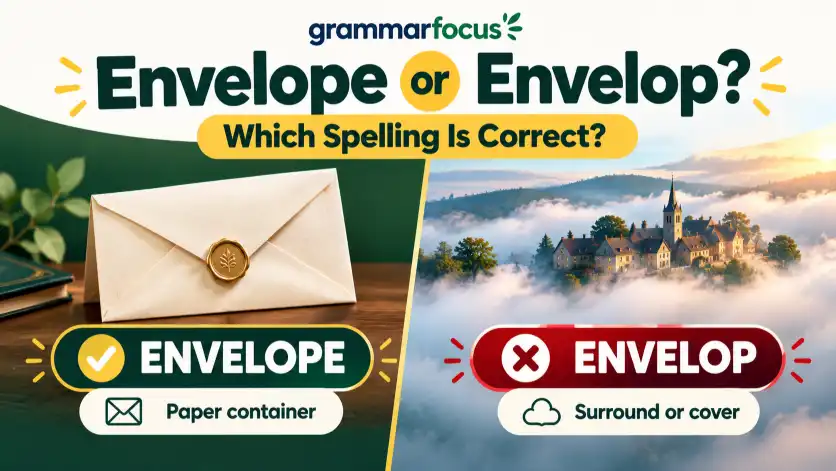
Envelope is the correct word for a paper container used to hold a letter, card, bill, or document. Envelop is also a correct English word, but it is a verb meaning to surround, cover, or wrap something completely.
The words envelope and envelop look almost identical, but they have different meanings and grammatical uses.
Use envelope when you mean a paper covering for mail. Use envelop when something surrounds or covers another thing.
For example, you can put a letter in an envelope, but fog can envelop a village. Learning the difference is simple when you remember that an envelope is a thing, while envelop describes an action.
Envelope or Envelop: Quick Answer
| Word | Part of Speech | Meaning | Example |
| Envelope | Noun | A paper container for a letter or document | Put the card in an envelope. |
| Envelop | Verb | To surround, cover, or wrap something completely | Fog began to envelop the town. |
The Simple Difference
- Envelope = a paper container
- Envelop = to surround, cover, or wrap
Both words are correct, but they usually cannot replace each other.
Pronunciation and Word Form
Envelope
- US pronunciation: /ˈen.və.loʊp/
- UK pronunciation: /ˈen.və.ləʊp/
- Part of speech: Noun
Example: She placed the invitation inside an envelope.
Envelop
- US pronunciation: /ɪnˈveləp/
- UK pronunciation: /ɪnˈveləp/
- Part of speech: Verb
Example: Thick smoke began to envelop the building.
Pronunciation Difference
Envelope is usually pronounced:
EN-vuh-lohp
Envelop is usually pronounced:
en-VEL-up
The main difference is the stress. In envelope, the stress falls on the first syllable. In envelop, the stress falls on the second syllable.
Definition and Meaning of Envelope
An envelope is a flat paper container used to hold a letter, greeting card, bill, photograph, cheque, or document. It usually has an opening, a flap, and a space for an address.
Most envelopes include:
- An opening for inserting papers
- A flap that can be folded over
- A front side for the recipient’s address
- A back side that can be sealed
Examples of Envelope
- I received a white envelope in the mail.
- Please write your address on the envelope.
- She opened the envelope carefully.
- He placed the cheque inside an envelope.
- The invitation came in a beautiful envelope.
Common Types of Envelopes
Letter Envelope
A letter envelope is used for sending personal or formal letters.
Example: She placed the handwritten letter inside an envelope.
Business Envelope
A business envelope is commonly used for invoices, official letters, and company documents.
Example: The company sent the contract in a business envelope.
Padded Envelope
A padded envelope contains extra protective material. It is useful for sending small items that may need protection during delivery.
Example: The seller mailed the headphones in a padded envelope.
Greeting Card Envelope
A greeting card envelope is designed to hold a birthday card, wedding card, or another greeting card.
Example: He put the birthday card into its envelope.
Document Envelope
A document envelope is often larger and is used for papers, certificates, or forms.
Example: Please send the completed documents in a large envelope.
Definition and Meaning of Envelop
Envelop is a verb. It means to surround, cover, or wrap something completely.
It is often used when something spreads around a person, place, object, or area. The word can describe physical surroundings as well as feelings, moods, and other abstract ideas.
Common things that can envelop something include:
- Fog
- Smoke
- Darkness
- Clouds
- Heat
- Silence
- Fear
- Peace
- Sadness
- Mist
Examples of Envelop
- Fog began to envelop the road.
- Darkness enveloped the village.
- Smoke enveloped the building.
- A feeling of peace enveloped the room.
- Thick clouds enveloped the mountain.
The verb often creates the idea that something surrounds or covers another thing from different sides.
Envelope vs. Envelop: The Main Difference
The main difference between envelope and envelop is their grammatical role.
Envelope Is a Noun
A noun names a person, place, thing, or idea. In everyday English, envelope commonly names the paper container used for letters, cards, and documents.
Example: The document is in the envelope.
In this sentence, envelope is the object that holds the document.
Envelop Is a Verb
A verb describes an action or state. Envelop describes the action of surrounding, covering, or wrapping something.
Example: Fog began to envelop the village.
In this sentence, envelop explains what the fog is doing.
Compare These Sentences
The envelope was on the desk. Darkness began to envelop the desk.
In the first sentence, envelope is a thing. In the second sentence, envelop describes an action.
Quick Grammar Test
Ask yourself:
- Am I talking about a paper container? Use envelope.
- Am I talking about something surrounding or covering another thing? Use envelop.
Envelope or Envelop: Common Grammar Patterns
Common Patterns with Envelope
Because envelope is a noun, it can appear after articles, possessive words, and adjectives.
Common words used with envelope include:
- An
- The
- This
- That
- My
- Your
- A large
- A sealed
- A brown
Examples
- an envelope
- the envelope
- my envelope
- a sealed envelope
- a large envelope
- the brown envelope
Example sentence: I put the receipt in the envelope.
Common Patterns with Envelop
Because envelop is a verb, it can follow modal verbs and verb phrases.
Common patterns include:
- can envelop
- may envelop
- might envelop
- began to envelop
- started to envelop
- continued to envelop
- will envelop
- could envelop
Examples
- Fog can envelop the valley.
- Darkness began to envelop the town.
- Smoke might envelop the room.
- Clouds started to envelop the mountain.
Example sentence: A thick mist began to envelop the village.
Common Mistakes with Envelope and Envelop
Mistake 1: Using “Envelop” for a Letter Container
Incorrect: Put the letter in an envelop. Correct: Put the letter in an envelope.
Use envelope when you mean the paper container used for mailing a letter or document.
Mistake 2: Using “Envelope” as a Verb
Incorrect: Fog began to envelope the village. Correct: Fog began to envelop the village.
When you mean “surround” or “cover,” use envelop.
Mistake 3: Confusing the Pronunciation
The two words have different stress patterns:
- Envelope: EN-vuh-lohp
- Envelop: en-VEL-up
Learning the pronunciation can help you recognize the difference while speaking and writing.
Mistake 4: Writing “Envelop” in a Mailing Sentence
Incorrect: She bought an envelop for the invitation. Correct: She bought an envelope for the invitation.
The word for a mailing container is spelled envelope, with the final -e.
Mistake 5: Using “Envelope” for Surrounding
Incorrect: Darkness began to envelope the street. Correct: Darkness began to envelop the street.
Use envelop when something surrounds or covers another thing.
Envelope or Envelop in American and British English
Both envelope and envelop are spelled the same way in American English and British English. The difference is based on meaning and grammar, not regional spelling.
| English Variety | Paper Container | Surrounding Action |
| American English | Envelope | Envelop |
| British English | Envelope | Envelop |
Canadian and Australian English also generally use the same spellings.
Remember
- Envelope = a paper container
- Envelop = to surround or cover
- The spelling does not change between American and British English.
A Simple Memory Trick
Remember this sentence:
An envelope holds a letter, while envelop means surround.
You can also connect each word with a familiar example:
| Meaning | Correct Word |
| Envelope | |
| Card | Envelope |
| Document | Envelope |
| Fog | Envelop |
| Darkness | Envelop |
| Smoke | Envelop |
Another Easy Trick
As a memory aid, connect the final -e in envelope with the paper container. Remember that envelop is the verb meaning “to surround.”
This is only a memory trick, not a formal spelling rule.
Quick Review
| If You Mean… | Use This Word |
| A paper container | Envelope |
| A letter holder | Envelope |
| A mailing cover | Envelope |
| To surround something | Envelop |
| To cover something completely | Envelop |
| To wrap something around | Envelop |
Key Point
Both words are correct, but the correct choice depends on the meaning.
- The letter is in an envelope.
- Fog began to envelop the road.
The Origin of Envelope and Envelop
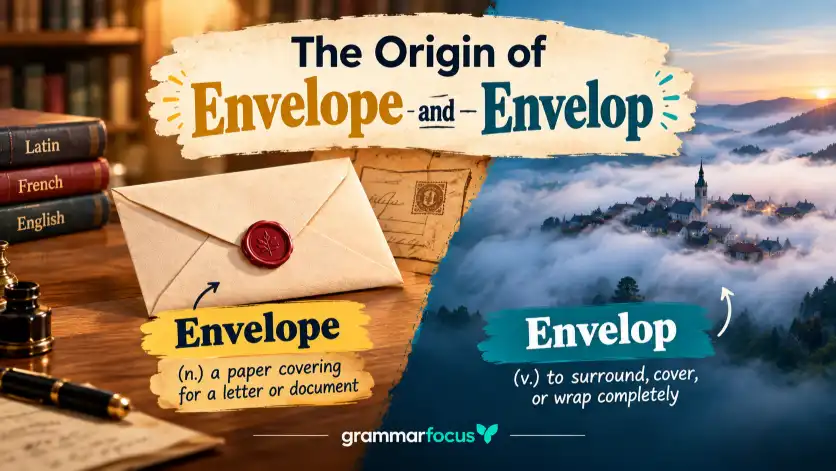
The words envelope and envelop are related. Both are connected with the idea of covering, wrapping, or surrounding something.
Origin of Envelope
The noun envelope entered English through French. It developed from a word associated with a covering or something that wraps around another thing.
Over time, envelope became the usual English word for the paper container used to hold letters, cards, and documents.
Origin of Envelop
The verb envelop also came through French. It developed from the idea of wrapping around or surrounding something.
Its modern meaning still reflects that original idea.
Example: A blanket can envelop a person, and fog can envelop a town.
Envelope in Different Situations
The word envelope is not limited to personal letters. It can describe different paper containers and protective coverings.
Letters and Cards
- She put the birthday card in an envelope.
- The letter arrived in a sealed envelope.
- He opened the envelope slowly.
Bills and Payments
- The bill came in a white envelope.
- She placed the payment inside an envelope.
- Please send the cheque in a secure envelope.
Official Documents
- The certificate was delivered in a large envelope.
- The lawyer received an envelope containing important papers.
- Keep the documents in the original envelope.
Invitations
- The wedding invitation came in a decorated envelope.
- Please write the guest’s name on the envelope.
- The invitation envelope matched the colour of the card.
Protective Packaging
- The company sent the small item in a padded envelope.
- The photographs were placed in a protective envelope.
- The documents were kept in a waterproof envelope.
Envelop in Different Situations
The verb envelop is common in descriptive writing because it creates a strong image of something spreading around another thing.
Fog
- Fog enveloped the road before sunrise.
- A thick mist began to envelop the valley.
- The mountain was enveloped in fog.
Darkness
- Darkness enveloped the village.
- The forest was slowly enveloped in darkness.
- Nightfall enveloped the quiet streets.
Smoke
- Smoke enveloped the building.
- The room was enveloped in smoke.
- A cloud of smoke began to envelop the area.
Clouds
- Dark clouds enveloped the mountain.
- Clouds began to envelop the hilltops.
- The peaks were enveloped in thick grey clouds.
Feelings and Emotions
- A sense of calm enveloped the room.
- Fear began to envelop the crowd.
- Sadness enveloped her after the news.
- A feeling of happiness enveloped the family.
Silence
- Complete silence enveloped the hall.
- A peaceful quiet enveloped the garden.
- Silence enveloped the audience after the announcement.
Active and Passive Forms of Envelop
Because envelop is a verb, it can appear in several grammatical forms.
Present Form: Envelop
Use envelop for a present action or after modal verbs.
- Clouds envelop the mountain.
- Fog can envelop the road.
Third-Person Singular: Envelops
Use envelops with he, she, it, or a singular subject in the present tense.
- Thick fog envelops the valley.
- Darkness envelops the village at night.
Past Form: Enveloped
The past tense of envelop is enveloped.
- Fog enveloped the village.
- Darkness enveloped the street.
Present Participle: Enveloping
The -ing form is enveloping.
- The enveloping mist made driving difficult.
- An enveloping silence filled the room.
Past Participle: Enveloped
The past participle is also enveloped. It often appears in passive sentences.
- The village was enveloped in fog.
- The building was enveloped in smoke.
Important Spelling Note
The correct form is enveloped, not envelopped.
- Incorrect: The town was envelopped in fog.
- Correct: The town was enveloped in fog.
Useful Expressions with Envelope
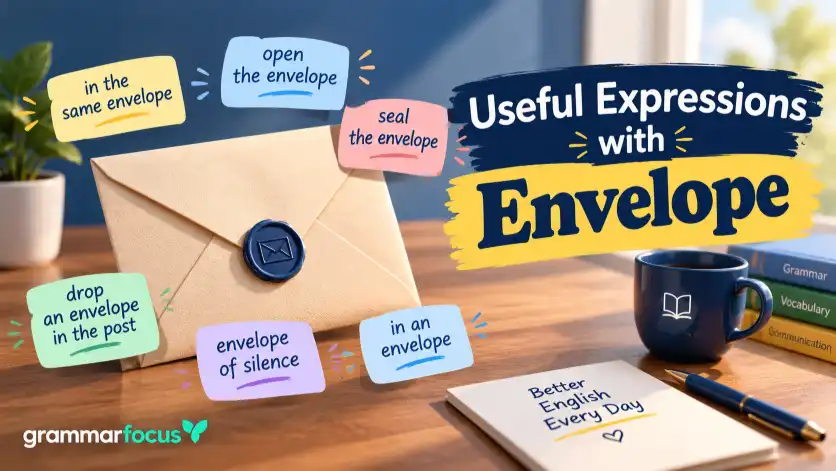
The noun envelope appears in several expressions. Some are common in everyday English, while others are used in technical or specialized contexts.
Push the Envelope
Push the envelope means to go beyond usual limits or try something new.
Example: The designer likes to push the envelope with creative ideas.
Within the Envelope
Within the envelope can mean staying within a particular limit, range, or boundary.
Example: The project must remain within the approved budget envelope.
Envelope of Protection
An envelope of protection describes a covering or boundary that provides protection.
Example: The equipment has an envelope of protection against dust.
Flight Envelope
In aviation, a flight envelope refers to the range of conditions in which an aircraft can operate safely.
Example: The aircraft remained within its safe flight envelope.
Technical Meaning of Envelope
In technical writing, envelope may describe an outer boundary, range, or covering.
Example: The machine operates within a specified temperature envelope.
Synonyms and Related Words
Synonyms of Envelope
Depending on the context, envelope may be related to:
- Cover
- Wrapper
- Packet
- Sleeve
- Container
These words are not always exact replacements. The best choice depends on the type of object being described.
Example: Put the document in a protective sleeve.
Synonyms of Envelop
Depending on the context, envelop may mean:
- Surround
- Cover
- Wrap
- Enclose
- Engulf
- Shroud
Examples:
- Fog surrounded the village.
- Smoke engulfed the building.
- Darkness covered the street.
- A blanket wrapped around the child.
Related Word Forms
- Enveloped = the past tense and past participle of envelop
- Enveloping = surrounding or covering
- Envelopment = the act of surrounding or covering
- Envelope = a noun for a paper container or, in technical contexts, an outer boundary
Envelope vs. Envelop: Sentence Practice
Choose the correct word for each sentence.
- Please place the document in an envelope.
- Thick fog began to envelop the road.
- The invitation arrived in a decorated envelope.
- Darkness enveloped the forest.
- She sealed the envelope carefully.
- Smoke began to envelop the building.
- He wrote the address on the envelope.
- A feeling of peace enveloped the room.
Practice Rule
If the word names a container, choose envelope.
If the word describes surrounding or covering, choose envelop.
Frequently Asked Questions
Q1. Is envelope or envelop correct?
Answer. Both words are correct, but they have different meanings. Envelope is a noun for a paper container. Envelop is a verb meaning to surround or cover.
Q2. What is the difference between envelope and envelop?
Answer. Envelope means a paper container used for letters or documents. Envelop means to surround, cover, or wrap something completely.
Q3. Is envelop a spelling mistake?
Answer. No. Envelop is a correct English verb. It is used when something surrounds or covers another thing.
Example: Fog began to envelop the town.
Q4. Is envelope a verb?
Answer. In standard everyday English, envelope is mainly used as a noun. The verb meaning “to surround” is spelled envelop, without the final -e.
Q5. How do you pronounce envelope?
Answer. Envelope is commonly pronounced EN-vuh-lohp in American English. In British English, the final sound uses the British /əʊ/ vowel.
Q6. How do you pronounce envelop?
Answer. Envelop is pronounced en-VEL-up. The stress falls on the second syllable.
Q7. What is the past tense of envelop?
Answer. The past tense of envelop is enveloped.
Example: Darkness enveloped the village.
Q8. Can envelope and envelop be used interchangeably?
Answer. No. They usually cannot be used interchangeably because they have different meanings and grammatical roles.
- Put the letter in an envelope.
- Fog began to envelop the road.
Final Conclusion
Envelope and envelop are both correct words, but they are used in different ways.
Use envelope when you mean a paper container for a letter, card, bill, or document.
Use envelop when you mean to surround, cover, or wrap something completely.
Remember
- Envelope = paper container
- Envelop = surround or cover
- Enveloped = past tense of envelop
- Enveloping = surrounding or covering
The easiest way to remember the difference is:
A letter goes inside an envelope. Fog can envelop a village.
Learn More About Grammar:
- Fly or Flies? The Grammar Rule Everyone Forgets (2026)
- Summary vs Summery: One Letter, Big Difference (2026)
- Gest vs Jest: A Word Most People Have Never Heard (2026)

I’m Alex Morgan, an American English writer with 6 years of experience exploring grammar, punctuation, sentence structure, and everyday English usage. I enjoy turning confusing grammar rules into clear, practical explanations that help readers write and communicate with confidence.



2 thoughts on “Envelope or Envelop? Know the One-Letter Difference (2026)”