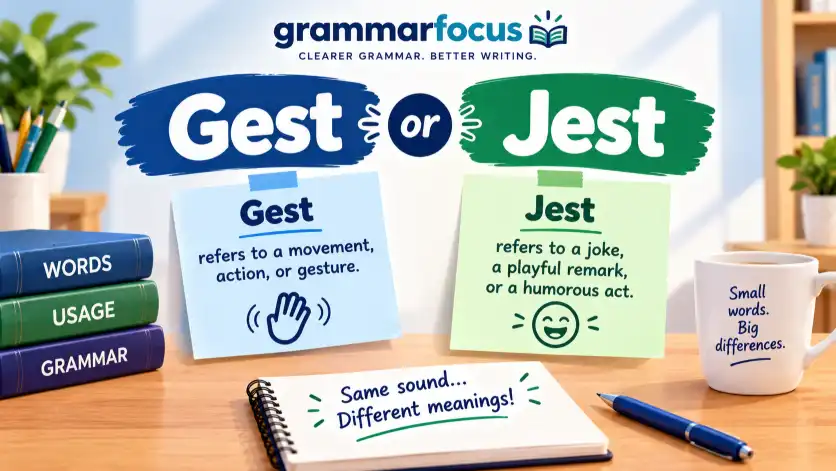
Have you ever seen gest or jest and wondered which spelling is correct? These words look almost identical, but they do not have the same meaning or everyday use.
Jest is a real and commonly used English word. It means a joke, playful remark, or something said or done without serious intent. Gest is also a real word, but it is rare and mainly appears in historical or literary contexts.
For most modern writing, jest is the word you are likely looking for. If you mean a joke or playful comment, write jest, not gest.
This guide explains the difference between gest and jest, their meanings, pronunciation, origins, common mistakes, and the situations where each word may appear.
Gest or Jest: Quick Answer
Jest is the standard word when you mean a joke, playful remark, or humorous action. Gest is an uncommon historical word that can refer to a story, tale, exploit, or deed.
The easiest way to remember the difference is:
- Jest = joke
- Gest = historical or literary word
Examples:
He made the comment in jest.
She was only jesting with you.
The old text describes the king’s gests and adventures.
In modern everyday English, jest is far more useful. You will commonly see it in phrases such as in jest, make a jest, and jesting.
If you are writing a normal email, article, school assignment, or social media post and want to describe a joke, jest is almost certainly the correct choice.
Quick Comparison Table
| Word | Meaning | Modern Use | Example |
| Jest | A joke or playful remark | Commonly recognized | He said it in jest. |
| Jest | To joke or speak playfully | Less common than “joke” | She was only jesting. |
| Gest | A deed, exploit, or old tale | Rare and mainly historical/literary | The poem tells of his gests. |
What Does Jest Mean?
Jest is a noun and a verb. Its main meaning is connected with humor, joking, or playful speech.
As a noun, jest means a joke or humorous remark.
His comment was meant as a jest.
Here, the speaker did not intend the comment to be taken seriously.
The word can also describe playful behavior:
They exchanged a few jests during the meeting.
As a verb, jest means to speak or act jokingly.
I was only jesting.
This means:
I was only joking.
The Phrase “In Jest”
One of the most common expressions with jest is in jest.
In jest means that something was said or done as a joke rather than seriously.
For example:
I said it in jest, so please don’t take it personally.
His criticism was partly in jest.
This phrase is useful when the speaker wants to make their intention clear.
Jest in Modern English
Although jest is a correct modern English word, it can sound slightly formal or old-fashioned in some everyday situations.
Most people would normally say joke or joking in casual conversation:
I was only joking.
This sounds more natural than:
I was only jesting.
However, jest remains useful in formal writing, literature, and expressions such as in jest.
What Does Gest Mean?
Gest is a much less common word. It has historical and literary uses rather than being a normal everyday alternative to jest.
Historically, gest could refer to a story, tale, deed, exploit, or account of notable actions. The word is associated with older forms of English and medieval literature.
For example, an old literary text might use gest when describing the deeds or adventures of a famous person.
Because this word is uncommon today, many modern readers may assume gest is simply a misspelling of jest.
In most everyday contexts, that assumption will be correct.
If you want to say that someone made a joke, the correct word is:
He said it in jest.
Not:
He said it in gest.
Is Gest a Mistake?
Not always. Gest is a genuine English word, but its modern use is limited.
This distinction matters because dictionaries may list a word even when it is rarely used in contemporary communication.
You may encounter gest in historical texts, older literature, or discussions of medieval stories. It should not normally be used as a modern spelling of jest.
So, if your intended meaning is joke, choose jest.
Gest vs Jest: The Main Difference
The two words differ mainly in meaning, frequency, and context.
Jest is connected with joking or humor.
Gest is associated with an old or literary meaning involving a story, deed, or exploit.
Compare these sentences:
He made the remark in jest.
This means he made the remark as a joke.
Now compare:
The poem tells of the hero’s gests.
Here, gests refers to the hero’s notable deeds or adventures in an older literary sense.
The words may look similar, but they should not be treated as interchangeable.
A Simple Memory Trick
Think:
Jest = joke
Both words begin with J.
When you are writing about humor, joking, or a playful comment, jest should come to mind first.
For gest, remember that it belongs mainly to older or literary language.
The Origin of Gest and Jest
The history of these words helps explain why their meanings are so different despite their similar spelling.
Origin of Jest
Jest entered English through Old French and Latin roots connected with telling stories, deeds, or things done. Over time, its meaning developed toward humorous speech, joking, and playful behavior.
English has used jest for centuries, and the word continues to appear in modern writing.
Its connection with joking is now firmly established in phrases such as:
In jest
And:
Jesting remark
Origin of Gest
Gest has an older history and is related to medieval uses of the word for a deed, exploit, or story about notable actions.
It is connected with the idea of something done or accomplished. In older literature, gest could therefore be used for accounts of heroic deeds or adventures.
Over time, this use became much less common in everyday English.
That is why modern readers are much more likely to encounter jest than gest.
Pronunciation and Word Form
The pronunciation is an important clue because gest and jest do not normally sound the same.
Jest
Pronunciation:
US: /dʒest/
UK: /dʒest/
It sounds like jest, rhyming with words such as best, rest, and test.
Part of speech: Noun and verb
Examples:
His comment was made in jest.
She was jesting with her friend.
Gest
Pronunciation:
US: /dʒest/
UK: /dʒest/
When pronounced as the historical English word, gest can have the same pronunciation as jest.
Part of speech: Noun
Because the two words can sound identical, spelling and context are especially important.
If you hear someone use the word but cannot see it written, you may need to use the meaning of the sentence to determine if they mean jest or the rare historical gest.
British English vs American English
There is no major American-versus-British spelling difference between these two words.
| Word | British English | American English | Main Use |
| jest | jest | jest | Joke or playful remark |
| gest | gest | gest | Rare historical or literary word |
Jest in British and American English
Jest is recognized in both British and American English.
For example:
He meant the comment in jest.
The sentence works naturally in both varieties.
However, joke is generally more common in everyday conversation than jest.
Gest in British and American English
Gest is also a recognized word, but it is uncommon in both varieties.
You are much more likely to encounter it in historical, literary, or specialized discussions than in ordinary conversation.
Therefore, you should not choose gest simply because you are writing for a British audience. The meaning and context determine the correct word.
Which One Should You Use?
For most modern writing, the choice is simple.
Use Jest for a Joke
Choose jest when you mean:
- a joke
- a humorous remark
- playful speech
- something not meant seriously
- joking behavior
Examples:
She made the comment in jest.
He was only jesting.
The remark was intended as a jest.
Use Gest Only in Historical or Literary Contexts
Use gest only when the context specifically calls for its rare historical or literary meaning.
For example, if you are discussing an old text about a hero’s deeds, gest may be the appropriate word.
The medieval poem records the hero’s gests.
For ordinary modern communication, however, jest is the safer and more natural choice when you mean a joke.
The Practical Rule
If you are unsure, ask yourself:
Do I mean “joke”?
If yes, use jest.
Am I discussing an old story, deed, or literary account?
If yes, gest may be appropriate.
This simple context check prevents the most common mistake between the two words.
Common Phrases With Jest
Jest appears in several useful expressions. Learning these phrases can help you recognize the word in real writing.

In Jest
In jest means that something was said or done as a joke rather than seriously.
She made the comment in jest.
He was speaking in jest, not trying to offend anyone.
This is one of the most common modern uses of jest.
Jest With
The verb jest can describe playful or joking conversation.
They jested with each other during the interview.
However, in casual modern English, joke with is usually more natural.
They joked with each other during the interview.
A Jest
As a noun, jest can mean a joke or humorous remark.
His final remark was a jest.
The phrase can sound somewhat formal, so joke is often preferred in everyday conversation.
Common Mistakes With Gest and Jest
The biggest mistake is using gest when you actually mean jest.
Mistake 1: “In Gest”
Incorrect:
He said it in gest.
Correct:
He said it in jest.
The phrase meaning “as a joke” is in jest.
Mistake 2: “I Was Only Gesting”
Incorrect:
I was only gesting.
Correct:
I was only jesting.
Jesting is the present participle of jest and means joking.
Mistake 3: “A Gest”
If you are talking about a normal joke, gest is not the correct spelling.
Incorrect:
That was a funny gest.
Correct:
That was a funny jest.
The rare word gest should only be used when its historical or literary meaning is intended.
Mistake 4: Assuming Gest Is Always Wrong
It is also incorrect to say that gest is never a word.
Gest is a genuine English word, but it is uncommon. It can appear in historical or literary contexts where it refers to a deed, exploit, or story.
So the better rule is:
Gest is not the modern spelling of jest, but it is a separate historical word.
Gest or Jest in Different Contexts
Context makes the choice much easier.
| Context | Correct Word | Example |
| A joke | Jest | He made the comment in jest. |
| A playful remark | Jest | Her answer was meant as a jest. |
| Joking behavior | Jest | They were jesting with one another. |
| A historical deed | Gest | The text describes the hero’s gests. |
| A medieval literary account | Gest | The poem records his famous gests. |
If the sentence is about modern humor, jest is almost always the answer.
If the sentence discusses old literature, heroic deeds, or historical storytelling, gest may be appropriate.
Jest vs Joke: Are They the Same?
Jest and joke are closely related, but they are not always equally natural.
Both can describe something humorous or something said without serious intent.
For example:
He was only joking.
He was only jesting.
Both sentences communicate a similar idea.
The difference is mainly one of modern usage and tone. Joke is much more common in everyday English, while jest can sound more formal, literary, or slightly old-fashioned.
The phrase in jest, however, remains useful and natural:
I meant that in jest.
So if you want the most conversational wording, joke is often the better choice. If the context is formal, literary, or specifically uses the expression in jest, jest works well.
Everyday Examples
Here are practical examples showing how jest works in modern English.
In Conversation
Don’t take him seriously. He was only jesting.
I said that in jest.
In Emails
My earlier comment was intended in jest.
This can be useful when you want to clarify that a written comment was not meant seriously.
In Articles and Blogs
The writer uses humor and jest to make the topic more engaging.
In Literature
The character’s jest made the entire room laugh.
In Formal Writing
The remark was delivered in jest rather than as a serious criticism.
These examples show why jest still has a place in modern English even though joke is more common in casual speech.
When Should You Avoid Gest?
For most modern writing, you should avoid gest unless you have a specific reason to use its historical meaning.
If you are writing:
- an email
- a school assignment
- a blog post
- a business document
- a social media post
- a casual message
- everyday conversation
And you mean joke, use jest.
For example:
She was only joking.
Or:
She was only jesting.
Do not replace jest with gest simply because the two words look similar.
The rare word gest belongs mainly in specialized historical or literary contexts. Using it in an ordinary sentence about humor can make your writing look like it contains a spelling mistake.
Google Trends & Modern Usage
Searches for gest or jest are mainly driven by spelling confusion. Because the two words can look almost identical and can share the same pronunciation, writers may be unsure which spelling belongs in a sentence.
Modern searches are likely to focus on phrases such as:
- gest or jest
- jest meaning
- gest meaning
- in jest meaning
- jesting meaning
- is gest a word
- jest vs joke
- how to spell jest
The key search intent is usually simple: the reader wants to know if gest or jest is correct.
For modern English, the answer depends on the intended meaning. If the sentence is about a joke, playful comment, or joking behavior, jest is the appropriate word.
If the context is historical or literary and refers to a deed, exploit, or old tale, gest may be correct.
This is why treating gest as nothing more than a spelling error would be incomplete. It is a real word, but its use is much narrower than jest.
Key Takeaways
- Jest is the correct word when you mean a joke or playful remark.
- Jest can also be a verb meaning to joke.
- In jest means that something was said or done as a joke.
- Jesting means joking or speaking playfully.
- Gest is a real but rare historical or literary word.
- Do not use gest as an alternative spelling of modern jest.
- Joke is usually more natural than jest in casual conversation.
- Always use context to decide between the two words.
FAQs About Gest or Jest
Q1. Is gest or jest correct?
Answer. Both are real English words, but they have different meanings. Jest is the correct choice when you mean a joke, playful remark, or joking behavior. Gest is a rare historical or literary word associated with a deed, exploit, or tale.
Q2. What is the difference between gest and jest?
Answer. Jest relates to humor and joking, while gest has an uncommon historical meaning connected with a deed, exploit, or story. In modern everyday writing, jest is the word you will normally need when talking about a joke.
Q3. Is “in jest” correct?
Answer. Yes. In jest is a standard expression meaning that something was said or done as a joke rather than seriously. For example, “He made the comment in jest.” The spelling in gest is incorrect when you mean “as a joke.”
Q4. Is “gest” a real word?
Answer. Yes. Gest is a real English word, but it is rare in modern usage. It can refer to a deed, exploit, or historical or literary tale. It should not be used as a modern spelling of jest when you mean a joke.
Q5. Is jest the same as joke?
Answer. Jest and joke have closely related meanings, but joke is much more common in everyday conversation. Jest can sound more formal or literary. The expression in jest is still widely understood and useful in modern English.
Q6. What does jesting mean?
Answer. Jesting means joking or speaking in a playful way rather than speaking seriously. For example, “I was only jesting” means “I was only joking.” In casual conversation, however, “I was only joking” is usually the more natural choice.
Q7. How do you remember the spelling of jest?
Answer. A simple memory trick is Jest = Joke. Both words begin with the letter J, which can help you remember the correct spelling when talking about humor. Use jest for a joke and reserve gest for its rare historical or literary meaning.
Q8. Can gest and jest be used in the same sentence?
Answer. They can appear in the same sentence if the writer is deliberately discussing their different meanings. For example, a historical article might explain that a gest describes a deed while a jest describes a joke. They are separate words, even though they look and sound alike.
Conclusion
Choosing between gest or jest is usually easy once you identify the meaning you want.
Use jest when you mean a joke, playful remark, or joking behavior. It appears in useful expressions such as in jest and jesting, although joke is often more natural in casual conversation.
Gest is also a legitimate word, but it has a much narrower role. It belongs mainly to historical and literary contexts, where it can refer to a deed, exploit, or old tale.
The best memory rule is simple:
Jest = joke.
Gest = rare historical or literary word.
So, if you want to say that someone was joking, write “They were speaking in jest.” If you are discussing an old literary account of someone’s deeds, gest may be the word you need.
Read More Articles:
- Edition or Addition? How to Choose the Right Word Every Time
- Bass or Base? Even Native Speakers Mix These Up (2026)

I’m Alex Morgan, an American English writer with 6 years of experience exploring grammar, punctuation, sentence structure, and everyday English usage. I enjoy turning confusing grammar rules into clear, practical explanations that help readers write and communicate with confidence.







1 thought on “Gest vs Jest: A Word Most People Have Never Heard (2026)”