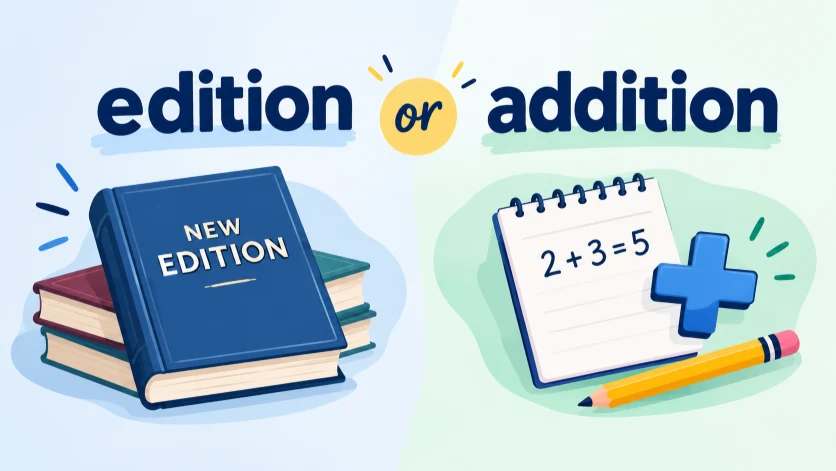
Have you ever typed edition or addition and stopped because both words look and sound almost the same? You are not alone. Edition or addition are two commonly confused words with different meanings. Edition refers to a particular version of a book, newspaper, magazine, publication, or product, while addition refers to something that is added to something else or the process of adding numbers in mathematics.
For example, you might buy the latest edition of a textbook, but a new chapter can be an addition to the textbook.
Although these words may look and sound similar, they are used in different situations and cannot be used interchangeably.
Knowing the difference becomes much easier when you look at the words around them and understand what each word means in context.
In this guide, you will learn what edition and addition mean, where they come from, how they are pronounced, how they differ in British and American English, and which word fits common situations.
Edition or Addition: Quick Answer
Edition means a particular version or form of something that has been published, released, or produced. Addition means something that has been added to something else or the act of adding.
A simple way to remember the difference is:
- Edition = a version
- Addition = something added
Examples:
- I bought the latest edition of the dictionary.
- The publisher released a special edition of the novel.
- The website has a new addition to its resources.
- The teacher made an addition to the lesson.
- Five plus three is an addition problem.
A useful grammar clue is also helpful. Edition is commonly followed by of, while addition is often followed by to.
- The second edition of the book
- A new addition to the team
- The latest edition of the magazine
- An addition to the website
This pattern can help you choose the right word quickly.
Quick Comparison Table
| Version | Meaning | Correct? | Typical Region | Example |
| Edition | A particular version or release | Yes | US, UK, Canada, Australia | I bought the latest edition of the book. |
| Addition | Something added to something else | Yes | US, UK, Canada, Australia | The new chapter is an addition to the book. |
| Edition | A mathematical process | No | All major varieties | Use addition, not edition. |
| Addition | A published version of a book | No | All major varieties | Use edition, not addition. |
What Does Edition or Addition Mean?
Although edition and addition share similar sounds, they describe different ideas. Understanding their meanings in context is the best way to avoid mistakes.
What Does Edition Mean?
An edition is a particular version of something that has been published, released, or produced.
The word is especially common with books and other publications. A book may have a first edition, second edition, revised edition, student edition, or special edition.
For example:
I am reading the third edition of the grammar book.
This means the book exists in different published versions, and the speaker is using the third one.
The word can also describe versions of newspapers, magazines, journals, and other regular publications.
Did you read today’s morning edition of the newspaper?
Here, edition identifies a particular release of the newspaper.
Edition for Books and Publications
In publishing, edition is one of the most common words for describing different versions of the same work.
A new edition may contain corrections, updated information, revised chapters, or other changes. However, it is still treated as a version of the original work.
Common expressions include:
- first edition
- second edition
- revised edition
- new edition
- latest edition
- special edition
- limited edition
- student edition
- digital edition
For example:
The author published a revised edition of the book.
The important point is that the edition is a version, even when that version contains new or changed material.
Edition for Products and Special Releases
Edition is not limited to books. It can also describe a particular release or version of a product.
For example:
The company launched a limited edition of the watch.
Here, limited edition means a specially produced version with limited availability.
You may also see expressions such as:
- collector’s edition
- special edition
- deluxe edition
- anniversary edition
- limited edition
In each case, edition points to a particular version or release.
What Does Addition Mean?
An addition is something that is added to something else. It can be a new object, person, feature, piece of information, or part of a larger thing.
For example:
The new employee is a welcome addition to the team.
The employee is not a new version of the team. The person has been added to it.
Another example is:
The author made an addition to the final chapter.
The added material is an addition.
This word is often used with to:
An addition to the website
An addition to the family
An addition to the report
An addition to the building
Addition in Mathematics
Addition also has a specific mathematical meaning. It is the process of combining numbers to find a total.
For example:
7 + 5 = 12
This is an example of addition.
You may hear phrases such as:
- Addition problem
- Addition sign
- Addition equation
- Addition facts
- Simple addition
This mathematical meaning is completely different from edition.
The Key Difference Between Edition and Addition
The easiest way to separate the two words is to focus on what is changing.
An edition is a version of something.
An addition is something added to something.
Consider a textbook. If the publisher releases a corrected version of the textbook, it may be called a new edition. If the author adds a new chapter to an existing book, that chapter is an addition.
This distinction also explains why these words can sometimes appear in the same context.
The new edition contains several additions to the original textbook.
Here, edition describes the new version of the textbook, while additions describes the material that was added.
That is an important difference: a new edition can contain additions, but an addition does not automatically create a new edition.
A Simple Context Test
When you are unsure which word to use, ask yourself:
Am I talking about a version?
If yes, use edition.
Am I talking about something that was added?
If yes, use addition.
For example:
- latest version → latest edition
- new material added → new addition
- second published version → second edition
- new person joining a group → new addition
This simple test works in most everyday situations.
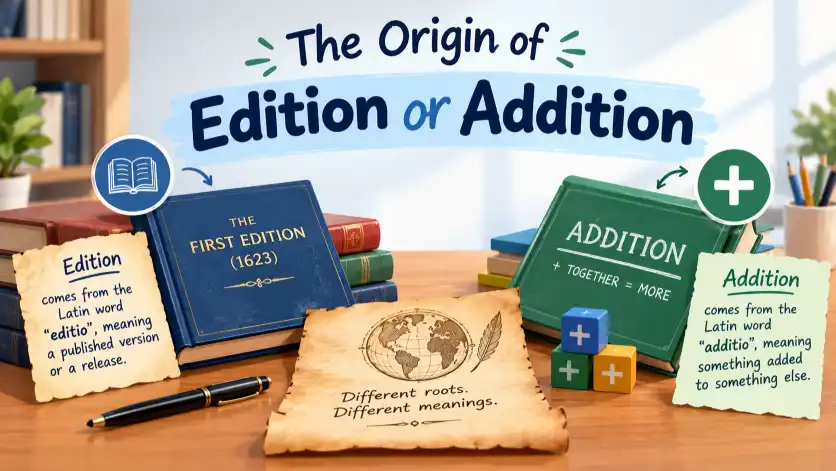
The Origin of Edition or Addition
The similarity between these words is not accidental. Both are connected to Latin words and entered English through forms related to the idea of doing or putting something forward.
The Origin of Edition
Edition comes from Latin editio, meaning a bringing forth, publishing, or issuing. It is related to the Latin verb edere, meaning to bring forth or publish.
Over time, the word became closely associated with published works. English speakers began using edition to identify a particular form or issue of a publication.
Today, the publishing sense remains the most familiar use of the word.
That history helps explain why we say:
The first edition of a book
Rather than using addition for a different published version.
The Origin of Addition
Addition comes from Latin additio, meaning an adding or something added. It is connected with the Latin verb addere, meaning to add.
The word developed into English with the central idea of adding something to something else.
That meaning remains clear in modern expressions such as:
An addition to the report.
And:
Addition in mathematics.
Why Are Edition and Addition Confused?
The two words are often confused because their endings and sounds are very similar.
Compare:
- Edition
- Addition
Both contain the ending -ition, and both have a similar rhythm when spoken. The difference is mainly at the beginning:
- Edition begins with an e sound
- Addition begins with an a sound
Their meanings, however, are quite different.
A useful memory trick is:
Edition = version
Addition = add
The beginning of addition can remind you of add, which makes its meaning easier to remember.
Pronunciation and Word Form
Knowing how the two words sound can help you recognize them when speaking or listening.
Edition
Pronunciation:
US: /ɪˈdɪʃən/
UK: /ɪˈdɪʃən/
It sounds roughly like ih-DISH-uhn.
Part of speech: Noun
Example:
The latest edition is available online.
Addition
Pronunciation:
US: /əˈdɪʃən/
UK: /əˈdɪʃən/
It sounds roughly like uh-DISH-uhn.
Part of speech: Noun
Example:
The new feature is a useful addition to the app.
The standard US and UK pronunciations are essentially the same in IPA. The main difference you hear is the first vowel sound: edition starts with /ɪ/, while addition starts with /ə/.
British English vs American English
There is no major difference between edition and addition in British and American English. Both words have the same basic meanings and are spelled the same way.
The main difference is not the word itself but the context in which it is used.
| Context | British English | American English | Example |
| Book version | edition | edition | the second edition of the book |
| Newspaper release | edition | edition | the evening edition |
| Added item | addition | addition | a new addition to the team |
| Mathematics | addition | addition | addition of whole numbers |
| Product release | special edition | special edition | a limited edition watch |
Edition in British and American English
British and American writers both use edition for different versions of books, newspapers, magazines, and products.
For example:
The revised edition is now available.
This sentence works naturally in both varieties of English.
Addition in British and American English
The same is true for addition.
The new manager is a valuable addition to the company.
This sentence is natural in both British and American English.
Addition can also mean a new part of a building, especially when talking about construction or property.
For example:
They built an addition to the house.
This usage is common in American English and is also understandable in British English, although British speakers may use other wording depending on the context.
The important point is that you do not need to choose edition or addition based on if you are writing for a British or American audience. Choose the word based on its meaning.
Which One Should You Use?
The correct choice depends on what you are describing, not on your location.
Use Edition for a Version
Choose edition when you mean a particular version, release, or form of a published or produced work.
Use it for:
- books
- newspapers
- magazines
- journals
- digital publications
- special product releases
- revised versions
- limited versions
Examples:
I ordered the latest edition of the textbook.
This is the collector’s edition of the game.
The Sunday edition has a special section.
Use Addition for Something Added
Choose addition when something has been added to an existing thing, group, place, or collection.
Examples:
The new chapter is an addition to the book.
Sarah is the newest addition to our team.
The company made an addition to its website.
What About the US, UK, Canada, and Australia?
The basic rule stays the same across major English varieties:
- US English: edition for a version, addition for something added
- UK English: edition for a version, addition for something added
- Canadian English: follows the same basic distinction
- Australian English: follows the same basic distinction
So there is no regional spelling choice such as edition versus addition. They are two different words with two different meanings.
In Academic Writing
Both words are common in academic writing, but they serve different purposes.
Use edition when identifying a specific version of a source:
The study appears in the fourth edition of the textbook.
Use addition when referring to material that has been added:
The new section is a useful addition to the course material.
When citing books or other sources, always check the exact edition being used. This can matter when page numbers or content differ between versions.
In Business Writing
Both words are also common in professional communication.
Use edition for a particular publication or release:
The spring edition of our newsletter is now available.
Use addition for something newly included:
The new service is an important addition to our product range.
The same meaning-based rule works in emails, reports, presentations, websites, and other professional content.
New Edition vs New Addition
The phrases new edition and new addition may look similar, but they describe two different situations.
A new edition is a new version of something that already exists. It may include corrections, updates, new information, or changes to the original version.
The publisher released a new edition of the textbook.
A new addition is something newly added to an existing thing, group, collection, or place.
The new chapter is a useful addition to the textbook.
The easiest clue is the noun that follows the phrase. If you are talking about a version, use edition. If you are talking about something that has been added, use addition.
These two ideas can also appear together:
The new edition includes several additions to the original content.
Here, edition identifies the new version, while additions identifies the things added to it.
Edition of vs Addition to
One of the most useful patterns for avoiding mistakes is knowing which preposition usually follows each word.
Edition of
Edition commonly appears with of when you identify the work or product that the edition belongs to.
Examples:
- the first edition of the book
- the latest edition of the magazine
- the revised edition of the guide
- the special edition of the newspaper
- the digital edition of the journal
For example:
I downloaded the latest edition of the report.
Addition to
Addition commonly appears with to when you identify what received the new material, person, feature, or part.
Examples:
- an addition to the team
- an addition to the family
- an addition to the website
- an addition to the report
- an addition to the building
For example:
The new employee is a valuable addition to the team.
A Quick Grammar Clue
When you see of, think about a particular version:
the second edition of the novel
When you see to, think about something being added:
a new addition to the novel
This is not an absolute grammar rule for every possible sentence, but it is a very useful pattern in everyday English.
In Addition vs In Addition To
Another common source of confusion is the difference between in addition and in addition to.
In Addition
In addition is an expression that means also, as well, or furthermore. It is often used to introduce another point or fact.
The course is affordable. In addition, it is available online.
Here, in addition connects one idea with another.
More examples:
The hotel has free Wi-Fi. In addition, breakfast is included.
She speaks English.In addition, she speaks Spanish.
In Addition To
This phrase means besides or as well as. It is normally followed by a noun, pronoun, or gerund.
In addition to English, she speaks Spanish.
In addition to studying, he works part-time.
The company offers insurance in addition to paid leave.
A common mistake is writing in edition to. That is incorrect when you mean besides or as well as.
Correct:
In addition to the main course, we ordered dessert.
Incorrect:
In edition to the main course, we ordered dessert.
The word edition refers to a version or release. It does not replace addition in this expression.
Edition in TV and Radio
Edition can also refer to a particular broadcast of a regular television or radio program.
For example:
Tonight’s edition of the news begins at 7 p.m.
The morning edition of the program focused on local events.
In this context, edition means a particular installment or broadcast of a program.
This usage follows the same basic idea of edition as a particular release or version. It does not mean that something was physically added.
You may also see similar wording in newspapers and online media:
The evening edition of the news.
The weekend edition of the program.
The latest edition of the show.
Addition as a Building Extension
Addition has another useful meaning when talking about buildings.
An addition can be a new part that is built onto an existing house or building.
For example:
They built an addition to the back of the house.
The school needs a new classroom addition.
In these sentences, the addition is a physical extension of an existing structure.
This meaning is especially common in American English, particularly in conversations about houses, renovations, and construction.
It is different from edition because there is no new version involved. Something new has been physically added to the existing building.
Second Edition vs Second Addition
The phrase second edition is standard when talking about the second published version of a book or other work.
The author is preparing the second edition of the textbook.
This means the work has been published or released in an earlier version and is now available in another version.
Second addition does not normally describe the second version of a book.
If you mean that something was added for the second time, you would usually express the idea differently depending on the context.
For example:
The second addition to the collection was a rare painting.
Here, addition refers to something added to the collection, not a new edition of the collection itself.
So when talking about published versions, remember:
first edition → second edition → third edition
Common Mistakes With Edition and Addition
Because the words look and sound similar, small spelling mistakes can change the meaning.
Mistake 1: Using Addition for a Book Version
Incorrect:
I bought the latest addition of the textbook.
Correct:
I bought the latest edition of the textbook.
The textbook has a particular version, so edition is the correct choice.
Mistake 2: Using Edition for Something Added
Incorrect:
The new employee is a great edition to the team.
Correct:
The new employee is a great addition to the team.
The employee has been added to the team, so addition is needed.
Mistake 3: Writing “In Edition To”
Incorrect:
In edition to the report, she submitted the charts.
Correct:
In addition to the report, she submitted the charts.
The expression is always in addition to when it means “besides” or “as well as.”
Mistake 4: Confusing “New Edition” With “New Addition”
Incorrect when talking about an added feature:
The new edition to the website is a search tool.
Better:
The new addition to the website is a search tool.
The search tool has been added to the website. It is not a new version of the website.
Memory Tip
Think of the first letters:
ADDITION → ADD
If something is added, you probably need addition.
If you mean a particular version, choose edition.
When One Choice Sounds Wrong
Sometimes you can identify the correct word by looking at the words around it.
Certain clues strongly suggest edition:
- first
- second
- third
- latest
- revised
- updated
- special
- limited
- collector’s
- student
- digital
Examples:
The latest edition
The revised edition
The limited edition
These phrases normally describe a version or release.
Other clues strongly suggest addition:
- new member
- extra room
- added feature
- additional information
- new section
- new employee
- new building space
- something added
Examples:
A new addition to the team
An addition to the house
An addition to the report
A simple question can help:
Is it a version of something? → edition
Has it been added to something? → addition
This context test is often faster than trying to remember a formal definition.
Everyday Examples of Edition and Addition
Seeing the words in realistic sentences makes the distinction easier to apply.
In Emails
Please use the latest edition of the employee handbook.
I have made an addition to the document.
In Business Writing
The company released a special edition of its annual report.
The new service is an important addition to our product range.
In News
The evening edition of the newspaper included the latest results.
The website made an addition to its coverage section.
In Blogs
I recommend the latest edition of this grammar guide.
The new example is a helpful addition to the article.
In Academic Writing
The second edition of the textbook contains updated references.
The new section is a useful addition to the study guide.
In Daily Conversation
Have you seen the new edition of that magazine?
The puppy is the newest addition to their family.
Notice that the surrounding context makes the intended meaning clear. A publication has an edition, while a person, feature, section, or object can be an addition.
Google Trends & Modern Usage
People often search edition or addition because the two words are close in spelling and pronunciation.
Searchers may also encounter one of the words while writing phrases such as latest edition, new addition, second edition, or in addition to.
Modern search intent around these words is therefore broader than simply asking for a dictionary definition.
Common searches include:
- edition or addition
- new edition or new addition
- latest edition or latest addition
- second edition or second addition
- edition of or addition to
- in addition to
- addition to the team
- latest edition of a book
The most useful way to understand this search behavior is through context. People usually know roughly what they want to say but need help choosing the correct word or phrase.
For writers, students, editors, and ESL learners, focusing on the surrounding words can make the choice much easier.
There is no need to rely on a regional spelling difference. Edition and addition are separate words in both American and British English, so the correct choice depends on meaning.
Key Takeaways
- Edition means a particular version, release, or form of something.
- Addition means something that has been added to something else.
- Use edition of when identifying the work or publication being discussed.
- Use addition to when identifying what received something new.
- In addition means also or furthermore.
- In addition to means besides or as well as.
- A new edition is a new version, while a new addition is something newly added.
- The difference is based on meaning, not on British versus American English.
FAQs About Edition or Addition
Q1. Is edition or addition correct?
Answer. Both words are correct, but they are used for different meanings. Use edition for a particular version or release, such as “the latest edition of the book.” Use addition for something that has been added, such as “a new addition to the team.”
Q2. What is the difference between edition and addition?
Answer. An edition is a version of something, especially a book, publication, or product. An addition is something added to an existing thing, group, or place. For example, a revised book is a new edition, while a new chapter can be an addition to the book.
Q3. Is it the latest edition or latest addition?
Answer. Use latest edition when you mean the newest version of something. Use latest addition when you mean something that was most recently added. For example, “the latest edition of the magazine” refers to a publication, while “the latest addition to the team” refers to a new team member.
Q4. Is it a new edition or a new addition?
Answer. Choose new edition for a new version or release. Choose new addition for something newly included or added. A new edition of a textbook may contain several new additions, such as an extra chapter, updated examples, or additional exercises.
Q5. Is it the second edition or second addition of a book?
Answer. Second edition is the standard phrase when you mean the second published version of a book. “Second addition” does not normally describe a new book version. Use addition when referring to something that has been added to the book or another work.
Q6. Is “in addition to” correct?
Answer. Yes. In addition to is the correct expression when you mean “besides” or “as well as.” For example, “In addition to English, she speaks Spanish.” In edition to is incorrect for this meaning.
Q7. Is “new addition to the team” correct?
Answer. Yes. New addition to the team is correct because the person has been added to an existing team. For example, “Our new designer is a valuable addition to the team.” You would not use edition because the team is not being described as a new version.
Q8. Can edition and addition be used in the same sentence?
Answer. Yes. They can appear together when they describe different things. For example, “The new edition contains several additions to the original text.” Here, edition refers to the new version, while additions refers to material that was added.
Conclusion
The difference between edition and addition becomes simple once you focus on the meaning.
Use edition when you are talking about a particular version, release, or form of something. This is why we say first edition, latest edition, revised edition, and special edition.
Use addition when something has been added to an existing thing, group, place, or collection. This gives us phrases such as new addition to the team, addition to the report, and addition to the house.
Also remember the useful patterns edition of and addition to. When you see in addition or in addition to, the word is always addition, not edition.
The simplest memory rule is:
Edition = version.
Addition = something added.
Once you connect each word with its core idea, choosing between them becomes much easier in everyday writing, academic work, business communication, and online content.
Read More Articles:
- Bass or Base? Even Native Speakers Mix These Up (2026)
- Gest vs Jest: A Word Most People Have Never Heard (2026)

I’m Alex Morgan, an American English writer with 6 years of experience exploring grammar, punctuation, sentence structure, and everyday English usage. I enjoy turning confusing grammar rules into clear, practical explanations that help readers write and communicate with confidence.







3 thoughts on “Edition or Addition? How to Choose the Right Word Every Time ”