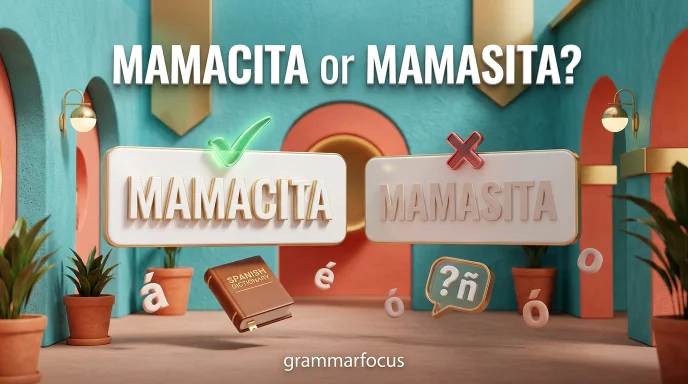
Mamacita is the correct standard spelling, while mamasita is generally a misspelling of the Spanish word. Mamacita is an affectionate form related to mamá, the Spanish word for “mother” or “mom.”
Depending on the context, it can also be used as a playful or flirtatious term for an attractive woman.
The intended meaning often depends on the relationship between the speakers and the situation in which the word is used.
The confusion between mamacita and mamasita mainly comes from pronunciation. In many Spanish speaking regions, the c in mamacita produces an “s” sound, so English speakers may naturally write what they hear as mamasita.
However, pronunciation does not change the standard spelling. If you are writing the Spanish word, mamacita is the form to use.
In this article, we will explain the difference between mamacita and mamasita, including their pronunciation, meaning, origin, spelling, common mistakes, and everyday usage.
By the end, you will know which form is correct and when it is appropriate to use it.
Mamacita or Mamasita: Quick Answer
Mamacita is the standard Spanish spelling, while mamasita is generally a misspelling when the intended word is the Spanish term mamacita.
The word is a familiar or affectionate form related to mamá, meaning “mother,” but in everyday speech it can also be used as an affectionate term for an attractive woman, depending on the context.
If you are writing the Spanish word, mamacita is the spelling to use. The form mamasita changes the spelling and does not follow the standard Spanish formation of the word.
For example:
- Correct: Hola, mamacita.
- Incorrect: Hola, mamasita.
However, context matters. In some situations, mamacita can sound affectionate and playful.
In others, especially when directed at a woman who is not the speaker’s mother, it can sound flirtatious or objectifying.
Mamacita vs. Mamasita: Quick Comparison
| Feature | Mamacita | Mamasita |
| Standard Spanish spelling | Yes | No |
| Commonly recognized form | Yes | Less common |
| Related to mamá | Yes | Intended to be, but spelling is incorrect |
| Meaning | Little mom, mommy, or affectionate/flirtatious term | Usually an incorrect spelling of mamacita |
| Standard usage | Spanish and English contexts | Mostly informal misspelling |
| Recommended spelling | Mamacita | Avoid |
The key difference is the letter c.
Spanish uses the suffix -cita in mamacita. The spelling mamasita replaces the c with s, which is not the standard form of this word.
Pronunciation and Word Form
Mamacita
- US pronunciation: /ˌmɑːməˈsiːtə/
- UK pronunciation: /ˌmæməˈsiːtə/
- Part of speech: Noun
- Spanish form: mamacita
Example:
He called her “mamacita” in a playful way.
The word is commonly pronounced with the stress on the -cita part: ma-ma-SEE-ta.
Mamasita
- Common pronunciation: Similar to mamacita
- Part of speech: Noun when used as an intended spelling of mamacita
- Status: Nonstandard spelling
Example:
“Mamasita” is often written online when people mean “mamacita.”
Because mamasita is not the standard spelling, it does not have a separate standard Spanish meaning equivalent to mamacita.
Definition and Meaning of Mamacita or Mamasita
What Does Mamacita Mean?
Mamacita is an affectionate Spanish word formed from mamá, meaning “mother” or “mom.” The ending gives the word a diminutive or affectionate sense.
Depending on the situation, mamacita can mean:
- little mom
- mommy
- mother, used affectionately
- an affectionate term for a woman
- a flirtatious term for an attractive woman
The exact meaning depends heavily on who says it, who hears it, and the situation.
When a child uses mamacita for their mother, the word can sound warm and affectionate.
In other contexts, especially popular culture and casual speech, the word may be directed toward an attractive woman.
For example:
Mi mamacita está en casa.
In a family context, this can refer affectionately to a mother.
By contrast:
Hola, mamacita.
When said to an unrelated woman, this may have a flirtatious meaning.
What Does Mamasita Mean?
Mamasita is generally used as an alternative spelling of mamacita, especially in informal online writing.
It is important not to treat the two spellings as equal standard forms. If your goal is to write the Spanish word correctly, mamacita is the appropriate choice.
The Origin of Mamacita
The story of mamacita begins with the Spanish word mamá, which means “mother” or “mom.”
Spanish has several diminutive suffixes that can express smallness, affection, familiarity, or emotional closeness. One of these is -cito / -cita.
Because mamá is a feminine noun, the form mamacita uses the feminine -cita ending.
The basic formation can be understood like this:
mamá → mamacita
The word does not simply mean a physically small mother. Diminutive forms in Spanish often carry an emotional meaning.
They can make a word sound affectionate, familiar, or endearing.
Similar formations appear in many Spanish words. The meaning of a diminutive can change according to the speaker, relationship, region, and context.
Over time, mamacita has also developed wider informal uses. In some varieties of Spanish and in Spanish influenced English, it may describe or address an attractive woman.
This broader use is especially familiar through music, movies, television, and popular culture.
Because the word has different social meanings, translating it simply as “little mother” does not always capture how people actually use it.
Why Is It Mamacita, Not Mamasita?
The main spelling question is simple: Why does the word contain “c” instead of “s”?
The answer comes from the Spanish diminutive ending.
The standard form is:
mamá + -cita → mamacita
The c belongs to the diminutive formation. Writing mamasita removes that standard spelling pattern.
This is why mamasita is usually considered a misspelling when someone intends to write mamacita.
A common reason for the mistake is pronunciation. In many varieties of Spanish, the letter c before i can produce an s-like sound, depending on the variety of Spanish being spoken.
For example, in much of Latin America, the c in mamacita is pronounced like an s sound.
That can make the spelling mamasita seem logical to English speakers who are writing the word by sound.
But pronunciation does not determine the spelling.
The standard written form remains:
Mamacita
not:
Mamasita
British English vs. American English Spelling
Unlike words such as colour/color or centre/center, mamacita does not have separate British and American spellings.
The standard Spanish spelling is mamacita in both English-speaking contexts.
| Usage | British English | American English |
| Standard borrowed Spanish form | mamacita | mamacita |
| Nonstandard spelling | mamasita | mamasita |
| Recommended form | mamacita | mamacita |
American English may encounter mamacita more frequently because of the strong influence of Spanish in the United States, but this does not create a different spelling.
British English also uses mamacita when the Spanish word is used.
Therefore, there is no British versus American spelling choice here. The important distinction is between the standard Spanish spelling and the common misspelling.
Is Mamacita an English Word?
Mamacita is a Spanish word that is also used in English-language speech and writing.
English regularly borrows words and expressions from other languages.
Some remain strongly connected to their original language, while others become familiar to English speakers through culture, entertainment, food, music, or everyday conversation.
Mamacita is usually still recognized as Spanish rather than as a fully ordinary English word.
Its use in English can also depend on the speaker’s intention.
For example, an English speaker might use mamacita jokingly because they have heard it in a song or movie.
A bilingual speaker may use it naturally within a Spanish-speaking conversation.
The same word can therefore feel different in different settings.
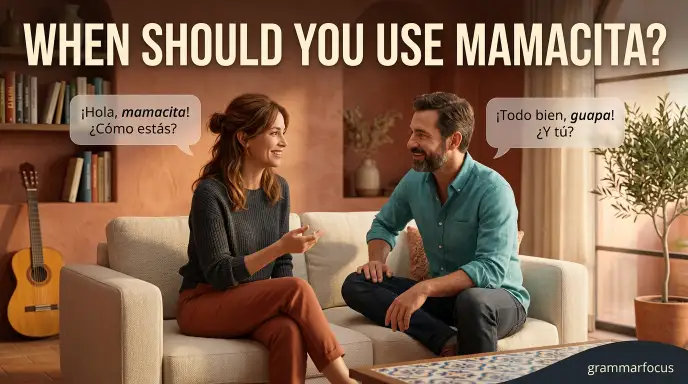
When Should You Use Mamacita?
Use mamacita when you intentionally want to use the Spanish term and the context makes its meaning clear.
For example, it may appear in:
- Spanish conversations
- affectionate family language
- informal dialogue
- songs and entertainment
- bilingual conversations
- playful or flirtatious speech
Still, tone matters.
Calling someone’s mother mamacita affectionately can be very different from calling an unrelated woman mamacita. The latter can sound flirtatious and may not be welcome in every situation.
For formal writing, professional communication, or situations where the listener’s preferences are unknown, it is usually better to choose a neutral form of address.
The spelling question, however, remains straightforward:
If you mean the Spanish word, write “mamacita,” not “mamasita.”
Common Mistakes with Mamacita and Mamasita
The most common mistake is replacing the c in mamacita with an s. This usually happens because the word can sound like it contains an “s” sound.
Mistake 1: Writing Mamasita as the Standard Form
Incorrect: She called her mamasita.
Correct: She called her mamacita.
If you are using the Spanish word, keep the c before ita.
Mistake 2: Assuming Both Spellings Are Correct
Mamacita and mamasita should not be treated as two standard spelling options.
Mamacita is the established spelling. Mamasita is generally an informal misspelling or phonetic variation.
Mistake 3: Using Mamacita Without Considering Context
The word can have different meanings depending on the relationship between the speakers.
A family member may use it affectionately, while someone addressing an unrelated woman may intend a flirtatious meaning. Because of this difference, the word should be used thoughtfully.
Mistake 4: Treating Mamacita as a Formal Title
Mamacita is informal and expressive. It is not a formal title like Ms., Mrs., or Madam.
For business emails, official documents, and professional introductions, a neutral form of address is usually more appropriate.
Mamacita in Everyday Examples
Seeing the word in different settings makes its meaning easier to understand.
Family Context
A person may use mamacita as an affectionate name for their mother.
Example:
My little brother always calls our mother mamacita.
Here, the word has a warm family meaning.
Casual Conversation
A bilingual speaker might use the word naturally during an informal conversation.
Example:
He grew up speaking Spanish and often uses words such as mamacita with his family.
The surrounding conversation helps the listener understand the intended meaning.
Popular Culture
Mamacita is also familiar to many English speakers through music, television, movies, and other forms of entertainment.
In these settings, it may be used as a playful or flirtatious expression rather than as a literal reference to someone’s mother.
Social Media
The word sometimes appears in captions, comments, usernames, and informal posts.
Example:
That song uses “mamacita” as a playful term of affection.
Online writing can be less consistent with standard spelling, which is one reason mamasita may appear even though mamacita is the standard form.
Formal Writing
In formal English, avoid using mamacita unless the word itself is relevant to the subject.
For example, a language article, translation, or cultural discussion may naturally mention the word.
A formal business message, however, would normally use a person’s name or an appropriate professional title.
Mamacita vs. Mamasita: Which One Should You Use?
If you are deciding between mamacita and mamasita, choose mamacita when you mean the Spanish word.
The spelling is consistent in both British and American English because it comes from Spanish rather than from a British American spelling difference.
A simple way to remember it is:
Mamacita = standard spelling
Mamasita = common misspelling
If you are writing dialogue or quoting someone who intentionally wrote mamasita, you may reproduce that spelling when accuracy to the original text matters. Otherwise, standard writing should use mamacita.
It is also useful to think about the context, not just the spelling. Even when mamacita is spelled correctly, its meaning can change depending on how it is used.
Is Mamasita Ever Correct?
Mamasita can appear in informal writing, but it is not the standard spelling of the Spanish word mamacita.
You may see mamasita in social media posts, lyrics, usernames, casual messages, or phonetic writing. Its appearance does not make it an alternative standard spelling.
If someone writes:
Hey, mamasita!
they may clearly intend mamacita. The reader can often understand the meaning from context.
For edited content, educational writing, dictionaries, language lessons, and other situations where standard spelling matters, mamacita is the safer choice.
How to Remember the Correct Spelling
A simple spelling trick can help:
Mama + cita = mamacita
Think of the ending as -cita, not -sita.
You can also remember that the standard word contains the letter c:
mamaCita
This small detail separates the standard spelling from the commonly seen mamasita.
If you are unsure while writing, check the word before publishing it. This is especially useful when using Spanish words in English articles, captions, or dialogue.
Frequently Asked Questions
Q1. Is Mamacita or Mamasita correct?
Answer. Mamacita is the standard spelling of the Spanish word. Mamasita is generally a misspelling or informal phonetic version.
Q2. What does mamacita mean?
Answer. Mamacita is an affectionate form related to the Spanish word mamá, meaning “mother” or “mom.” Depending on context, it can also be used as an affectionate or flirtatious term for a woman.
Q3. Is mamacita a Spanish word?
Answer. Yes. Mamacita is a Spanish word formed from mamá with a diminutive and affectionate ending. It is also familiar to many English speakers through popular culture.
Q4. Why do people spell mamacita as mamasita?
Answer. The spelling mamasita can result from hearing the word pronounced with an “s” sound. Writers may spell the word according to its sound instead of its standard Spanish spelling.
Q5. Is mamacita appropriate to use for anyone?
Answer. Not necessarily. The word can be affectionate in a family setting but may sound flirtatious when directed at an unrelated woman. The relationship and context are important.
Q6. Is mamacita used in American English?
Answer. Yes. English speakers in the United States may use or recognize mamacita, particularly in bilingual communities and popular culture. It remains a Spanish-origin expression.
Q7. Does British English spell mamacita differently?
Answer. No. There is no separate British spelling of mamacita. The standard form remains mamacita in both British and American English.
Q8. Can I use mamasita in formal writing?
Answer. It is better to use mamacita when you intend the standard Spanish word. Mamasita may be understood, but it is not the standard spelling.
Conclusion
Mamacita is the standard spelling, while mamasita is generally a nonstandard spelling of the same intended word. The difference comes down to one important letter: c.
Mamacita is related to the Spanish word mamá and can express affection or familiarity. Depending on the context, it may also be used as a playful or flirtatious term for a woman.
If you are writing the word yourself, remember the simple pattern:
Mamacita = correct standard spelling
Mamasita = generally a misspelling
The best choice is therefore mamacita whenever you want the standard Spanish form.
Learn More About Grammar:
- Occurring or Occuring: Which Spelling Is Correct?
- Theaters or Theatres? Why Are Both Spellings Used?
- Envelope or Envelop? Know the One-Letter Difference (2026)

I’m Elena Cooper, an English grammar writer with 6 years of experience explaining grammar, punctuation, sentence structure, word usage, and common English mistakes. I create clear, practical, and easy-to-follow content that helps readers understand confusing grammar rules and use English accurately and confidently.