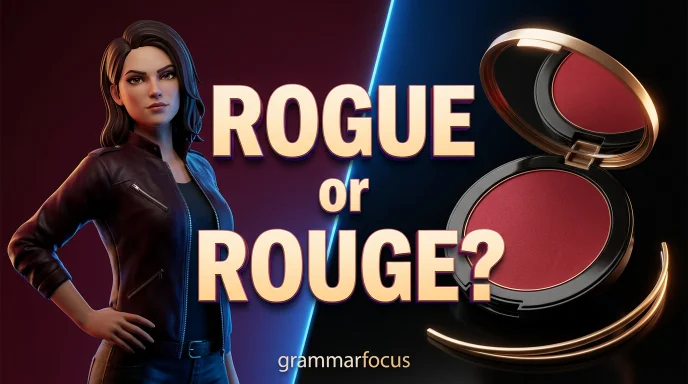
Rogue and rouge are different English words with completely different meanings. Rogue usually describes a dishonest, unpredictable, or independent person, while rouge can refer to a reddish color or a type of red cosmetic used on the cheeks. Although the two words contain the same letters, their meanings, pronunciations, and uses are not the same.
This pair causes confusion because rogue and rouge look remarkably similar when written. The only difference in their spelling is the position of the u and g, yet that small change creates two separate words.
Rogue is pronounced with a hard g sound, while rouge has a softer sound associated with French-influenced pronunciation.
Knowing the difference is especially useful when writing about a troublesome person, a dangerous or unpredictable element, makeup, colors, or descriptions involving red.
A simple spelling mistake can change the meaning of an entire sentence. This guide explains what rogue and rouge mean, how to pronounce them, and how to use each word correctly.
Rogue or Rouge: Quick Answer
Rogue and rouge have different meanings:
- Rogue means a dishonest, troublesome, independent, or unpredictable person or thing.
- Rouge means a reddish color or a cosmetic traditionally applied to the cheeks.
Examples
- A rogue employee leaked the confidential information.
- She applied rouge to her cheeks.
In the first sentence, rogue describes a person who behaves improperly or outside expected rules. In the second, rouge refers to a cosmetic product.
A useful way to remember the difference is to connect rouge with red. Both words are associated with a reddish color.
Quick Comparison: Rogue vs Rouge
| Word | Meaning | Part of Speech | Common Context |
| Rogue | Dishonest, troublesome, independent, or unpredictable person or thing | Noun, adjective | People, animals, technology, organizations |
| Rouge | A reddish color or red cosmetic | Noun, adjective | Makeup, color, cosmetics |
The two words should not be treated as spelling variants. They are separate vocabulary items.
Pronunciation and Word Form
Rogue
- US pronunciation: /roʊɡ/
- UK pronunciation: /rəʊɡ/
- Part of speech: Noun and adjective
- Word form: Rogue
Example:
A rogue trader caused serious financial problems.
As a noun, rogue can refer to a person or thing that behaves outside accepted rules. As an adjective, it can describe something uncontrolled, dangerous, or unpredictable.
Rouge
- US pronunciation: /ruːʒ/
- UK pronunciation: /ruːʒ/
- Part of speech: Noun and adjective
- Word form: Rouge
Example:
The artist used a soft rouge shade in the painting.
The word rouge has a sound ending in /ʒ/, similar to the sound in the middle of vision.
Definition and Meaning of Rogue
Rogue has several related meanings, but they all involve behavior that does not follow normal expectations.
As a noun, a rogue can be a person who behaves dishonestly, independently, or in a troublesome way.
For example:
The company discovered that a rogue employee had changed the records.
Here, rogue employee suggests that the employee acted improperly or outside the organization’s rules.
The word can also describe someone who is unconventional or difficult to control:
He was known as a charming rogue.
In this expression, rogue does not necessarily describe a dangerous criminal. It can refer to someone who is mischievous, unconventional, or morally questionable.
As an adjective, rogue can describe something that operates outside normal control:
- a rogue trader
- a rogue state
- a rogue wave
- a rogue program
- a rogue animal
The exact meaning depends on the noun that follows it.
Definition and Meaning of Rouge
Rouge has a very different meaning. It is associated with the color red and with cosmetics.
As a noun, rouge traditionally refers to a red or reddish cosmetic applied to the cheeks to give them more color.
For example:
She used a small amount of rouge before the performance.
The word can also describe a reddish color or shade.
In this sense, you might encounter expressions such as:
- a deep rouge
- a warm rouge shade
- rouge lipstick
- rouge-colored fabric
The word has French origins, and its meaning is closely connected with the French word rouge, meaning “red.”
Modern makeup products are more often described with words such as blush, but rouge remains a valid English word, particularly in beauty writing, historical contexts, and descriptions of color.
The Main Difference Between Rogue and Rouge
The clearest difference is their meaning.
Rogue is connected with uncontrolled, dishonest, troublesome, or unconventional behavior.
Rouge is connected with red color and cosmetics.
Compare these sentences:
The rogue operator ignored the safety rules.
The designer selected a dark rouge for the interior.
The first sentence discusses behavior. The second describes a color.
Their pronunciations are also different. Rogue ends with a hard g sound, while rouge ends with the /ʒ/ sound.
Because the spelling difference is small, checking the meaning before choosing the word can prevent mistakes.
When Should You Use Rogue?
Use rogue when you are describing a person, animal, organization, or thing that behaves outside normal rules or expectations.
Rogue as a Noun
A noun use can describe a person who behaves dishonestly or independently:
The rogue was eventually caught by the authorities.
It can also refer to an unconventional or mischievous person:
Everyone considered him a lovable rogue.
Rogue as an Adjective
The adjective is especially common before another noun:
A rogue trader lost millions of dollars.
The researchers tracked a rogue wave.
The security team removed a rogue device from the network.
In each case, rogue suggests something that is outside normal control, rules, or expectations.
When Should You Use Rouge?
Use rouge when the context involves a reddish color or a cosmetic associated with the cheeks.
For cosmetics:
The actress wore traditional rouge for the stage performance.
For color:
The room featured curtains in a rich rouge shade.
The word may appear more often in specialized, artistic, historical, or descriptive contexts than in everyday conversations about modern makeup.
For ordinary modern beauty discussions, blush is often the more familiar term. However, rouge remains correct when that is the intended word or style.
Common Mistakes With Rogue and Rouge
Mistake 1: Using Rouge for a Troublesome Person
Incorrect:
The rouge employee broke the company rules.
Correct:
The rogue employee broke the company rules.
A troublesome or unauthorized person is described as rogue, not rouge.
Mistake 2: Using Rogue for a Red Cosmetic
Incorrect:
She applied rogue to her cheeks.
Correct:
She applied rouge to her cheeks.
The cosmetic is rouge.
Mistake 3: Assuming the Words Are Spelling Variants
Rogue and rouge are not two spellings of the same word. They have separate meanings and different pronunciations.
Writing the wrong one can completely change the intended meaning.
Rogue in Modern Contexts
The word rogue appears in many modern fields, so its meaning is not limited to describing people.
Technology
A rogue device may be an unauthorized device connected to a network.
The IT team detected a rogue device on the company’s system.
Finance
A rogue trader is a trader who acts outside authorized rules or controls.
The bank investigated the actions of a rogue trader.
Nature
A rogue wave is an unusually large and dangerous wave.
The ship encountered a rogue wave during the storm.
These examples show why rogue can describe something that operates outside expected conditions.
Rouge in Color and Beauty
The word rouge is strongly connected with red tones.
In beauty-related writing, it can describe traditional cheek color:
The vintage makeup kit contained a small container of rouge.
In design and art, rouge may describe a rich reddish shade:
The painter added rouge to create a warmer tone.
Because the word can describe both a cosmetic and a color, context tells the reader which meaning is intended.
The Origin of Rogue
The history of rogue is interesting because the word originally had a narrower sense than many of its modern uses.
English began using rogue in the sixteenth century. Early uses were connected with a dishonest or unprincipled person, particularly someone living by questionable means. Over time, the word developed broader meanings.
Today, rogue can describe people, animals, organizations, technologies, and natural phenomena that behave outside expected limits.
The original idea of someone operating outside accepted rules remains visible in many of these modern uses.
That development explains why the word can describe both a troublesome person and something such as a rogue wave or rogue device.

The Origin of Rouge
Rouge comes from French, where rouge means red. The word entered English with its connection to red color and cosmetics.
Its history explains why the word can describe both a makeup product and a reddish shade. Traditional rouge was used to add color to the cheeks, giving the face a warmer or more vivid appearance.
The French connection also helps explain its pronunciation. Unlike rogue, which ends with a hard g sound, rouge ends with the /ʒ/ sound.
This difference in both meaning and pronunciation makes the two words separate vocabulary items despite their similar spelling.
Rogue or Rouge in Different Contexts
The correct word becomes easier to identify when you look at the subject of the sentence.
People
When describing a person who acts dishonestly, independently, or outside accepted rules, use rogue:
The rogue agent ignored the instructions.
Technology
For an unauthorized or uncontrolled technological element, rogue is appropriate:
The software detected a rogue application.
Nature
Some unusual natural events are also described with rogue:
The crew prepared for another rogue wave.
Color and Makeup
When the subject involves a reddish cosmetic or shade, use rouge:
The artist chose a muted rouge for the costume design.
This context-based approach is often more useful than trying to remember the spelling alone.
Rogue vs Rouge in Everyday Writing
Writers can avoid confusion by identifying the meaning before typing the word.
If the sentence involves behavior, control, rules, or unexpected activity, rogue is probably the intended word.
If it involves red, makeup, cosmetics, or a reddish shade, rouge is usually the appropriate choice.
Consider these examples:
- The company removed a rogue account from its system.
- The costume included a rouge-colored scarf.
- A rogue animal escaped from the enclosure.
- The makeup artist selected rouge for the character.
- A rogue wave damaged the vessel.
- The painting uses several shades of rouge.
The surrounding nouns provide strong clues about which spelling belongs in the sentence.
Rogue in Expressions and Collocations
Certain combinations with rogue appear frequently in English.
Rogue Trader
A rogue trader is a trader who acts outside authorized rules or controls.
The bank introduced new controls after the rogue trader incident.
Rogue Wave
A rogue wave refers to an unusually large and potentially dangerous ocean wave.
The vessel changed course after reports of a rogue wave.
Rogue State
Rogue state is a political term used in some contexts to describe a state viewed as acting outside accepted international norms. Because the term can be politically contested, its meaning depends on the source and context.
Rogue Employee
A rogue employee is someone who acts outside an organization’s rules or authorization.
The company investigated the actions of a rogue employee.
These combinations show how flexible rogue has become in modern English.
Rogue vs Rouge: A Simple Memory Trick
A short memory trick can make the spelling easier to remember:
ROUGE → RED
Both rouge and red are associated with color.
For rogue, think about someone or something that has gone outside the expected rules.
You can remember the contrast as:
Rogue breaks the rules; rouge relates to red.
This is not a grammatical rule, but it is a useful spelling association.
Rogue or Rouge in Formal Writing
Both words can appear in formal writing, but only when their meanings are relevant.
Rogue is common in professional and technical contexts, especially when discussing unauthorized activity:
The security team identified a rogue device.
It can also appear in journalism, business writing, science, and technology.
Rouge is more specialized. It may appear in historical writing, art, fashion, cosmetics, or descriptions of color:
The designer selected a deep rouge for the collection.
If the intended meaning is simply “red,” red is usually clearer in ordinary writing. Similarly, blush may be more familiar than rouge when discussing modern everyday makeup.
Frequently Asked Questions About Rogue or Rouge
Q1. What is the easiest way to remember rogue and rouge?
Answer. Connect rouge with red because both relate to color. Use rogue for a person or thing that behaves outside normal rules, control, or expectations.
Q2. Is rogue a noun or an adjective?
Answer. Rogue can function as both a noun and an adjective. As a noun, it can describe a dishonest or unconventional person. As an adjective, it can describe something unauthorized, uncontrolled, or unpredictable.
Q3. Is rouge only used for makeup?
Answer. No. Rouge can refer to a cosmetic, but it can also describe a reddish color or shade. The intended meaning depends on the context.
Q4. Why are rogue and rouge pronounced differently?
Answer. They are separate words with different histories and sound patterns. Rogue ends with a hard /g/ sound, while rouge ends with /ʒ/. Their similar spelling does not indicate similar pronunciation.
Q5. Is rouge still used in modern English?
Answer. Yes. Rouge remains a valid English word, particularly in descriptions of color, traditional cosmetics, art, fashion, and historical contexts. In everyday makeup conversations, blush is often more familiar.
Q6. Can rogue describe something other than a person?
Answer. Yes. Modern English commonly uses rogue for things such as unauthorized software, devices, traders, waves, animals, and other elements that behave outside expected conditions.
Q7. Is “rogue employee” correct?
Answer. Yes. Rogue employee is a natural phrase for an employee who acts outside organizational rules, authority, or expected procedures.
Q8. Is “rouge employee” correct?
Answer. No, not if you mean an employee who behaves improperly or outside company rules. In that context, the correct word is rogue. Rouge relates to red color or cosmetics.
Conclusion
Although rogue and rouge look almost identical, they belong to completely different areas of vocabulary.
Rogue is associated with behavior that is dishonest, uncontrolled, unauthorized, unconventional, or outside expected limits. Rouge is connected with red color and a traditional type of cosmetic.
The spelling difference becomes easier to remember once the meanings are connected with familiar ideas.
Think of rogue in terms of rules and unexpected behavior, while rouge can be connected with red.
When writing about technology, business, people, animals, or unusual natural events, rogue may be the word you need.
For cosmetics, reddish shades, art, or color descriptions, rouge is the appropriate choice.
A quick final reminder:
Rogue = outside the rules or expected control.
Rouge = red or a red cosmetic.
Learn More About Grammar:
- Occurring or Occuring: Which Spelling Is Correct?
- Mamacita or Mamasita? The Correct Spelling Explained
- Theaters or Theatres? Why Are Both Spellings Used?

I’m Alex Morgan, an American English writer with 6 years of experience exploring grammar, punctuation, sentence structure, and everyday English usage. I enjoy turning confusing grammar rules into clear, practical explanations that help readers write and communicate with confidence.








2 thoughts on “Rogue or Rouge? The Spelling Mix Up Finally Explained”