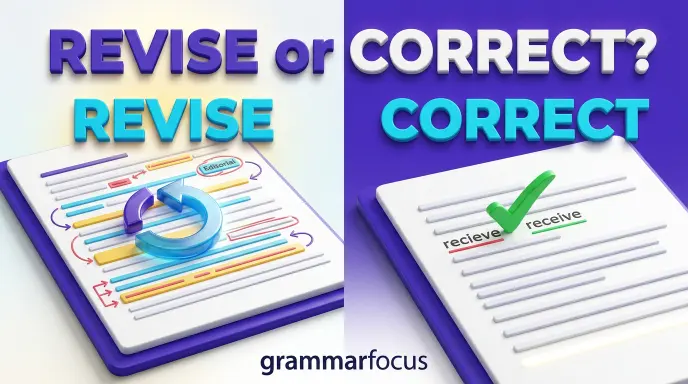
When choosing between revise or correct, use revise when you want to improve, change, or update something, and use correct when you want to fix an error or make something accurate. Both verbs are common in English, but they describe different kinds of changes.
You might revise an essay to improve its organization and wording, while you might correct a spelling mistake without changing the rest of the sentence.
In some situations, the two words can overlap, especially when a revision also fixes errors. However, they are not always interchangeable.
Understanding the difference helps you choose the right word in emails, school assignments, professional documents, editing work, and everyday conversations.
The key idea is simple: revise focuses on improvement or modification, while correct focuses on fixing something that is wrong or inaccurate.
This article explains their meanings, pronunciation, word forms, origins, and common uses so you can use revise and correct confidently.
Revise or Correct: Quick Answer
Revise means to review something and make changes to improve, update, or modify it.
Correct means to identify and fix something that is wrong, inaccurate, or mistaken.
For example:
- I need to revise my essay before submitting it.
- I need to correct a spelling mistake in my essay.
The first sentence suggests that the writer will review and improve the essay. The second focuses on fixing a specific error.
A useful way to remember the difference is:
Revise = improve or change
Correct = fix an error
Quick Comparison: Revise vs Correct
| Word | Main Meaning | Common Use | Example |
| Revise | To review and improve or change something | Essays, documents, plans, drafts | She revised her report. |
| Correct | To fix something wrong or inaccurate | Errors, mistakes, answers, information | He corrected the answer. |
Although both words involve making changes, their focus is different. Revision can involve many improvements, while correction usually targets a particular problem.
Pronunciation and Word Form
Revise
- US pronunciation: /rɪˈvaɪz/
- UK pronunciation: /rɪˈvaɪz/
- Part of speech: Verb
- Past tense: revised
- Past participle: revised
- Noun: revision
Example: The editor asked me to revise the article.
The final sound in revise is a /z/ sound.
Correct
- US pronunciation: /kəˈrɛkt/
- UK pronunciation: /kəˈrekt/
- Part of speech: Verb and adjective
- Past tense: corrected
- Past participle: corrected
- Noun: correction
Example: Please correct the error before sending the document.
As a verb, correct means to fix something that is wrong.
Definition and Meaning of Revise and Correct
What Does Revise Mean?
Revise means to examine something again and make changes to improve it, update it, or make it more suitable.
The changes may involve wording, structure, organization, details, or ideas. A revision does not necessarily mean that the original work was incorrect.
For example:
The student revised her essay before submitting it.
The student may have changed the structure, added information, removed unnecessary sentences, or improved the wording.
Revise is especially common with:
- Essays
- Articles
- Reports
- Books
- Drafts
- Plans
- Policies
- Documents
It can also mean to update information when circumstances change.
Example:
The company revised its safety policy last year.
Here, revised means the policy was reviewed and changed.
What Does Correct Mean?
Correct means to make something right by fixing an error, mistake, or inaccuracy.
For example:
The teacher corrected my answer.
The answer contained a problem, and the teacher fixed it.
Correct can refer to:
- Spelling mistakes
- Grammar errors
- Wrong answers
- Incorrect information
- Mathematical errors
- Misunderstandings
- Incorrect behavior
For example:
Please correct the spelling mistake.
The editor corrected several factual errors.
She corrected her earlier statement.
In each case, something was considered wrong or inaccurate and needed to be fixed.
The Main Difference Between Revise and Correct
The clearest difference is the purpose of the change.
When you revise something, you usually look at it again and make improvements. The original version may already be acceptable, but you want to make it clearer, stronger, more effective, or more up to date.
When you correct something, you fix a specific problem. The original version contains an error or something inaccurate.
Consider these two examples:
Revise:
I revised my presentation to make it easier to understand.
Correct:
I corrected a spelling error in my presentation.
In the first example, the entire presentation may have been reviewed and improved. In the second, the focus is on one particular mistake.
A Simple Rule
Ask yourself:
Am I improving or changing the work?
→ Use revise.
Am I fixing something that is wrong?
→ Use correct.
Sometimes both actions happen together. An editor might revise an article and correct its grammar at the same time.
The Origin of Revise and Correct

Origin of Revise
Revise comes from Latin roots associated with looking at something again. The word entered English through French and developed the sense of examining, reviewing, and changing written material.
That idea of looking again is still useful for understanding the modern meaning.
When you revise a document, you return to it, review it, and decide what should be changed.
This is why revise is closely connected with words such as revision and revised.
Origin of Correct
Correct comes from Latin correctus, meaning made straight, improved, or put right. It entered English through French and developed its modern sense of fixing errors or making something accurate.
The central idea has remained connected to putting something right.
That makes the modern distinction easy to remember:
Revise → review and change
Correct → fix what is wrong
Revise and Correct in Writing
Writing is one of the areas where these two verbs are most often confused.
A writer may revise a paragraph by changing its structure, replacing weak words, adding details, or removing unnecessary information.
A writer may correct the same paragraph by fixing spelling, grammar, punctuation, or factual errors.
For example:
Revision:
The writer revised the introduction to make the main idea clearer.
Correction:
The writer corrected three grammar mistakes in the introduction.
Both actions improve the final text, but they do so in different ways.
A useful editing process can involve both:
- Revise the overall content and organization.
- Correct specific errors.
- Review the final version for clarity.
This distinction is particularly useful when a teacher, editor, or employer asks you to make changes to a document.
Revise vs Correct in American and British English
Revise and correct have the same basic meanings in both American and British English. There is no major spelling difference between the two varieties.
| Word | American English | British English |
| Revise | revise | revise |
| Correct | correct | correct |
| Revision | revision | revision |
| Correction | correction | correction |
However, revise can have an additional meaning in British English that is especially common in education.
In British usage, revise often means to study material again in preparation for an examination.
For example:
I need to revise for my English exam.
In American English, students are more likely to say:
I need to study for my English exam.
This does not mean that Americans never use revise. The word is still used when talking about editing or changing written work.
Common Mistakes With Revise and Correct
Mistake 1: Using “Correct” for Every Change
Not every change is a correction.
❌ I corrected my entire essay to make it more engaging.
✅ I revised my entire essay to make it more engaging.
If the writer is changing the structure, style, or content for improvement, revise is usually the better choice.
Mistake 2: Using “Revise” for a Simple Error
When you fix one clear mistake, correct is often more precise.
❌ Please revise the spelling mistake.
✅ Please correct the spelling mistake.
The mistake itself needs to be fixed, so correct fits naturally.
Mistake 3: Thinking Revision Means the Original Was Wrong
A revision does not necessarily mean that the first version was incorrect.
A writer can revise a good article to make it clearer, shorter, or more engaging.
For example:
The author revised the introduction before publication.
The introduction may not have contained an error. It simply needed improvement.
Mistake 4: Confusing “Revise” With “Review”
These words are related, but they are not identical.
Review usually means to examine or evaluate something.
Revise means to examine something and then make changes to it.
For example:
The manager reviewed the report.
This means the manager examined it.
The manager revised the report.
This means the manager made changes to it.
Everyday Examples of Revise and Correct
At School or College
Students often revise essays, assignments, and projects.
Maria revised her essay after receiving feedback.
Teachers may correct mistakes in those assignments.
The teacher corrected several grammar errors.
In British English, students can also revise for an exam.
James is revising for his final exams.
In the Workplace
Professionals may revise reports, proposals, schedules, or plans when information changes.
The team revised the project proposal after the meeting.
They may also correct inaccurate information.
The assistant corrected the date in the report.
In Editing
Editors frequently do both jobs.
An editor may revise a sentence to improve its flow and correct a spelling mistake in the same paragraph.
For example:
The editor revised the headline and corrected two punctuation errors.
This sentence shows the difference clearly: one action improves the writing, while the other fixes specific mistakes.
Revise or Correct: Which Word Should You Use?
Choose revise when your goal is to improve, update, reorganize, or modify something.
Choose correct when your goal is to fix an error, mistake, or inaccurate detail.
| Situation | Better Word |
| Improve an essay | Revise |
| Fix a spelling mistake | Correct |
| Update a policy | Revise |
| Fix a wrong answer | Correct |
| Improve a draft | Revise |
| Fix incorrect information | Correct |
| Change a plan after new information | Revise |
| Fix a grammar error | Correct |
The two words can sometimes appear together because revision and correction are both parts of good editing.
The important difference is if you are improving or changing the work or fixing something that is wrong.
Frequently Asked Questions
Q1. What is the difference between revise and correct?
Answer. Revise means to review and change something to improve or update it, while correct means to fix something that is wrong or inaccurate.
Q2. Should I revise or correct an essay?
Answer. You can do both, depending on the change. Revise an essay when you want to improve its structure, ideas, wording, or organization. Correct it when you are fixing grammar, spelling, punctuation, or factual errors.
Q3. Is revise the same as edit?
Answer. The words are closely related, but they are not always identical. Revise usually focuses on making meaningful changes or improvements, while edit can include a wider range of changes, such as correcting errors, adjusting style, or preparing text for publication.
Q4. Does revise mean study?
Answer. Yes, revise can mean study again, particularly in British English. For example, She is revising for her mathematics exam. In American English, study or review is more common in this context.
Q5. Can you revise a mistake?
Answer. It is usually more natural to correct a mistake. You can revise a document, sentence, paragraph, or draft that contains mistakes, but the specific mistake itself is normally corrected.
Q6. What is the noun form of revise?
Answer. The main noun form is revision. For example: The report needs another revision before publication.
Q7. What is the noun form of correct?
Answer. The noun form is correction. For example: The teacher made a correction to the student’s answer.
Q8. Is “revise” used differently in British English?
Answer. Yes. In British English, revise commonly means to study material again before an examination. The word also has its usual meaning of reviewing and changing written material.
Conclusion
Revise and correct are both useful verbs, but they focus on different types of changes.
Revise means to review something and make improvements, updates, or other changes. Correct means to fix an error, mistake, or inaccurate detail.
Use revise for essays, drafts, reports, plans, and other material that needs improvement or modification.
Use correct for spelling mistakes, grammar errors, wrong answers, and inaccurate information.
A simple rule can help:
Revise = review and improve.
Correct = fix what is wrong.
Remembering this difference will make your writing more precise in academic, professional, and everyday English.
Learn More About Grammar:
- Theaters or Theatres? Why Are Both Spellings Used?
- Mamacita or Mamasita? The Correct Spelling Explained
- Rogue or Rouge? The Spelling Mix Up Finally Explained

I’m Alex Morgan, an American English writer with 6 years of experience exploring grammar, punctuation, sentence structure, and everyday English usage. I enjoy turning confusing grammar rules into clear, practical explanations that help readers write and communicate with confidence.







4 thoughts on “Revise or Correct: Meaning, Differences & Examples ”