
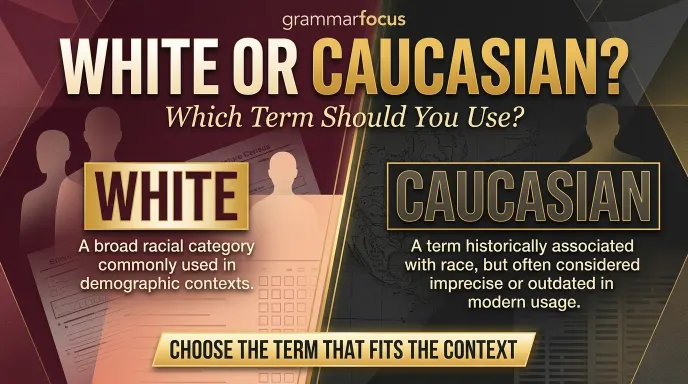
White or Caucasian are terms sometimes used to describe race or identity, but they do not mean exactly the same thing. White is the more common term in everyday use, while Caucasian is an older term that still appears in some official and historical contexts.
Understanding the difference helps you choose respectful and accurate language in conversations, writing, and formal documents.
The best term depends on the context, the person’s own preference, and the purpose of the discussion.
White or Caucasian: Quick Answer
White is the more widely used term for a racial category, especially in modern everyday language.
Caucasian is an older label that has historically been used as a synonym for White, but it is less precise and can be misleading.The two terms are not perfect substitutes in every situation.
White generally refers to a racial identity, while Caucasian originally relates to the Caucasus region and later became part of older racial classification systems.
| Feature | White | Caucasian |
| Main use | Describes a racial identity | Older racial label; also relates to the Caucasus region |
| Modern usage | Common in everyday and official contexts | Less common in many modern contexts |
| Historical background | Developed through social and racial classifications | Became widely used through older racial theories |
| Geographic meaning | Not limited to one country or region | Literally connected to the Caucasus region |
| Best use | General discussion when relevant and appropriate | Historical discussion or a specific source’s terminology |
Definition and Meaning of White or Caucasian
What Does White Mean?
White is a term used to describe people who are socially classified as belonging to a White racial group.
In many countries, this category includes people with family backgrounds in Europe, although official definitions differ across countries and institutions.
The term is commonly used in population statistics, demographic research, and discussions of race. Its meaning can change depending on local history and official rules.
For example:
- A census may include a White category for collecting population data.
- A report may discuss differences in experiences among racial groups.
- A person may identify as White as part of their racial identity.
The word does not describe every aspect of a person’s background. It does not automatically tell you their nationality, culture, language, or family history.
What Does Caucasian Mean?
Caucasian is a term historically used to describe a broad racial group that older classification systems associated with people from Europe and several nearby regions.
The word comes from the Caucasus, an area between the Black Sea and the Caspian Sea.
In modern everyday English, Caucasian is often used to mean White. However, the terms are not exact equivalents in every context.
The older racial meaning of Caucasian comes from classifications that are now widely considered outdated and scientifically unreliable.
For example:
- An older document may classify a person as Caucasian.
- A historical text may discuss Caucasian as a racial category.
- A modern article may use White when discussing racial identity.
When writing for a general audience, White is usually clearer than Caucasian if you mean the modern racial category.
The Origin of White or Caucasian
The Origin of White
The word white has existed in English for centuries as a color term. Over time, it also became associated with racial categories in parts of Europe and other societies.
The use of White as a racial label developed through historical social, political, and legal systems.
Its meaning has changed across periods and places. As a result, the term is not simply a biological description; it also reflects how societies have classified people.
Today, the word appears in demographic data, social research, and discussions about racial identity. The exact definition depends on the country and the context.
The Origin of Caucasian
The term Caucasian became associated with racial classification in the late eighteenth century.
German scholar Johann Friedrich Blumenbach used the term in a classification system that connected a supposed human racial group with the Caucasus region.
That classification influenced later discussions of race, but its assumptions do not reflect modern scientific understanding of human variation. Human genetic diversity cannot be accurately divided into a few clear cut racial types.
Although Caucasian remains in some documents and everyday speech, many modern writers prefer more direct terms.
When the intended meaning is a racial identity, White is often clearer. When discussing people from the Caucasus, use a specific regional or national term when it is known.
White vs. Caucasian: Important Usage Differences
The main difference is how the terms are understood today.
White is commonly used to describe a racial identity. Caucasian is often used as an older synonym for White, but it also has a geographic connection to the Caucasus region.
Consider these examples:
- Modern demographic context: “The report collected data on White respondents.”
- Historical context: “The text examines older Caucasian racial classifications.”
- Geographic context: “The Caucasus region includes communities with diverse languages and identities.”
These examples show why context matters. A person from the Caucasus is not automatically described accurately by the racial label White, and a person classified as White does not necessarily have ancestry from the Caucasus.
Use specific terms for nationality, ethnicity, or regional identity when those details are relevant and known. Avoid guessing someone’s identity from their appearance alone.
White or Caucasian: Which Term Should You Use?
In most modern writing, White is the clearer choice when you need to refer to a racial category.
However, the best wording depends on the subject, the audience, and the reason for using the term.
Use these guidelines to choose the right expression.
- Everyday conversation: Use the term that fits the context and respects the person’s own identity.
- Academic writing: Define the term clearly, especially when discussing race, history, or population data.
- Official documents: Follow the terminology used by the relevant organization or form.
- Historical research: Use Caucasian when discussing older racial classifications or quoting a historical source.
- Geographic discussions: Use specific terms such as Georgian, Armenian, or Azerbaijani when referring to people from those backgrounds and when the information is known.
Avoid using Caucasian simply because it sounds more formal. A longer or older term is not automatically more accurate.
Common Mistakes with White or Caucasian
People often use these terms as if they have identical meanings in every situation. This can create confusion.
Mistake 1: Assuming Caucasian Is More Scientific
Incorrect assumption: Caucasian is a more scientific term for White people.
Better understanding: The term comes from older racial classification systems. Modern science does not support dividing humanity into a few distinct biological races based on those systems.
Mistake 2: Treating Race and Nationality as the Same
Race and nationality describe different things. White may refer to racial identity, while nationality usually refers to a person’s connection to a country.
For example, a person may be White and American, White and British, or White and Australian. These terms describe different aspects of identity.
Mistake 3: Assuming Everyone From Europe Is White
Europe includes people with many racial, ethnic, cultural, and family backgrounds. A person’s nationality or place of birth does not automatically determine their racial identity.
Mistake 4: Using Caucasian for Everyone From the Caucasus
The Caucasus is a diverse geographic region with many ethnic groups, languages, and national identities.
The word Caucasian can be ambiguous because it has both geographic and historical racial meanings.
When you know the specific background, a regional, ethnic, or national term may be more accurate.
Everyday Examples of White and Caucasian
Here are examples showing how the terms may appear in different contexts.
Example 1: Population research
“The study compared health outcomes among several racial groups, including White participants.”
Here, White identifies a category used in the study. The researchers should explain how that category was defined.
Example 2: Historical writing
“The author examined how older scholars used the term Caucasian in racial classifications.”
Here, Caucasian is appropriate because the sentence discusses historical terminology.
Example 3: Official forms
“The form asks respondents to select a racial category.”
The correct response depends on the options and definitions provided by that organization. Do not assume every country uses the same categories.
Example 4: Describing someone’s background
“She is an American of Armenian heritage.”
This wording gives a more specific national context and family background than a broad racial label, assuming the information is accurate.
Example 5: Writing for a general audience
“The survey included people who identified as White.”
This wording makes clear that the category is based on how participants identified themselves.
Is Caucasian Still an Accepted Term?
Caucasian still appears in conversation, older publications, some institutional documents, and historical discussions. Many readers understand it as a synonym for White.
However, the term has limitations. Its racial meaning comes from outdated classification systems, and its geographic meaning can cause confusion.
For these reasons, many modern writers prefer White when discussing racial identity.
That does not mean every use of Caucasian is automatically wrong. It may be necessary when quoting a source, explaining historical terminology, or following a document’s exact wording.
The key is to make your meaning clear and avoid treating the terms as universally interchangeable.
Key Takeaway
White is generally the clearer modern term for a racial category. Caucasian is an older label that has often been used with the same meaning, but it also refers to the Caucasus region and reflects outdated racial classifications.
Choose the term that fits your context. For modern writing, use White when that is the intended category, follow official definitions in demographic research, and use specific ethnic or national terms when relevant.
Frequently Asked Questions
Q1. Are White and Caucasian the same thing?
Answer. They are often used to mean the same racial category in everyday English, but their meanings are not identical in every context. Caucasian also has a geographic meaning connected to the Caucasus region.
Q2. Is White a better term than Caucasian?
Answer. In many modern contexts, White is clearer when referring to racial identity. The most suitable term still depends on the purpose, audience, and terminology used by the relevant organization.
Q3. Why do people use the word Caucasian?
Answer. The term became common through older racial classification systems. It remains in some documents and everyday speech, even though many modern writers prefer more precise wording.
Q4. Does Caucasian mean someone is from the Caucasus?
Answer. The word can refer to the Caucasus region, but it has also been used as a racial label. Because these meanings differ, specific regional or national terms are often clearer when discussing geographic background.
Q5. Is Caucasian an outdated term?
Answer. Its use as a broad racial classification is considered outdated by many modern writers and researchers. However, the word still appears in some contexts, especially historical discussions and established documents.
Q6. Is White an ethnicity or a race?
Answer. White is generally used as a racial category, not a single ethnicity. People identified as White may have many different ethnic, national, cultural, and family backgrounds.
Q7. Should I use Caucasian on a formal form?
Answer. Follow the wording and instructions provided on the form. If the form uses Caucasian, follow its definitions. In your own writing, use the term that accurately reflects the intended category.
Q8. What is the most respectful term to use?
Answer. Use clear, relevant wording and respect how people describe themselves. Avoid making assumptions about someone’s identity based only on appearance, and use a specific ethnic or national term when it is relevant and known.
Conclusion
The difference between White and Caucasian comes down to modern usage, history, and context.
White is generally clearer when describing a racial identity, while Caucasian is an older term that can carry historical or geographic meanings.
For clear and respectful writing, choose precise language, explain categories when needed, and follow the terminology used by the relevant source or organization.
Learn More About Grammar:
- Argentinian or Argentine: The Difference Explained With Examples
- Vez or Ves: Which One Is Correct? Meaning, and Spelling in 2026
- Wane or Wain: Which Word Is Correct? Meaning and Examples

I’m Elena Cooper, an English grammar writer with 6 years of experience explaining grammar, punctuation, sentence structure, word usage, and common English mistakes. I create clear, practical, and easy-to-follow content that helps readers understand confusing grammar rules and use English accurately and confidently.








3 thoughts on “White or Caucasian: Meaning, Differences, and Usage in 2026”