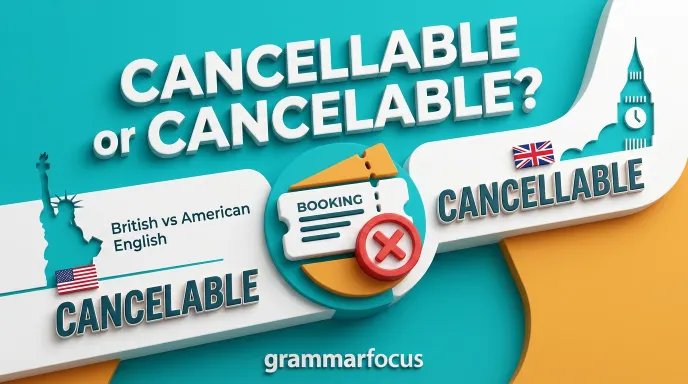
Cancellable or cancelable are both correct spellings. Cancellable is generally preferred in British English, while cancelable is the standard American English spelling.
Both words mean that something can be canceled, such as a booking, subscription, contract, or order. The difference comes from British and American spelling conventions for the final -l.
Knowing which spelling to use helps you write clearly for US, UK, and Commonwealth audiences.
Cancellable or Cancelable: Quick Answer
Cancellable and cancelable are both correct. The main difference is regional spelling.
- Cancellable commonly used in British English.
- Cancelable commonly used in American English.
- Both mean able to be canceled.
- Both are pronounced essentially the same way.
Examples
- British English: The ticket is cancellable up to 24 hours before departure.
- American English: The ticket is cancelable up to 24 hours before departure.
So, if your audience uses American English, choose cancelable. If your audience uses British English, cancellable is generally the natural spelling.
Quick Comparison: Cancellable vs Cancelable
| Feature | Cancellable | Cancelable |
| Spelling | Double l | Single l |
| Meaning | Able to be canceled | Able to be canceled |
| British English | Common | Less common |
| American English | Less common | Common |
| Part of speech | Adjective | Adjective |
| Pronunciation | Essentially the same | Essentially the same |
The only major difference is the spelling of the final l. The meaning remains unchanged.
Pronunciation and Word Form
Although the spellings differ, cancellable and cancelable are pronounced almost identically.
Cancellable
- US IPA: /ˈkæn.səl.ə.bəl/
- UK IPA: /ˈkæn.səl.ə.bəl/
- Part of speech: Adjective
- Meaning: Able to be canceled
Example:
The reservation is cancellable without a fee.
Cancelable
- US IPA: /ˈkæn.sə.lə.bəl/
- UK IPA: /ˈkæn.sə.lə.bəl/
- Part of speech: Adjective
- Meaning: Able to be canceled
Example:
The membership is cancelable at any time.
In normal speech, most readers and listeners will not notice a meaningful pronunciation difference between the two spellings.
Definition and Meaning of Cancellable and Cancelable
Both cancellable and cancelable describe something that can be canceled.
The word comes from the verb cancel, which means to stop, withdraw, or decide that something previously arranged will no longer happen.
For example:
- A cancellable reservation can be canceled.
- A cancelable order can be canceled.
- A cancellable subscription can be ended.
- A cancelable ticket can be canceled under stated conditions.
The adjective does not necessarily mean that cancellation is free. A service can be cancellable while still having a cancellation fee or deadline.
For example:
This booking is cancellable, but a cancellation fee applies after Friday.
Here, cancellable means cancellation is possible, not that cancellation is necessarily free.
Why Are There Two Spellings?
The two spellings exist because British and American English developed different conventions for doubling the final consonant when suffixes are added.
The base verb is:
cancel
When -able is added, British English commonly doubles the final l:
cancel + able → cancellable
American English commonly keeps one l:
cancel + able → cancelable
This is a spelling difference rather than a difference in meaning.
A similar pattern can be seen with other words. British English often uses forms such as travelled and travelling, while American English commonly uses traveled and traveling.
However, spelling conventions can vary by dictionary, publisher, organization, and individual style.
The important point is that cancellable and cancelable are established spellings with the same basic meaning.
The Origin of Cancel and Cancellable
The verb cancel has a long history in English. It ultimately comes from the Latin cancellare, meaning to make something invalid or remove its effect.
The Latin word is related to cancellus, referring to a lattice or barrier.
Over time, cancel developed its modern English meanings, including stopping an arrangement, withdrawing an event, or making an agreement no longer effective.
The adjective cancellable/cancelable developed from the verb cancel plus the suffix -able.
The suffix -able commonly means capable of, fit for, or able to be.
For example:
- readable = able to be read
- washable = able to be washed
- breakable = able to be broken
- cancelable = able to be canceled
Therefore, the basic meaning is easy to understand: something cancellable or cancelable is something that can be canceled.
Cancellable in British English
In British English, cancellable with two ls is the spelling you are most likely to encounter.
It is commonly used in areas such as travel, business, subscriptions, reservations, and contracts.
Examples
- The hotel room is cancellable until noon on Monday.
- This insurance policy is cancellable under certain conditions.
- The subscription is cancellable at any time.
- Your appointment is cancellable without charge before the deadline.
If your website, publication, or organization follows British English, cancellable is a consistent choice.
Cancelable in American English
In American English, cancelable with one l is commonly preferred.
It appears frequently in customer policies, product descriptions, contracts, booking information, and subscription terms.
Examples
- The order is cancelable before it ships.
- This plan is cancelable at any time.
- The reservation is cancelable within 48 hours.
- The service is cancelable with no long-term commitment.
For US focused writing, cancelable generally fits standard American spelling conventions better.
Cancellable or Cancelable: What Should You Use?
Choose the spelling based on the variety of English you are using.
Use cancellable when writing primarily in British English. Use cancelable when writing primarily in American English.
The choice is especially important for professional writing because consistency makes your content look polished.
If the rest of your document follows American spelling, cancelable is the natural choice. If it follows British spelling, cancellable is generally more appropriate.
Neither form changes the underlying meaning. The difference is mainly one of regional spelling convention.
Common Mistakes With Cancellable and Cancelable
One common mistake is assuming that one spelling is always wrong. That is not the case. Both “cancellable” and “cancelable” are accepted spellings, but speakers of different English varieties tend to use different forms.
Another mistake is using cancelible. This spelling is incorrect because the adjective is formed from cancel + able, not cancel + ible.
A related mistake is forgetting that the word is an adjective.
It describes something that can be canceled:
- The booking is cancelable.
- The policy is cancellable.
- The subscription is cancelable.
Do not use cancellable and cancelable as if they have different meanings. The spelling changes, but the basic definition stays the same.
When Should You Use Cancellable?
Use cancellable when your writing follows British English conventions or when your target audience commonly uses British spelling.
It works naturally in policies, travel information, business communication, and everyday writing.
Examples
- The reservation is cancellable before the deadline.
- This order is cancellable until it is processed.
- Your membership remains cancellable during the trial period.
- The agreement is cancellable under specific conditions.
If your organization already uses British spellings such as travelling, cancelled, or organised, using cancellable helps maintain consistency.
When Should You Use Cancelable?
Use cancelable when writing in American English.
It is particularly suitable for US websites, customer-service pages, product policies, and business documents.
Examples
- The subscription is cancelable at any time.
- This order is cancelable before shipment.
- The ticket is cancelable under the terms shown below.
- The service is cancelable after the first month.
If you write for an American audience, “cancelable” is usually the more familiar spelling.
Everyday Examples of Cancellable and Cancelable
These words appear in many situations where an arrangement can be stopped.
Travel
The flight booking is cancelable up to 24 hours before departure.
Hotels
The room is cancellable without a penalty until Tuesday.
Subscriptions
The monthly plan is cancelable whenever you no longer need it.
Orders
The purchase is cancellable before the warehouse processes it.
Contracts
The agreement is cancelable under the conditions listed in Section 5.
Appointments
Your appointment is cancellable before the scheduled time.
The exact spelling should follow the English style used by the surrounding content.
Cancellable or Cancelable: Which Spelling Should You Use?
The simplest rule is:
British English → cancellable
American English → cancelable
If you write for an international audience, readers can understand either spelling. However, consistency matters more than switching between the two forms.
For a US focused website, use cancelable throughout the article. For a UK focused publication, use cancellable.
Also remember that related forms follow their own spelling conventions. For example, British English commonly uses cancelled, while American English commonly uses canceled.
So you may see:
- British: cancelled, cancellable
- American: canceled, cancelable
These patterns help explain why the two forms can look different even though they come from the same verb.
Frequently Asked Questions
Q1. Is cancellable or cancelable correct?
Answer. Both are correct. British English commonly prefers “cancellable,” while American English commonly prefers “cancelable.”
Q2. Is cancelable the American spelling?
Answer. Yes. Cancelable with one l is the common American English spelling.
Q3. Is cancellable the British spelling?
Answer. Yes. British English commonly uses “cancellable” with two ls.
Q4. Do cancellable and cancelable have different meanings?
Answer. No. Both words mean that people can cancel something. The difference is mainly a regional spelling convention.
Q5. Is cancelible a correct spelling?
Answer. No. Cancelible is not the standard spelling. The accepted forms are cancelable and cancellable.
Q6. Should I use cancelable on a US website?
Answer. Yes. Cancelable is generally the more suitable spelling for content written in standard American English.
Q7. Can I use cancellable in American English?
Answer. People can understand it, but American English generally prefers the spelling “cancelable.”
Q8. How do you remember the difference?
Answer. Remember the simple regional rule: British English usually doubles the l in cancellable, while American English usually uses one l in cancelable.
Conclusion: Cancellable or Cancelable
Both spellings, cancellable and cancelable, correctly describe something that people can cancel.
The main difference is regional.Use cancellable for British English and cancelable for American English.
The pronunciation and meaning are essentially the same, so your choice should mainly depend on your target audience and overall spelling style.
If you are writing for American readers, choose cancelable. If you are following British English conventions, choose cancellable. Most importantly, use one spelling consistently throughout your writing.
Learn More About Grammar:
- Jems or Gems? Here’s the One That’s Wrong
- Sequal or Sequel: What’s the Difference?
- Concent or Consent? Don’t Make This Common Mistake

I’m Elena Cooper, an English grammar writer with 6 years of experience explaining grammar, punctuation, sentence structure, word usage, and common English mistakes. I create clear, practical, and easy-to-follow content that helps readers understand confusing grammar rules and use English accurately and confidently.