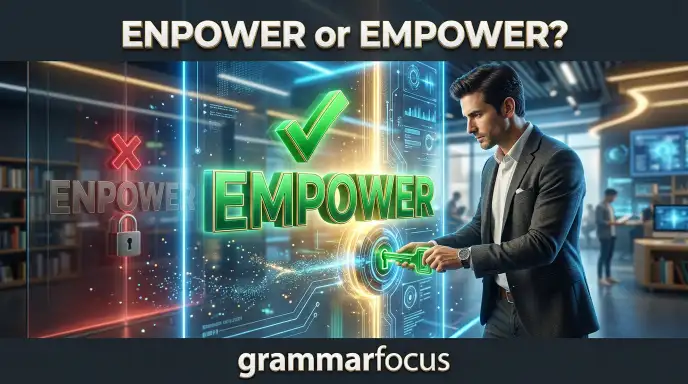
Empower is the correct spelling, while enpower is generally considered a misspelling in modern standard English. Empower means to give someone the authority, confidence, ability, or resources to do something.
It is a common verb used in education, business, leadership, technology, and everyday communication.The confusion between enpower or empower usually comes from pronunciation.
When people hear the word quickly, the first sound can make empower seem as though it begins with en-. However, the standard spelling is empower, with em- at the beginning.
For example, you can say that good education empowers students to make informed decisions.
A manager can empower employees by giving them more responsibility. A useful tool can also empower people to work more efficiently.
This guide explains the difference between enpower or empower, their pronunciation, meaning, origin, common mistakes, and correct everyday usage.
Enpower or Empower: Quick Answer
Empower is the correct standard spelling. Enpower is not the standard spelling of this verb.
| Word | Status | Meaning |
| Empower | Correct | Give someone power, authority, ability, or confidence |
| Enpower | Incorrect | Common misspelling of empower |
Example
Correct: Education can empower young people.
Incorrect: Education can enpower young people.
The easiest way to remember the correct form is to connect empower with the word power. The word contains power:
em + power = empower
Pronunciation and Word Form
Empower
- US IPA: /ɪmˈpaʊər/
- UK IPA: /ɪmˈpaʊə/
- Part of speech: Verb
- Meaning: To give someone the power, authority, ability, or confidence to do something
Example:
The training program empowers employees to solve problems independently.
Enpower
Enpower is not the standard spelling of the English verb. It is usually a spelling error caused by confusing the beginning of empower with the spelling pattern found in other words.
When writing or editing, use empower, not enpower.
Definition and Meaning of Empower
Empower means to give someone the power or ability to take action.
The word can describe formal authority, personal confidence, practical skills, or access to useful resources.
For example:
- A teacher can empower students to think independently.
- A manager can empower workers to make decisions.
- Technology can empower users to complete tasks more easily.
- Education can empower communities through knowledge.
The word does not always mean giving official legal power. It can also describe helping someone become more capable or confident.
Empower in Different Contexts
Authority:
The manager empowered her assistant to approve routine requests.
Confidence:
The experience empowered him to speak up.
Skills:
The course empowers learners with practical skills.
Resources:
The new software empowers teams to work faster.
In each example, empower suggests giving someone greater ability or control.
Why Is Empower Spelled With “Em-”?
The spelling empower comes from the word power combined with the prefix em-.
The important part to remember is that empower is closely connected to power.
Think of it this way:
power → empower → empowerment
These related forms all keep the mp combination.
- power
- empower
- empowered
- empowering
- empowerment
This pattern can help prevent the common spelling enpower.
The spelling may seem unusual at first because English has many words beginning with en-, such as enable, encourage, and enrich. However, empower has a different formation.
The Origin of Empower
The word empower developed in English from the idea of giving someone power or authority.
It is built around the noun power, which entered English through Old French and ultimately traces back to Latin roots related to ability and strength.
The prefix em- contributes the sense of putting into or causing someone to have a particular quality or ability.
Over time, empower became widely used for giving people authority, responsibility, or the ability to act.
The related noun empowerment later became especially common in discussions of education, workplaces, communities, and personal development.
Today, empower is a standard and widely used English verb.
Empower as a Verb
Empower is a transitive verb, so it normally takes an object.
Common patterns include:
empower + someone + to + verb
- The program empowers students to succeed.
- The system empowers users to manage their accounts.
- The training empowers employees to make decisions.
Another useful pattern is:
empower + someone + with + something
- The course empowers learners with practical skills.
- The program empowered workers with new tools.
These patterns are useful in both formal and everyday English.
Empower, Empowered, and Empowering
The verb empower changes form depending on the sentence.
Empower
Use the base form after to, modal verbs, and in certain present-tense structures.
We want to empower our customers.
Empowers
Use empowers with a singular third-person subject in the present tense.
Good leadership empowers employees.
Empowered
Use empowered for the past tense or as a participle.
The training empowered the team to act independently.
Empowering
Use empowering as the present participle or gerund.
The experience was empowering.
Keeping these forms connected to the base word empower makes the spelling easier to remember.
Common Mistakes With Enpower and Empower
The most common mistake is writing enpower instead of empower.
Mistake 1: Using Enpower
❌ The program will enpower students.
✅ The program will empower students.
Mistake 2: Writing Enpowered
❌ The training enpowered employees.
✅ The training empowered employees.
Mistake 3: Writing Enpowerment
❌ The course promotes enpowerment.
✅ The course promotes empowerment.
The same spelling rule applies to the related words. They all begin with emp-, not enp-.
Everyday Examples of Empower
Empower is common in professional, educational, and personal contexts. It often describes giving people the ability or confidence to take action.
Education
Good teachers empower students to think independently.
Workplace
The company empowers employees to make routine decisions.
Technology
This app empowers users to manage their accounts easily.
Community
Local programs can empower communities through education and training.
Personal Development
Learning new skills can empower people to reach their goals.
These examples show that empower can refer to authority, knowledge, skills, confidence, or resources.
Empower in Professional and Formal Writing
Empower is especially common in professional writing. Businesses often use it when discussing leadership, employee responsibility, customer choice, or organizational growth.
For example:
The new policy empowers employees to resolve customer issues more quickly.
In this sentence, employees receive greater authority to act without waiting for additional approval.
The word is also useful in formal reports:
The project aims to empower local businesses with better digital tools.
In both examples, empower expresses the idea of providing something that allows people to act more effectively.

How to Remember Empower
A simple memory trick is to focus on the word power.
POWER → EMPOWER
If you remember that empower contains power, it becomes easier to avoid the incorrect spelling enpower.
You can also remember the related forms:
- empower
- empowers
- empowered
- empowering
- empowerment
All of them begin with emp-.
A useful sentence to remember is:
Education can empower people with knowledge and skills.
Enpower or Empower: Which One Should You Use?
Use empower in standard English.
Enpower is generally a spelling mistake and should be avoided in formal, academic, professional, and published writing.
If you are checking your writing, look for the mp after the initial e:
✅ empower
❌ enpower
The same pattern applies to related forms:
✅ empowered
✅ empowering
✅ empowerment
This makes empower the only standard choice when you want to express the idea of giving someone power, ability, authority, or confidence.
Frequently Asked Questions
Q1. Is enpower a correct word?
Answer. No. Enpower is generally considered a misspelling. The standard English word is empower.
Q2. What is the correct spelling, enpower or empower?
Answer. Empower is the correct spelling. It means to give someone power, authority, ability, or confidence.
Q3. What does empower mean?
Answer. Empower means to give someone the ability, authority, resources, or confidence needed to take action.
Q4. Is empowerment spelled with “en” or “em”?
Answer. The correct spelling is empowerment, with em- at the beginning. Enpowerment is incorrect.
Q5. How do you use empower in a sentence?
Answer. You can say, “The training empowers employees to make better decisions.” Here, empower means to give employees greater ability or confidence.
Q6. What is the past tense of empower?
Answer. The past tense is empowered. For example: “The program empowered students to become more independent.”
Q7. What is the difference between empower and enable?
Answer. Empower often emphasizes giving someone power, authority, confidence, or control, while enable generally means making something possible or providing the means to do it.
Q8. Why do people spell empower as enpower?
Answer. The mistake probably comes from the sound of the word and confusion with common en- words such as enable and encourage. The standard spelling, however, is empower.
Conclusion:
Empower is the correct standard spelling, while enpower is a common misspelling. Empower means to give someone power, authority, ability, resources, or confidence to take action.
The easiest way to remember the spelling is to connect it with power:
power → empower → empowerment
If you are writing about education, business, technology, leadership, or personal development, use empower with mp, not enpower.
Learn More About Grammar:
- Minuscule or Miniscule: Which Spelling Is Correct?
- Crummy or Crumby? The Truth Behind These Two Words
- Concent or Consent? Don’t Make This Common Mistake

I’m Alex Morgan, an American English writer with 6 years of experience exploring grammar, punctuation, sentence structure, and everyday English usage. I enjoy turning confusing grammar rules into clear, practical explanations that help readers write and communicate with confidence.








1 thought on “Empower or Enpower: Only One Is a Real Word”