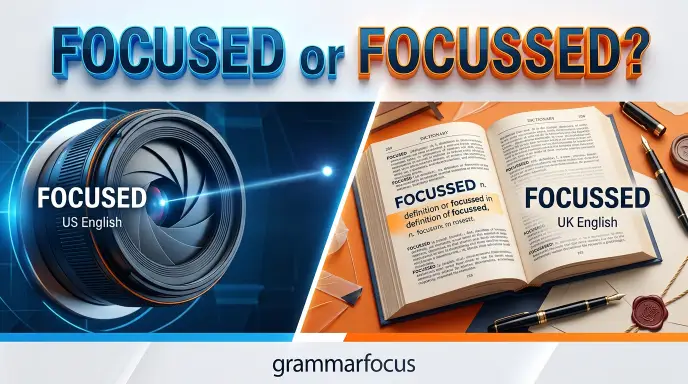
Focused and focussed are both correct spellings of the past tense and past participle of focus, but they follow different spelling conventions. In American English, focused is the standard spelling, while focussed is commonly used in British English and some other varieties.
The word means giving close attention to something or directing attention toward a particular point. The main difference is therefore not meaning but spelling style.
Knowing which form fits your audience can help you keep your writing consistent and avoid unnecessary spelling mistakes.
Both forms are widely understood, and neither should automatically be treated as a spelling error.
In this guide, you will learn the difference between focused or focussed, how each form is pronounced, where the spellings are used, and how to choose the right one for American or British English.
Focused or Focussed: Quick Answer
Focused and focussed have the same meaning and pronunciation. The main difference is regional spelling preference.
| Word | Common usage | Meaning |
| Focused | American English; also widely used internationally | Giving close attention to something |
| Focussed | British English and some other varieties | Giving close attention to something |
For example:
- She stayed focused on her studies.
- She stayed focussed on her studies.
Both sentences have the same meaning.
In most American English writing, choose focused. In British English, focussed is an established spelling, although focused is also used.
Pronunciation and Word Form
Both focused and focussed are pronounced the same way.
Focused
- US: /ˈfoʊkəst/
- UK: /ˈfəʊkəst/
- Part of speech: Verb form / adjective
Example:
He remained focused during the meeting.
Focussed
- US: /ˈfoʊkəst/
- UK: /ˈfəʊkəst/
- Part of speech: Verb form / adjective
Example:
She stayed focussed on the main task.
The extra s in focussed does not create a different pronunciation.
Definition and Meaning of Focused
Focused means giving your attention to a particular person, activity, subject, or goal.
It is the standard spelling of the word in American English.
For example:
- The student remained focused during the lesson.
- We need to stay focused on the main issue.
- She is focused on improving her writing.
Focused can also describe something directed toward a specific point or purpose.
For example:
The company launched a focused advertising campaign.
Here, focused describes something carefully directed toward a particular goal.
Definition and Meaning of Focussed
Focussed has the same meaning as focused. The difference is the spelling.
It is an established spelling in British English and is also found in some other English varieties.
For example:
- The student remained focussed during the lesson.
- We need to stay focussed on the main issue.
- The team is focussed on customer needs.
The extra s does not change the meaning of the word. It simply reflects a spelling convention.
The Main Difference Between Focused and Focussed
The main difference is regional spelling.
Focused uses one s before the -ed ending:
focus → focused
Focussed uses two s letters:
focus → focussed
Both forms come from the verb focus, which means to direct attention toward something.
The spelling you choose should match the variety of English you are using. If you are writing for an American audience, focused is usually the natural choice.
If you are following British English spelling conventions, focussed is an established option.
The important point is consistency. Do not switch between the two forms randomly within the same piece of writing.

When Should You Use Focused?
Use focused when you are following American English spelling conventions.
It is especially common in:
- American business writing
- American academic writing
- US websites
- American news and media
- Professional documents written in US English
Examples:
- The manager is focused on improving productivity.
- Our research is focused on language development.
- She remained focused despite the noise.
- The campaign is focused on local communities.
Focused is also widely seen outside the United States, so it may appear in international English even when the writer is not American.
When Should You Use Focussed?
Use focussed when following British English spelling conventions or a style guide that prefers the doubled consonant.
Examples:
- The team remained focussed on its objectives.
- The report is focussed on workplace communication.
- He was completely focussed on the task.
- The discussion remained focussed on education.
This spelling can be appropriate in British English writing, including some professional, educational, and editorial contexts.
However, British English also uses focused, so seeing the single-s spelling does not necessarily mean the writer has made a mistake.
Why Does Focus Have Two Spellings?
The difference comes from English spelling conventions for words ending in a vowel plus a consonant.
Some varieties of English double the final consonant before adding an ending such as -ed or -ing in certain words. This produces forms such as focussed and focussing.
American English often keeps a single s in these forms:
- focus → focused
- focus → focusing
British English uses both patterns, so you may encounter:
- focus → focused
- focus → focussed
And:
- focus → focusing
- focus → focussing
This is why both spellings can appear in reliable English writing.
Focused vs Focussed in American and British English
The easiest way to understand the difference is to consider the variety of English.
| English variety | Common form |
| American English | focused |
| British English | focused and focussed |
| International English | focused is widely used |
| Australian English | focused and focussed can occur |
Usage can vary between dictionaries, publishers, organizations, and style guides. Therefore, the spelling should be checked against the style standard you are following.
For American English, focused is the safer standard choice. For British English, either form may be encountered, but consistency matters more than choosing one form in isolation.
Common Mistakes With Focused and Focussed
One common mistake is assuming that one spelling must always be wrong.
For example:
❌ British English must always use focussed.
✅ British English uses both focused and focussed.
Another mistake is treating the two forms as different words.
❌ Focused and focussed have different meanings.
✅ Focused and focussed have the same basic meaning.
Writers may also mix spellings in the same document:
The team remained focussed, but the report was focused on sales.
This is not necessarily grammatically wrong, but it creates an inconsistent spelling style if both forms are being used simply as alternatives.
Choose a style and use it consistently throughout your article, report, website, or document.
Focused or Focussed in Everyday Sentences
Both spellings work naturally in ordinary sentences.
American style spelling:
- I need to stay focused today.
- She is focused on her career.
- The students remained focused during the exam.
British style spelling:
- I need to stay focussed today.
- She is focussed on her career.
- The students remained focussed during the exam.
The meaning remains unchanged. The difference is mainly the spelling convention used by the writer.
The Origin of Focused and Focussed
The word focus comes from Latin focus, meaning a hearth or fireplace. The word later developed a scientific meaning connected with a point where rays of light meet.
From there, its broader meaning became connected with directing attention toward a particular subject or point.
As English developed different spelling conventions, forms such as focused and focussed appeared.
The single s spelling became especially common in American English, while the doubled s form remained established in British English and some other varieties.
The two spellings therefore developed as spelling variants of the same word rather than as words with different meanings.

Focused and Focussed as Verb Forms
Both spellings can function as forms of the verb focus.
The base verb is:
focus
Its common forms include:
- focus
- focuses
- focused / focussed
- focusing / focussing
Examples:
- The teacher focuses on practical skills.
- The teacher focused on practical skills.
- The teacher is focusing on practical skills.
The spelling choice mainly affects focused/focussed and focusing/focussing. The meaning remains the same.
Focused and Focussed as Adjectives
Both forms can also work as adjectives. In this use, they describe someone or something that gives attention to a particular purpose.
For example:
- She is a focused student.
- He is a focussed professional.
- The company needs a focused strategy.
- They developed a focussed approach.
When used as adjectives, the forms still have the same basic meaning.
A useful way to understand the adjective is to think of focused or focussed as describing something directed toward a clear goal.
Focused on and Focussed on
One of the most common patterns is focused on or focussed on.
Both are correct depending on the spelling convention.
Examples:
- The course is focused on communication skills.
- The course is focussed on communication skills.
- She is focused on her studies.
- She is focussed on her studies.
The preposition on is important because English commonly uses focus on when identifying the subject receiving attention.
For example:
The report focuses on customer satisfaction.
The same pattern works in the past form:
The report focused on customer satisfaction.
Focused on vs Focused in
Learners sometimes confuse focused on with focused in.
When you mean directing attention toward a subject, focused on is normally the natural expression.
Example:
The lesson is focused on grammar.
The phrase focused in can occur in other structures, particularly when focus in has a more specific technical or physical meaning, but it is not normally the replacement for focused on in everyday sentences.
For ordinary writing, remember:
focus on something
The discussion focused on the main problem.
Focused in Professional and Academic Writing
Focused and focussed are both useful in professional and academic contexts when they describe attention, purpose, or direction.
Examples include:
- The study focused on language development.
- The project was focused on reducing costs.
- The research team remained focussed on the original question.
- The report presents a focused analysis of the issue.
For formal documents, the most important consideration is the style guide being followed.
If an organization uses American English, focused will usually fit naturally. If it follows British English, focused or focussed may be acceptable depending on its editorial rules.
Consistency is more important than switching between forms.
Focused and Focussed in Digital Communication
Online writing contains both spellings. Websites, blogs, social media posts, emails, and online publications may use either form depending on the writer’s preferred variety of English.
For example:
- Stay focused on your goals.
- Stay focussed on your goals.
Both sentences are understandable and grammatically sound.
For a website aimed mainly at American readers, focused is generally the more suitable choice. A British English website may use focussed if that matches its house style.
Related Words: Focus, Focuses, and Focusing
Knowing the related forms can make the spelling pattern easier to understand.
Focus
The base verb and noun.
Please focus on the instructions.
Focuses
The third-person singular present form.
The article focuses on common spelling mistakes.
Focused / Focussed
The past tense and past participle.
The article focused on spelling mistakes.
Focusing / Focussing
The present participle or gerund.
The article is focusing on spelling mistakes.
The same regional spelling preference can affect both focused/focussed and focusing/focussing.
Focused or Focussed: Which One Should You Choose?
Choose according to the English variety and style guide you are following.
For American English, focused is the usual choice.
For British English, both focused and focussed are established, so check the preferred style of the publication or organization.
If you are writing for a mixed international audience and do not have a specific style requirement, focused is widely recognizable and commonly used.
The key is to avoid unnecessary switching. Once you choose a spelling style, apply it consistently throughout the same document.
FAQs About Focused or Focussed
Q1. Is focused or focussed correct?
Answer. Both focused and focussed are correct spellings. Focused is especially common in American English, while focussed is an established British English spelling.
Q2. Is focussed British spelling?
Answer. Yes. Focussed is an established spelling in British English. However, British English also uses focused, so the doubled-s form is not the only British option.
Q3. Is focused American spelling?
Answer. Yes. Focused is the standard and widely used spelling in American English.
Q4. Do focused and focussed have the same pronunciation?
Answer. Yes. The two spellings are normally pronounced the same way. The extra s in focussed does not change the pronunciation.
Q5. Is focussing also correct?
Answer. Yes. Focussing is another spelling variant, particularly associated with British English. Focusing is widely used as well.
Q6. Should I use focused or focussed in academic writing?
Answer. Follow the style guide required by your school, university, publisher, or organization. American-style academic writing generally uses focused, while British-style writing may use either form.
Q7. Which is more common in American English: focused or focussed?
Answer. Focused is the usual American English spelling. It is the form most appropriate when following standard US spelling conventions.
Q8. Can I use focused and focussed in the same article?
Answer. It is better to choose one spelling style and use it consistently. Mixing them without a clear reason can make the writing look inconsistent.
Key Takeaway
Focused and focussed have the same meaning and pronunciation. The main difference is spelling preference.
- Focused → standard American English and widely used internationally
- Focussed → established British English variant
- Both mean giving attention or directing something toward a particular point.
- Neither spelling changes the basic meaning.
- Consistency is important when choosing between them.
A simple rule is: use focused for standard US English, and use focussed when it matches the British English style you are following.
Conclusion
The difference between focused or focussed is mainly a matter of spelling convention, not meaning. Both forms come from focus and can describe giving attention to a subject, goal, or activity.
Use focused when following American English spelling. In British English, focused and focussed are both established, so the choice can depend on the preferred style guide.
Whichever form you choose, keep your spelling consistent throughout the same piece of writing.
Learn More About Grammar:
- Minuscule or Miniscule: Which Spelling Is Correct?
- Empower or Enpower: Only One Is a Real Word
- Crummy or Crumby? The Truth Behind These Two Words

I’m Elena Cooper, an English grammar writer with 6 years of experience explaining grammar, punctuation, sentence structure, word usage, and common English mistakes. I create clear, practical, and easy-to-follow content that helps readers understand confusing grammar rules and use English accurately and confidently.








3 thoughts on “Why Americans Write “Focused” and Brits Write “Focussed””