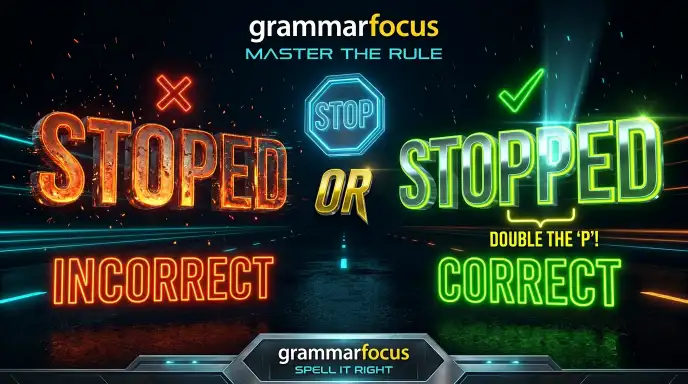
Stoped or stopped is a common spelling question because the past tense of stop follows a simple but important rule. The correct spelling is stopped, with two ps.
The word stoped is a misspelling in standard English. When you add ed to stop, you must double the final consonant before adding the ending. This rule also applies to other forms, such as stopping. Once you understand the pattern, you can avoid this mistake in everyday writing.
Stoped or Stopped: Quick Answer
Stopped is the correct spelling. It is the past tense and past participle of the verb stop. The spelling stoped is incorrect in standard English.
| Feature | Stoped | Stopped |
| Correct spelling | No | Yes |
| Meaning | Incorrect spelling of the intended word | Brought an action or movement to an end |
| Part of speech | Misspelling | Past tense and past participle of stop |
| Final consonant | One p | Double p |
| Example | She stoped the car. ❌ | She stopped the car. ✅ |
Quick tip: When a short verb ends in a single vowel followed by a consonant, you often double the final consonant before adding ed. That is why stop becomes stopped.
Pronunciation and Word Form
The correct word stopped is pronounced the same way in British and American English in most everyday speech. The incorrect spelling stoped does not have a separate standard pronunciation.
1. Stoped
- Pronunciation: No standard pronunciation as a spelling of the past tense of stop
- Part of speech: Incorrect spelling
- Correct form: Stopped
- Example: Incorrect: “The bus stoped near the school.”
The correct sentence is: “The bus stopped near the school.”
Writing stoped leaves out one p. Standard English requires the doubled consonant in this form.
2. Stopped
- US pronunciation: /stɑːpt/ or /stɑpt/
- UK pronunciation: /stɒpt/
- Part of speech: Past tense and past participle
- Base verb: Stop
- Example: The rain stopped before noon.
The word stopped can describe ending an action, halting movement, or no longer doing something.
For example:
- Movement: The driver stopped at the red light.
- An activity: She stopped talking when the teacher entered.
- A process: The machine stopped working.
- A habit: He stopped eating sweets every day.
In each example, stopped shows that an action or movement ended.
Definition and Meaning of Stoped or Stopped
Stopped is the past tense and past participle of stop. It means that someone or something ended an action, halted movement, or prevented an activity from continuing. The word stop is a regular verb. However, its spelling changes when you add ed. You double the final p before adding the ending.
Here are common uses of stopped:
1. Ending movement
- The taxi stopped outside the hotel.
- The train stopped at the next station.
- The cyclist stopped to check the map.
2. Ending an activity
- Maya stopped reading to answer the phone.
- The children stopped playing when it began to rain.
- I stopped working at six o’clock.
3. Preventing something
- The guard stopped the visitors from entering the building.
- A barrier stopped the car from moving farther.
- The new rule stopped people from parking near the entrance.
4. Ending a habit or routine
- He stopped drinking sugary drinks.
- She stopped using her phone before bed.
- They stopped visiting that restaurant.
The meaning changes with the sentence, but the spelling remains the same: stopped.
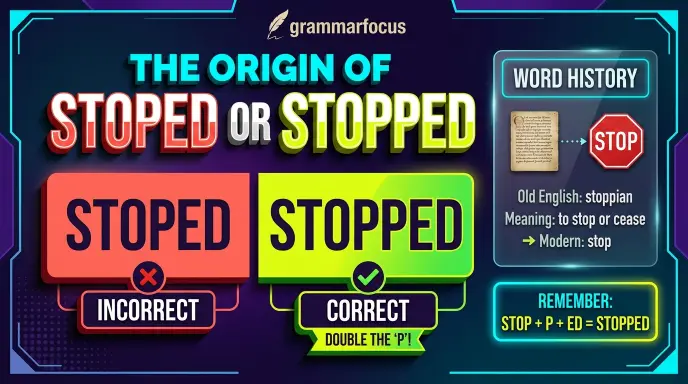
The Origin of Stoped or Stopped
The verb stop entered English through older Germanic language forms and became established in Middle English. Over time, it developed the familiar meaning of bringing movement or activity to an end.
The spelling stopped follows a common English spelling rule. When a verb ends in one vowel followed by one consonant, writers often double the final consonant before adding a vowel starting ending such as ed or ing. This usually happens when the final syllable is stressed or when the word is a short, single syllable verb like stop.
For this reason:
- Stop + ed = stopped
- Stop + ing = stopping
The same pattern appears in other common verbs:
- Plan → planned
- Shop → shopped
- Drop → dropped
- Clap → clapped
The spelling stoped does not follow this standard pattern for the past tense of stop. Therefore, use stopped in schoolwork, emails, reports, and everyday writing.
British English vs. American English Spelling
The spelling of stopped is the same in British and American English. Both varieties double the final p before adding ed. The spelling stoped is incorrect in standard English.
| Feature | British English | American English |
| Correct past tense | Stopped | Stopped |
| Incorrect form | Stoped | Stoped |
| Present participle | Stopping | Stopping |
| Base verb | Stop | Stop |
| Example | The bus stopped outside. | The bus stopped outside. |
Unlike words such as travelled and traveled, which follow different regional conventions, stopped does not change between British and American English.
Which Spelling Should You Use?
Always use stopped when writing the past tense or past participle of stop. There is no regional spelling difference for this word.
Follow these simple examples:
- Past tense: She stopped the car near the gate.
- Past participle: The machine has stopped working.
- Past perfect: They had stopped talking before the meeting began.
- Passive construction: The game was stopped because of heavy rain.
Remember the spelling rule: stop ends in a short vowel sound followed by a single consonant. When you add ed, double the final consonant.
The same pattern applies to stopping. You do not write stoping when you mean the act of bringing something to an end.
Common Mistakes with Stoped or Stopped
The most common mistake is forgetting to double the final p. These examples show how to correct it.
Mistake 1: Writing stoped instead of stopped
Incorrect: The teacher stoped the lesson.
Correct: The teacher stopped the lesson.
The past tense requires two ps.
Mistake 2: Using stoped in formal writing
Incorrect: The delivery truck stoped outside the office.
Correct: The delivery truck stopped outside the office.
Use the standard spelling in emails, reports, school assignments, and professional documents.
Mistake 3: Forgetting the double consonant in stopping
Incorrect: He is stoping the machine.
Correct: He is stopping the machine.
The final p is doubled before adding ing, just as it is before adding ed.
Mistake 4: Assuming British English uses stoped
Incorrect claim: Stoped is the British spelling.
Correct explanation: Both British and American English use stopped. The spelling stoped is not a standard regional variant.
Everyday Examples of Stoped or Stopped
Here are examples of the correct spelling in common situations.
At home
- I stopped watching television to answer the door.
- The washing machine stopped during the cycle.
- She stopped cooking when the power went out.
While travelling
- The bus stopped at the station.
- We stopped for lunch on the way home.
- The driver stopped at the traffic light.
At school or work
- The teacher stopped speaking when the bell rang.
- Our manager stopped the meeting to answer a question.
- The students stopped writing when time ran out.
In everyday conversations
- “Why did you stoped the video?” ❌
- “Why did you stopped the video?” ❌
- “Why did you stop the video?” ✅
The last example is correct because did already marks the past tense. After did, use the base verb stop, not stopped. This is another useful rule: write “I stopped the video,” but “Did you stop the video?”
Key Takeaway
Stopped is the only correct standard spelling for the past tense and past participle of stop. The spelling stoped is incorrect in both British and American English.
Remember to double the final p before adding ed or ing: stop → stopped → stopping.
Frequently Asked Questions
Q1. Is it stoped or stopped?
Answer. Stopped is correct. The word stoped is a misspelling in standard English.
Q2. Why does stopped have two p’s?
Answer. The final consonant is doubled before adding ed. This spelling pattern applies to the short verb stop.
Q3. Is stoped ever correct in English?
Answer. Not as the standard past tense of stop. Use stopped in normal English writing.
Q4. Is stopped the British or American spelling?
Answer. Both British and American English use stopped. There is no regional spelling difference.
Q5. What is the difference between stop and stopped?
Answer. Stop is the base form of the verb. Stopped is its past tense and past participle.
Q6. Is stopping spelled with one p or two?
Answer. Stopping has two ps. The final consonant is doubled before adding ing.
Q7. Should I write “Did you stopped” or “Did you stop”?
Answer. Write “Did you stop?” After did, use the base form of the verb. Do not add ed again.
Q8. How can I remember the correct spelling?
Answer. Remember the pattern stop → stopped → stopping. Both forms double the final p before adding their endings.
Conclusion
The choice between stoped or stopped is simple: stopped is correct, and stoped is a spelling mistake. The rule is the same in British and American English. Double the final p when adding ed or ing, and use the base form after helping verbs such as did.
Learn More About Grammar:
- Aluminium or Aluminum? One Metal, Two Spellings (2026)
- Esthetic or Aesthetic? Why Skincare Pros Spell It Differently
- Tomato or Tomatoe: Can You Spot the Spelling Mistake? (2026)

I’m Elena Cooper, an English grammar writer with 6 years of experience explaining grammar, punctuation, sentence structure, word usage, and common English mistakes. I create clear, practical, and easy-to-follow content that helps readers understand confusing grammar rules and use English accurately and confidently.








2 thoughts on “Stoped or Stopped? Fix It in 5 Seconds With This Rule”