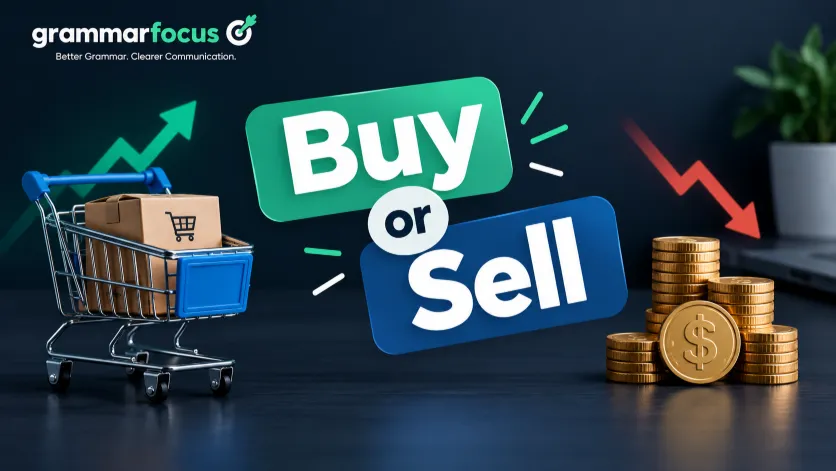
Buy or sell are two common English verbs related to shopping, money, and trade. Buy means to get something by paying money for it, while sell means to give something to another person in exchange for money.
These words describe opposite sides of the same transaction. A customer buys a product, and a shopkeeper sells it.
Understanding the difference between buy and sell helps you speak and write clearly in everyday conversations, business messages, online shopping, and financial situations.
Buy or Sell: Quick Answer
Use buy when you pay money to get something.
I want to buy a new phone.
Use sell when you give something to someone in exchange for money.
I want to sell my old phone.
The easiest way to remember the difference is:
- Buy = get something
- Sell = give something for money
For example, when you purchase a book from a shop, you buy the book. The shop sells the book to you.
Quick Comparison Table
| Buy | Sell |
| Means to get something by paying money | Means to give something for money |
| The customer buys | The shopkeeper or owner sells |
| Past form: bought | Past form: sold |
| Past participle: bought | Past participle: sold |
| Related noun: buyer | Related noun: seller |
| Example: I bought a phone. | Example: She sold a phone. |
Remember:
You buy what you want to receive, and you sell what you want to give for money.
Pronunciation and Word Forms
Buy
- US: /baɪ/
- UK: /baɪ/
The word buy rhymes with by and bye.
Sell
- US: /sel/
- UK: /sel/
The word sell rhymes with bell, tell, and well.
Main Word Forms
| Verb | Past Tense | Past Participle | -ing Form |
| buy | bought | bought | buying |
| sell | sold | sold | selling |
Examples:
- I buy fresh vegetables every week.
- I bought a new bag yesterday.
- She has bought a laptop.
- They are buying furniture.
And:
- They sell clothes online.
- He sold his old car.
- She has sold several products.
- We are selling handmade items.
Notice that buy and sell are irregular verbs. Their past forms are not made by adding -ed.
Definition and Meaning of Buy
The verb buy means to obtain something by paying money for it. It is used when a person becomes the customer in a transaction.
You can buy physical objects, services, food, tickets, digital products, and many other things.
Examples of Buy
- I want to buy a new pair of shoes.
- She bought a birthday gift for her brother.
- We need to buy some groceries.
- He has bought a ticket for the concert.
- They are buying a house.
The person who buys something is called a buyer or customer.
Common Expressions With Buy
Buy something
I want to buy a new watch.
Buy something from someone
I bought this jacket from a local shop.
Buy something for someone
She bought flowers for her mother.
Buy something online
I usually buy books online.
Buy into something
This expression can mean accepting or believing an idea.
He did not buy into the company’s plan.
Definition and Meaning of Sell
The verb sell means to give something to another person in exchange for money. It is used when a person provides a product or service to a customer.
A person or business that sells something is called a seller, shopkeeper, vendor, or merchant.
Examples of Sell
- This store sells school supplies.
- She wants to sell her old laptop.
- They sold their house last year.
- The company has sold thousands of products.
- He is selling handmade bags online.
The word sell can also describe offering services or ideas.
- The company sells insurance.
- The artist sells paintings.
- The speaker tried to sell his idea to the team.
Common Expressions With Sell
Sell something
They sell fresh bread every morning.
Sell something to someone
She sold her car to a friend.
Sell something for a price
He sold the table for $100.
Sell out
This means that all available items have been sold.
The concert tickets sold out quickly.
Sell well
This means that a product is popular and many people buy it.
This brand’s phones sell well.
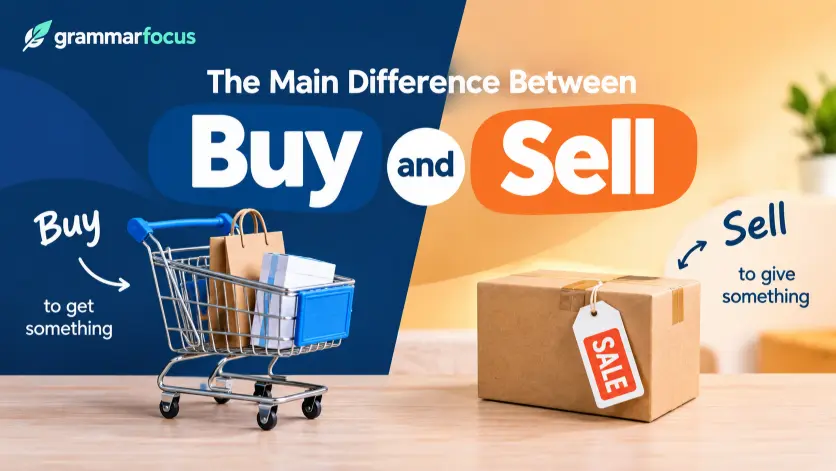
The Main Difference Between Buy and Sell
The main difference is the direction of the transaction.
When you buy, money moves from you to another person or business. You receive a product or service.
When you sell, a product or service moves from you to another person. You receive money in return.
Consider this example:
Ali bought a bicycle from Ahmed.
From Ali’s point of view, he bought the bicycle because he paid money and received it.
From Ahmed’s point of view, he sold the bicycle because he gave it to Ali and received money.
Both verbs describe the same transaction, but they focus on different people.
A Simple Memory Trick
Remember this sentence:
Buyers pay. Sellers receive payment.
You can also remember:
- The customer buys.
- The shopkeeper sells.
- The buyer receives.
- The seller gives.
This simple contrast makes the difference easy to understand.
Buy and Sell in a Shopping Situation
Imagine that you visit a clothing store.
You choose a shirt and pay for it. You buy the shirt.
The shop assistant gives you the shirt and receives your payment. The shop sells the shirt.
Here are both viewpoints:
- I bought a shirt from the store.
- The store sold me a shirt.
- The customer bought the product.
- The shopkeeper sold the product.
Both sentences can describe the same event:
I bought a phone from the shop.
The shop sold a phone to me.
The difference is not about the product. It is about who is giving money and who is receiving it.
Buy and Sell in Online Shopping
The words buy and sell are also common on websites and shopping apps.
Customers may see buttons such as:
- Buy now
- Buy it
- Buy product
- Sell an item
- Start selling
- Sell your products
Use buy when you want to purchase something.
Click Buy Now to place your order.
Use sell when you want to offer something for sale.
You can sell your old furniture through the app.
Online marketplaces connect buyers and sellers. The buyer pays for the item, while the seller provides and ships it.
Buy and Sell in Business
In business, buy and sell are often used to describe commercial activities.
A company may buy raw materials from suppliers. It may then use those materials to make products and sell them to customers.
For example:
The company buys cotton from local suppliers and sells finished clothes to customers.
A business can also buy and sell services.
- The agency buys advertising space.
- The agency sells marketing services.
- The restaurant buys ingredients.
- The restaurant sells prepared meals.
In business writing, the correct verb depends on the company’s role in the transaction.
Buy or Purchase: A Small Difference
Buy and purchase have the same basic meaning. Both mean to get something by paying money.
However, buy is more common in everyday English, while purchase often sounds more formal.
Everyday English:
I want to buy a new computer.
Formal or business English:
The company plans to purchase new equipment.
You can usually use buy in normal conversations. Use purchase when you want a more formal or professional tone.
Common Mistakes With Buy and Sell
Because buy and sell describe opposite actions, learners sometimes use them in the wrong place.
Mistake 1: Using Buy When You Mean Sell
Incorrect:
I want to buy my old car.
Correct:
I want to sell my old car.
Use sell when you want to receive money for something you own.
Mistake 2: Using Sell When You Mean Buy
Incorrect:
I need to sell a new laptop from the shop.
Correct:
I need to buy a new laptop from the shop.
Use buy when you pay money to receive a product.
Mistake 3: Confusing “Buy From” and “Sell To”
Use buy from to show where the customer gets something.
I bought this watch from Ali.
Use sell to to show who receives the product.
Ali sold this watch to me.
Both sentences can describe the same transaction.
Mistake 4: Using the Wrong Past Form
The past tense of buy is bought, not buyed.
Incorrect:
She buyed a new dress.
Correct:
She bought a new dress.
The past tense of sell is sold, not selled.
Incorrect:
He selled his bike.
Correct:
He sold his bike.
Buy and Sell in Real-Life Examples
At a Local Shop
A customer enters a shop to purchase groceries.
I need to buy some milk and bread.
The shopkeeper focuses on the other side of the transaction.
We sell fresh bread every morning.
In an Online Marketplace
Someone wants to offer an old phone to another person.
I want to sell my old phone online.
A different person is looking for a phone to purchase.
I want to buy a used phone at a reasonable price.
In a Business Email
A company may contact a supplier before purchasing materials.
We would like to buy 100 units of this product.
A supplier may respond with an offer.
We can sell the products at a discounted price.
In Daily Conversation
Did you buy anything from the market?
Yes, I bought a new shirt.
Are you going to sell your old laptop?
Yes, I plan to sell it next week.
These examples show how the two verbs work in natural conversations.
Buy, Sell, and Their Related Nouns
The verbs buy and sell also have related nouns.
| Word | Meaning | Example |
| Buyer | A person who buys something | The buyer paid in cash. |
| Seller | A person who sells something | The seller offered a discount. |
| Purchase | Something that is bought | This phone was an expensive purchase. |
| Sale | An act of selling or a reduced-price event | The shop is having a sale. |
A sale can also mean a period when products are offered at lower prices.
The store is having a summer sale.
Do not confuse sale with sell:
- Sell is a verb.
- Sale is a noun.
Buy or Purchase: Which Word Sounds Better?
Both buy and purchase are correct, but they suit different situations.
Use buy in casual and everyday speech:
I need to buy some stationery.
Use purchase in formal writing, business documents, or official notices:
Customers may purchase tickets through the website.
In most normal conversations, buy sounds more natural. In formal business writing, purchase may sound more professional.
British English vs. American English
There is no spelling difference between British and American English for buy or sell.
Both varieties use:
- buy
- bought
- buying
- sell
- sold
- selling
Examples:
American English:
I bought a new jacket yesterday.
British English:
I bought a new jacket yesterday.
The pronunciation and spelling remain the same in both varieties. The difference between buy and sell is based on meaning, not regional spelling.
Key Takeaways
- Buy means to get something by paying money.
- Sell means to give something in exchange for money.
- A customer buys a product.
- A shopkeeper or business sells a product.
- The past tense of buy is bought.
- The past tense of sell is sold.
- Use buy from for the source of a purchase.
- Use sell to for the person who receives the product.
- Sale is a noun, while sell is a verb.
- Buy is common in everyday English, while purchase is more formal.
FAQs About Buy or Sell
Q1. What is the difference between buy and sell?
Answer. Buy means to get something by paying money. Sell means to give something to another person in exchange for money.
Q2. Is it buyed or bought?
Answer. The correct past tense of buy is bought. For example, “I bought a new phone.”
Q3. Is it selled or sold?
Answer. The correct past tense of sell is sold. For example, “She sold her old car.”
Q4. Can buy and sell describe the same transaction?
Answer. Yes. One person buys a product, while the other person sells it. For example, “I bought a watch from Ali” and “Ali sold a watch to me.”
Q5. What is the difference between buy from and sell to?
Answer. Use buy from to identify the person or business that provides the product. Use sell to to identify the person who receives it.
Q6. Is purchase the same as buy?
Answer. Yes. Both words mean to get something by paying money. Buy is more common in everyday English, while purchase is more formal.
Q7. What is the noun form of sell?
Answer. The related noun is sale. For example, “The store is having a sale.” A person who sells something is called a seller.
Q8. Do British and American English use different forms of buy and sell?
Answer. No. Both British and American English use buy, bought, buying, sell, sold, and selling.
Conclusion
The words buy and sell describe opposite sides of a transaction. You buy something when you pay money to receive it. You sell something when you give it to another person in exchange for money.
Remember the basic difference:
Buy means receive. Sell means give for money.
Also remember their irregular past forms:
Buy → bought
Sell → sold
Once you understand who is paying and who is receiving the money, choosing between buy and sell becomes simple.
Get It Right

I’m Alex Morgan, an American English writer with 6 years of experience exploring grammar, punctuation, sentence structure, and everyday English usage. I enjoy turning confusing grammar rules into clear, practical explanations that help readers write and communicate with confidence.