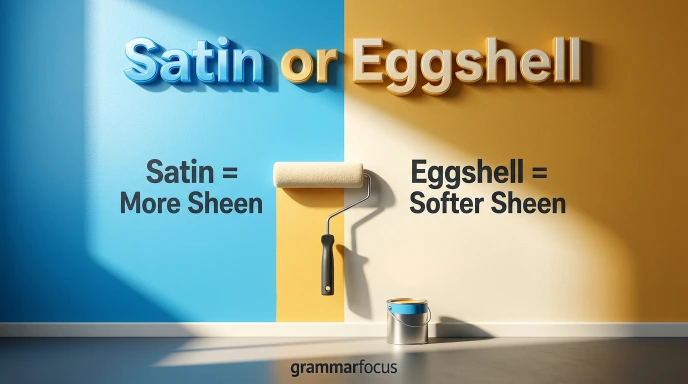
Satin or eggshell usually refers to two paint finishes, with satin having a slightly higher sheen and eggshell giving a softer, lower shine look. Both are common choices for interior walls and other painted surfaces.
People often search for satin or eggshell when choosing paint for a bedroom, living room, hallway, kitchen, or woodwork.
The names can be confusing because both finishes offer some shine and are often recommended for similar spaces.
The main difference is simple: eggshell reflects less light, while satin has a smoother and more noticeable sheen.
Compared with eggshell, satin is generally more resistant to cleaning and wear, although performance varies by paint brand and product.
Quick Answer
Both satin and eggshell are paint finishes, but they differ in their level of sheen.
| Feature | Satin | Eggshell |
| Sheen | Medium to moderately noticeable | Low and soft |
| Light reflection | Higher | Lower |
| Appearance | Smooth and slightly shiny | Soft and nearly matte |
| Durability | Generally higher | Generally good |
| Cleaning | Usually easier to clean | Easy to clean with many products |
| Best for | High traffic areas, trim, doors | Walls, bedrooms, living rooms |
| Shows wall flaws | More likely | Less likely |
| Overall look | Polished | Subtle |
Benjamin Moore describes eggshell as a low sheen finish and satin as a higher gloss option with greater durability and stain resistance. Sherwin Williams also places satin above eggshell in sheen.
Examples:
- We chose an eggshell finish for the living room walls.
- The designer used satin paint on the interior doors.
- Eggshell gives the bedroom a soft appearance.
- Satin is useful where the surface needs more frequent cleaning.
One important point is that paint sheen names can vary between manufacturers. Some brands group or label finishes differently, so always check the specific product’s sheen guide before buying.
Sherwin Williams, for example, uses “Eg Shel” and satin within its finish system.
Definition and Meaning
What Does Satin Mean?
Satin can refer to a smooth, shiny fabric, but in the context of paint, it means a finish with a noticeable but not highly glossy sheen.
A satin paint finish reflects more light than eggshell. It gives a surface a smooth, polished appearance without the strong shine associated with semi gloss or gloss paint.
Satin finishes are commonly used on:
- Doors
- Woodwork
- Trim
- Hallways
- High traffic walls
- Some exterior surfaces
Satin can also describe something that resembles the smooth or slightly glossy quality of satin fabric. Cambridge lists satin as both a fabric and a term used for a paint finish.
What Does Eggshell Mean?
Eggshell has two common meanings.
First, it means the hard outer covering of an egg. Second, it describes a paint finish with a soft, low sheen.
The paint meaning comes from the finish’s resemblance to the subtle surface of an eggshell.
Cambridge defines eggshell paint as paint that is slightly shiny when dry and suitable for walls and woodwork.
Eggshell paint is often used for:
- Bedrooms
- Living rooms
- Dining rooms
- Hallways
- General interior walls
Benjamin Moore describes eggshell as a low sheen finish that offers a soft glow and is suitable for many areas of a home.
Satin vs Eggshell in Simple Terms
The easiest way to remember the difference is:
Eggshell = softer, lower sheen.
Satin = smoother, higher sheen.
If you want walls to look more subtle and less reflective, eggshell may be suitable. If you want more sheen and easier maintenance, satin may be preferable for the particular surface.
However, there is no universal rule that makes one finish correct for every room. The surface, lighting, traffic, paint formula, and manufacturer’s specifications all matter.
The Origin of Satin or Eggshell
The words satin and eggshell have very different histories.

Origin of Satin
Satin entered English in the Middle English period.
Etymological sources trace it through Old or Middle French forms and ultimately connect it, with some uncertainty, to Arabic zaytūnī, referring to Zaitun, the medieval Arabic name associated with the Chinese port of Quanzhou.
The port was an important center for the silk trade.The word originally referred to a smooth, lustrous silk fabric. Over time, satin also developed adjective uses meaning smooth or glossy.
That sense later made the word suitable for describing surfaces with a similar appearance, including paint.
Origin of Eggshell
Eggshell is much more straightforward. It combines egg and shell and has been used in English for the outer covering of an egg since the early 15th century.
The color and surface related use developed later. Etymological records date the color term to the late 19th century.
The paint meaning developed naturally from the appearance of an eggshell: a surface that is not completely flat but does not have a strong glossy shine.
Why Are Satin and Eggshell Used for Paint?
Paint manufacturers use familiar words such as satin and eggshell to help customers imagine the appearance of a dried surface.
The comparison is visual:
- Satin suggests the smooth, gentle sheen of satin fabric.
- Eggshell suggests the soft, muted surface of an eggshell.
Today, both terms are established names for paint finishes, although their exact sheen levels can differ from one manufacturer or product line to another.
British English vs American English Spelling
There is no British versus American spelling difference between satin and eggshell.
Both American and British English use:
- satin
- eggshell
The difference people sometimes notice is not a national spelling variation. It usually comes from paint brands, product names, or style choices.
| Term | American English | British English | Meaning |
| Satin | satin | satin | A smooth or moderately shiny finish |
| Eggshell | eggshell | eggshell | A low sheen paint finish or an egg’s shell |
For example:
- US: We painted the hallway with satin paint.
- UK: We painted the hallway with satin paint.
And:
- US: The walls have an eggshell finish.
- UK: The walls have an eggshell finish.
There is therefore no need to change satin to another spelling when writing for a British audience, and eggshell remains the same as well.
Which Spelling Should You Use?
For satin and eggshell, the choice is simple: use the same spellings in American, British, Canadian, Australian, and other major forms of English.
If you are writing for a US audience, use:
satin
eggshell
If you are writing for a UK or Commonwealth audience, use:
satin
eggshell
For global content, product descriptions, design articles, and professional writing, these same spellings are appropriate.
The more important issue is meaning, not spelling. When discussing paint, make the context clear by using phrases such as satin finish, satin paint, eggshell finish, or eggshell paint.
For example:
Choose an eggshell finish for a softer look on interior walls.
Satin paint can provide a smoother, more durable surface.
This prevents readers from confusing eggshell the paint finish with the literal shell of an egg.
Common Mistakes
People often use satin and eggshell as if they mean exactly the same thing. They do not. Both describe paint finishes, but their sheen levels are different.
Mistake 1: Saying They Have the Same Sheen
❌ Satin and eggshell have the same amount of shine.
✅ Satin usually has more sheen than eggshell.
Mistake 2: Treating Eggshell as a Color
Eggshell can describe a color, but in phrases such as eggshell paint or eggshell finish, it usually describes the finish.
❌ I want eggshell because it is a paint color.
✅ I want an eggshell finish for the walls.
Mistake 3: Assuming Every Brand Uses the Same Sheen Level
Paint manufacturers may define their finishes differently. A satin finish from one brand may not look exactly like satin from another.
Better: Check the manufacturer’s product information before buying.
Mistake 4: Using Satin on Every Wall
Satin can highlight surface imperfections because it reflects more light.
Better: Consider eggshell when you want a softer wall appearance.
Mistake 5: Choosing Only by Name
The words satin and eggshell do not tell you everything about a paint product.
Consider:
- Surface condition
- Room lighting
- Cleaning needs
- Traffic level
- Paint quality
- Manufacturer specifications
Everyday Examples
The terms satin and eggshell appear often in home improvement, interior design, product descriptions, and everyday communication.
In an Email
Could you confirm if the walls should have a satin or eggshell finish?
This is useful when discussing a painting project with a contractor, designer, landlord, or supplier.
Satin or Eggshell in News or Home Design Articles
The designer selected an eggshell finish to create a soft look on the bedroom walls.
Here, eggshell describes the paint finish rather than the color of the wall.

On Social Media
Should I use satin or eggshell for my hallway?
This type of question is common when someone wants practical advice about paint appearance and maintenance.
In Formal Writing
The interior walls were finished with an eggshell coating, while the doors received a satin finish.
This sentence clearly separates the two finishes.
In a Product Description
This interior paint is available in satin and eggshell finishes.
Here, the words identify different finish options for the same paint color.
Google Trends & Usage Data
Search interest for satin and eggshell is strongly connected to home improvement, decorating, and paint selection.
Google Trends can be useful for comparing search interest, but it does not provide the number of searches for a term.
Its data represents relative search interest over a selected time and location.
Interest can also change with:
- Home renovation activity
- Seasonal painting projects
- Interior design trends
- DIY projects
- New paint products
- Regional terminology
The two words also have meanings outside painting. Satin can refer to fabric, while eggshell can refer to an egg’s shell or a color.
Therefore, general search data for these words does not necessarily represent searches for paint finishes.
For accurate research, compare terms in Google Trends with a relevant category such as Home & Garden and examine individual countries separately.
This gives a clearer picture of paint related search behavior.
In practical content, phrases such as satin paint, eggshell paint, satin finish, and eggshell finish are more specific than the individual words.
FAQs About
Q1. Is satin or eggshell more shiny?
Answer. Satin is generally more shiny than eggshell. Eggshell has a softer and lower sheen.
Q2. Is satin better than eggshell for walls?
Answer. It depends on the room and the desired appearance. Eggshell is often chosen for walls because its lower sheen gives a softer look, while satin can provide greater durability and easier cleaning.
Q3. Can I use eggshell paint on doors?
Answer. Yes, eggshell can be used on some doors, but the best finish depends on the door material, location, and manufacturer’s recommendations. Satin is also commonly used for doors and trim.
Q4. Does satin paint show wall imperfections?
Answer. Satin can make surface imperfections more noticeable because it reflects more light. A lower sheen eggshell finish may be more forgiving on walls.
Q5. Are satin and eggshell spelled differently in British English?
Answer. No. Both satin and eggshell have the same spelling in American and British English.
Q6. Is eggshell a paint color or a finish?
Answer. It can describe a color, but in phrases such as eggshell paint and eggshell finish, it commonly refers to the finish or sheen.
Q7. Which is easier to clean, satin or eggshell?
Answer. Satin is generally easier to clean because its higher sheen often provides a more durable surface. However, cleaning performance varies by paint product.
Conclusion:
The choice between satin or eggshell mainly comes down to sheen, appearance, durability, and the surface you are painting. Both are established paint finishes, but they create different visual effects.
Eggshell has a lower, softer sheen and is often used on interior walls where a subtle appearance is wanted.
Satin has more sheen and can provide a smoother, more polished look. It is also commonly selected for surfaces that need regular cleaning or greater resistance to wear.
Neither finish is automatically right for every project. Room lighting, wall condition, traffic, cleaning needs, and the manufacturer’s formula can all affect the result.
Always check the paint label or product guide before making a final choice.There is also no British versus American spelling issue here.
Satin and eggshell are spelled the same in both forms of English. For clear writing, use satin finish or eggshell finish when you are specifically discussing paint.
Get It Right:
- Which or What? Meaning, Difference & Usage (2026 Guide)
- Buy or Sell: Two Words, Totally Opposite Meanings (2026)
- Boxing or MMA: What’s the Difference? Rules, Skills, and More

I’m Elena Cooper, an English grammar writer with 6 years of experience explaining grammar, punctuation, sentence structure, word usage, and common English mistakes. I create clear, practical, and easy-to-follow content that helps readers understand confusing grammar rules and use English accurately and confidently.