Which and what are both used to ask questions, but “which” usually asks someone to choose from a limited set, while “what” asks about something in a more general way. The keyword which or what is commonly searched by people who are unsure which question word sounds correct in a particular sentence.
The two words can look similar in some questions, but they are not always interchangeable.
Use which when the possible choices are known, limited, or clearly defined. For example, if someone asks, “Which dress do you want?” they may be choosing from the dresses that are available.
Use what when the possible answer is open or not limited. For example, “What do you want to wear?” allows for a much wider range of answers.
Both words can work as pronouns and determiners, depending on how they are used. Learning the difference can help you form clearer questions in conversations, emails, schoolwork, and formal writing.
The easiest rule is simple: use which for a limited choice and what for a more open question.
Which or What: Quick Answer
Which and what both introduce questions, but they are used in different situations.
- Which is used when the choices are limited or already known.
- What is used when the possible answers are open or not clearly limited.
Quick Examples
- Which color do you prefer, blue or green?
- Which route should we take?
- What is your favorite color?
- What do you want for dinner?
In the first two examples, the choices are limited or understood. In the last two, the speaker is asking a broader question.
Which vs What at a Glance
| Word | Main Use | Typical Situation | Example |
| Which | Choosing from limited options | The choices are known or defined | Which shirt should I buy? |
| What | Asking about an open possibility | The answer is not limited | What shirt do you want? |
A useful shortcut is to think about the number of possible answers. If the choices are limited, which is often the better choice.
If almost any answer is possible, what is usually more natural.
Pronunciation and Word Form
Knowing how the two words sound can help you recognize them when speaking or listening.
Which
Pronunciation:
US: /wɪtʃ/
UK: /wɪtʃ/
It sounds roughly like wich.
Part of speech: Pronoun / Determiner
Example:
Which book would you like to read?
What
Pronunciation:
US: /wɑːt/
UK: /wɒt/
It sounds roughly like wot in British English and has a broader ah sound in standard American English.
Part of speech: Pronoun / Determiner
Example:
What book would you like to read?
The main difference in pronunciation is the vowel sound. Which begins with a short /ɪ/ sound, while what has a different vowel sound in British and American English.
Definition and Meaning of Which or What
Although which and what are both question words, they do not always ask for the same type of information.
What Does Which Mean?
Which is used when a person needs to choose between two or more known or limited possibilities.
For example:
Which phone should I buy?
The speaker may be looking at a small group of phones or discussing phones already mentioned.
Other examples include:
- Which restaurant should we visit?
- Which answer is correct?
- Which train leaves first?
- Which jacket belongs to you?
In each case, the possible choices are limited by the situation.
Which can also be used when the options are not directly listed but are still understood from the context.
For example:
Which university did you attend?
The question does not name every university, but the speaker is asking the listener to identify one particular university from the possible universities.
What Does What Mean?
What is generally used when the speaker wants information without limiting the answer to a specific set of choices.
For example:
What do you want to eat?
The person can choose from many possible foods.
Other examples include:
- What is your name?
- What happened yesterday?
- What do you need?
- What kind of music do you like?
The possible answers are usually broad.
Which and What as Determiners
Both words can come before a noun.
Examples with which:
- Which movie are you watching?
- Which laptop do you prefer?
- Which road should we take?
Examples with what:
- What movie are you watching?
- What laptop do you need?
- What road leads to the city center?
The difference depends on the situation and the range of possible answers.
Which and What as Pronouns
Both words can also stand alone without a noun immediately after them.
Examples with which:
Which do you prefer?
Which is yours?
Examples with what:
What do you need?
What happened?
Here, the question words themselves represent the information being requested.
The Origin of Which or What
Which and what are both very old English question words. Their histories are connected to the development of English from earlier Germanic languages.
Origin of Which
Which comes from Old English hwilc, which was used to ask about a particular person or thing from a group. Over time, its form changed as English developed.
The basic idea of choosing or identifying one item from a group has remained an important part of the word’s meaning.
This explains why which is commonly associated with choices and specific possibilities.
Origin of What
What comes from Old English hwæt. It has been used for centuries to ask about the identity, nature, or information related to something.
Its meaning has remained broad, which fits its modern use in open questions.
For example:
What is that?
The speaker is asking for information about something without giving a fixed list of possible answers.
Why Are Which and What Used Differently?
Their meanings developed in slightly different directions.
Which became strongly connected with selecting or identifying something from a group.
What remained broader and became a general question word used to ask for information about people, things, actions, events, and ideas.
This difference still helps explain their modern use.
British English vs American English Spelling
There is no standard spelling difference between British and American English for which or what.
Both varieties use:
- which
- what
The main difference you may notice is pronunciation, especially with what, rather than spelling.
Which in British and American English
The spelling which is standard in both varieties.
Examples:
- Which option do you prefer?
- Which bus should I take?
- Which answer is correct?
There is no separate British spelling of the word.
What in British and American English
The spelling what is also standard in both varieties.
Examples:
- What time is the meeting?
- What do you need?
- What happened?
Again, the spelling remains the same in British and American English.
Spelling Comparison
| Word | British English | American English | Main Function |
| Which | which | which | Limited or known choices |
| What | what | what | General or open questions |
Unlike words such as colour/color or licence/license, which and what do not have different standard spellings in British and American English. Both words are spelled the same in both varieties of English.
When Should You Use Which or What?
Choosing between which and what depends on the type of answer you expect. Use which when asking someone to choose, identify, or select something from a known group. By contrast, what is more suitable when the answer can be general or open.
Use Which for a Specific Choice
Choose which when the options are clear or limited.
Examples:
- Which dress should I wear?
- Which phone is yours?
- Which route is faster?
- Which subject do you like most?
- Which of these bags belongs to you?
In each sentence, the speaker has a particular group or set in mind.
Use What for a General Question
Use what when you want general information or do not have a fixed group of choices.
Examples:
- What is your name?
- What do you want for dinner?
- What happened yesterday?
- What kind of music do you like?
- What is your favorite movie?
These questions allow a wider range of answers.
Which and What Can Sometimes Both Be Correct
The choice is not always strict. Both words can be correct when the meaning is similar but the focus changes.
Compare these examples:
- Which color do you want?
- What color do you want?
The first question suggests that the speaker has a particular group of colors in mind. The second question sounds more general.
Another example:
- Which university did you attend?
- What university did you attend?
Which university may suggest that the speaker is thinking about a particular group of universities. What university asks for the name or identity of the university more generally.
Common Mistakes With Which or What
Mistake 1: Using Which for Every Question
Some writers use which whenever they ask about a thing. This is not always correct.
Incorrect or less natural:
- Which is your name?
Correct:
- What is your name?
Use what when asking for basic information such as a name, address, job, or reason.
Mistake 2: Using What When the Choices Are Clear
When someone must select one item from a known group, which is often the better choice.
Less precise:
- What of these shirts do you prefer?
Correct:
- Which of these shirts do you prefer?
The phrase which of these clearly refers to a specific group.
Mistake 3: Confusing Which With What Kind Of
Use what kind of when asking about a type or category.
Examples:
- What kind of food do you like?
- What kind of car does he drive?
- What kind of books do you read?
Use which when the choices are more specific.
Example:
- Which book should I buy?
Mistake 4: Using Which Instead of Who
Use who when asking about a person’s identity.
Incorrect:
- Which is calling you?
Correct:
- Who is calling you?
However, which person can be used when choosing one person from a known group.
Example:
- Which person is your manager?
Mistake 5: Forgetting the Word Order
In direct questions, the question word usually comes before the helping verb or main verb.
Correct examples:
- What are you doing?
- Which book is yours?
- What does this word mean?
- Which option do you prefer?
Avoid placing the words in an unnatural order.
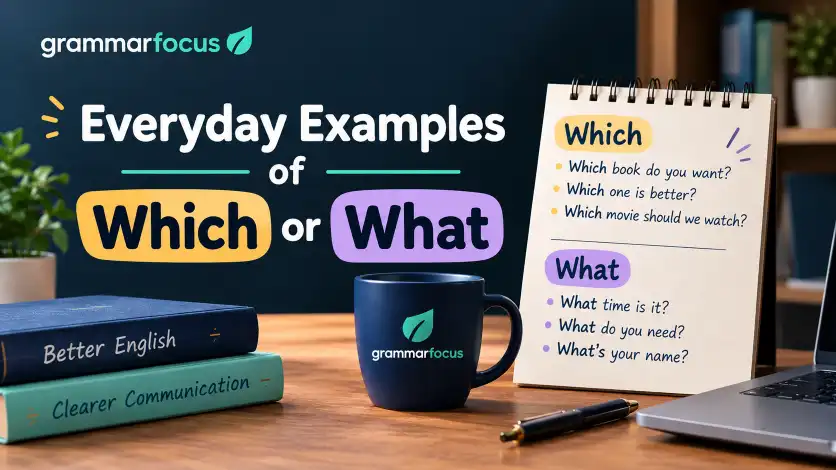
Everyday Examples of Which or What
The following examples show how both words work in daily conversations.
At a Restaurant
Which is useful when the menu or choices are known.
- Which dessert would you like?
- Which table should we choose?
- Which meal is less spicy?
What is useful for general questions.
- What would you like to eat?
- What is today’s special?
- What ingredients are in this dish?
At School
- Which subject is your favorite?
- Which teacher teaches English?
- What did you learn today?
- What is your homework?
- What topic are you studying?
While Shopping
- Which jacket fits me better?
- Which shoes should I buy?
- What size do you need?
- What color do you prefer?
- What are you looking for?
At Work
- Which file should I open?
- Which meeting are you attending?
- What is the main problem?
- What do you need from me?
- What time does the meeting start?
While Traveling
- Which train goes to Lahore?
- Which seat is yours?
- What time does the bus leave?
- What is the best way to get there?
- What places do you want to visit?
Which or What in Formal and Informal English
Both which and what are common in formal and informal English. The main difference is their meaning, not their level of formality.
Formal Examples
- Which option would you recommend?
- What information do you require?
- Which document should I submit?
- What is the purpose of this meeting?
Informal Examples
- Which one do you want?
- What are you doing?
- Which movie should we watch?
- What’s your plan for tonight?
In informal speech, what’s is often used as a short form of what is or what has.
Google Trends and Usage of Which or What
The search phrase which or what is useful for people who want to understand the difference between two common question words.
Search interest can change by country, season, and user intent.
Google Trends can help compare search interest for related phrases, but it does not directly prove which word is grammatically correct.
For grammar decisions, focus on the meaning and structure of the sentence.
A useful way to study this topic is to compare searches such as:
- which or what
- which vs what
- difference between which and what
- when to use which
- when to use what
For current search interest, use the official Google Trends website and compare the terms for your target country.
Frequently Asked Questions
Q1. What is the main difference between which and what?
Answer: Which usually asks someone to choose from a known or limited group. What usually asks for general or open information.
Q2. Is which used for limited choices?
Answer: Yes, which is often used for limited or clearly defined choices. For example, “Which shirt do you want?” However, the group does not always have to be physically limited.
Q3. Is what used for unlimited choices?
Answer: What is commonly used for general or open questions. For example, “What do you want to eat?” However, what can also be used when the possible answers are limited.
Q4. Can which and what both be correct?
Answer: Yes. Both can be correct when the speaker focuses on the question in a slightly different way. For example, “Which color do you want?” and “What color do you want?” are both natural.
Q5. Should I say what is your name or which is your name?
Answer: Say “What is your name?” This asks for someone’s name. “Which is your name?” is not natural in normal English.
Q6. Should I use which or what before a noun?
Answer: Both can come before a noun. Use which for a particular choice, such as “Which book?” Use what for a general question, such as “What book?”
Q7. Is which more formal than what?
Answer: No. Neither word is automatically more formal. The correct choice depends on the meaning of the question.
Q8. How can I remember the difference between which and what?
Answer: Remember this simple guide: which often points to a choice, while what usually asks for information. Then check the context before choosing a word.
Conclusion
Which and what are both important question words, but they do not always work in the same way.
Use which when you are choosing or identifying something from a particular group. Use what when you are asking for general information or a wider answer.
Remember that this is a helpful guide, not an unbreakable rule. The context can allow both words to be correct.
When you are unsure, ask yourself if you have a specific group in mind. If you do, which may be the better choice. If the question is more open, what will often sound more natural.
Get It Right

I’m Elena Cooper, an English grammar writer with 6 years of experience explaining grammar, punctuation, sentence structure, word usage, and common English mistakes. I create clear, practical, and easy-to-follow content that helps readers understand confusing grammar rules and use English accurately and confidently.







1 thought on “Which or What? Meaning, Difference & Usage (2026 Guide)”